How Bank Exit Plans Should Treat an Embedded AI Payment Agent
Four termination protocols, built before go-live, can strip an AI agent's authority.

An embedded AI payment agent needs an exit plan for more than its vendor contract. Because it can act on a bank’s payment rails, ending the relationship means withdrawing authority, securing evidence, preserving controls, and disconnecting live access. Each needs its own termination protocol, designed before deployment.
Why an AI payment agent is structurally different from every other vendor a bank offboards
A conventional software exit centers on canceling the license and migrating the data. An embedded AI payment agent has delegated transaction authority and uses it on live rails. It is not merely a tool the bank consults. It can initiate, route, and complete financial transactions autonomously, within the permissions it has received.
The IMF’s April 2026 note describes how probabilistic, adaptive decisions can clash with the deterministic requirements of payment infrastructure. An agent’s action can emerge across multiple steps involving model outputs, tool calls, and inter-agent handoffs. The apparent single-vendor relationship may also conceal dependencies on a foundational model, an orchestration layer, and tool APIs. Those dependencies complicate the boundary of an exit. The bank must establish not only that the supplier has stopped providing a service, but that its agent can no longer act and no queued actions survive termination.
What regulators currently require of exit plans for AI vendors, and where the guidance runs out
The FSB finalized twelve sound practices for AI governance on October 15, 2026, addressing firms’ responsibility for AI supplied by third parties, including AI they may not know is present. MAS 2026 guidelines explicitly cover AI agents. The Bank of England and FCA’s 2026 survey asked about agentic AI in detail for the first time, while the ECB’s 2026 letter demands an AI-cyber action plan from every significant institution by October 31, 2026. These developments establish supervisory attention, but they do not form one agent-exit rulebook.
The IMF note identifies emerging safeguards including mandate-based authorization, separation of decision-making from execution, agent identity frameworks, programmable payment controls, audit trails, and tiered human involvement. These are not collectively mandated by one binding rule. SR 26-2 carves out the systems at issue, and the third-party guidance remains proposed. No binding rule yet specifies how to revoke delegated transaction authority, sequence the withdrawal of live rail access, or establish that no agent-initiated actions remain queued after offboarding.
The CBA Agentic Symposium white paper identifies a related uncertainty in the Electronic Fund Transfer Act’s application to agent-initiated transactions. Consumers may bear liability for unauthorized transactions their agents make, an unsettled question that affects what a bank must document at exit. What does this leave the bank to do? It must design around existing obligations and the agent’s actual capabilities.
The four characteristics of an embedded AI payment agent that standard exit plans were never designed to address
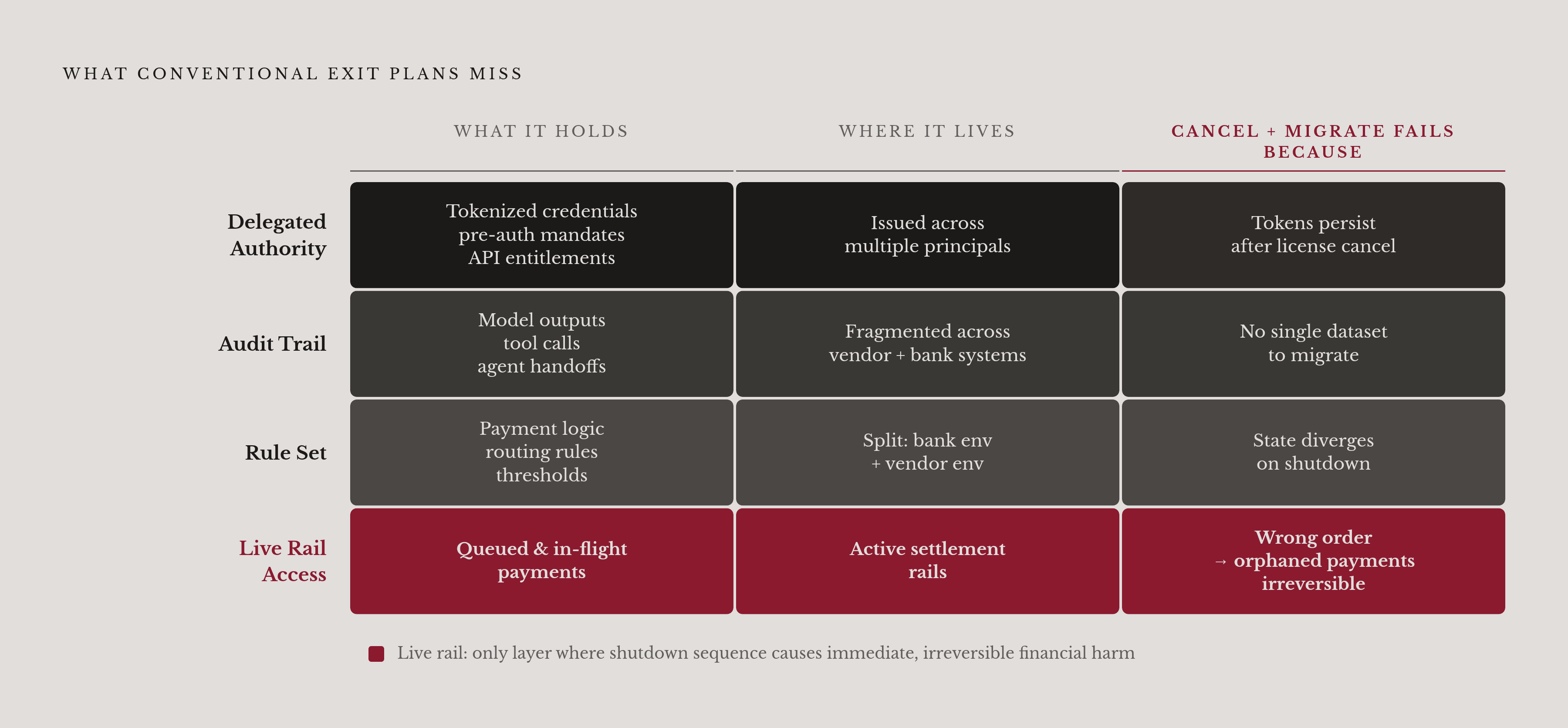
The first characteristic is delegated transaction authority. During normal operation, permission to initiate payments resides in contract language as well as tokenized credentials, pre-authorized mandates, or API-level entitlements. Santander and Mastercard’s demonstration of Europe’s first live AI-agent payment in 2026 used pre-authorized customer permissions and tokenized credentials. Authority is therefore a technical artifact as well. A standard exit plan may end the contract without identifying every entitlement through which the agent retains permission to act.
The second characteristic is the distributed audit trail. A consequential action can depend on a sequence of model outputs, tool calls, and handoffs between agents. That distribution weakens both explainability, meaning why an action occurred, and reproducibility, meaning whether its decision process can be reconstructed. At exit, the bank has to piece together evidence from those steps, a task that a conventional data-export provision does not cover.
The third characteristic is the configurable rule set. Spending limits, approval thresholds, permitted payee categories, and circuit breakers define the agent’s operating boundaries, but can reside partly in the bank’s environment and partly in the vendor’s. Those rules remain relevant during a transition. Rules left in the vendor’s environment may continue shaping agent behavior, while an outdated record may misstate the last authorized configuration.
The fourth characteristic is live rail access. The BCG Global Payments Report 2026 describes providers such as Ramp granting AI agents direct access to accounts from which they can transact. It also describes agents that act for a CFO or treasurer, route payments, and manage cash pooling under corporate policies. Unlike a data-vendor exit, withdrawal can affect queued and in-flight payments, creating the risk of payment failures or orphaned transactions if the shutdown order is wrong.
What a termination protocol for each of the four characteristics must actually contain
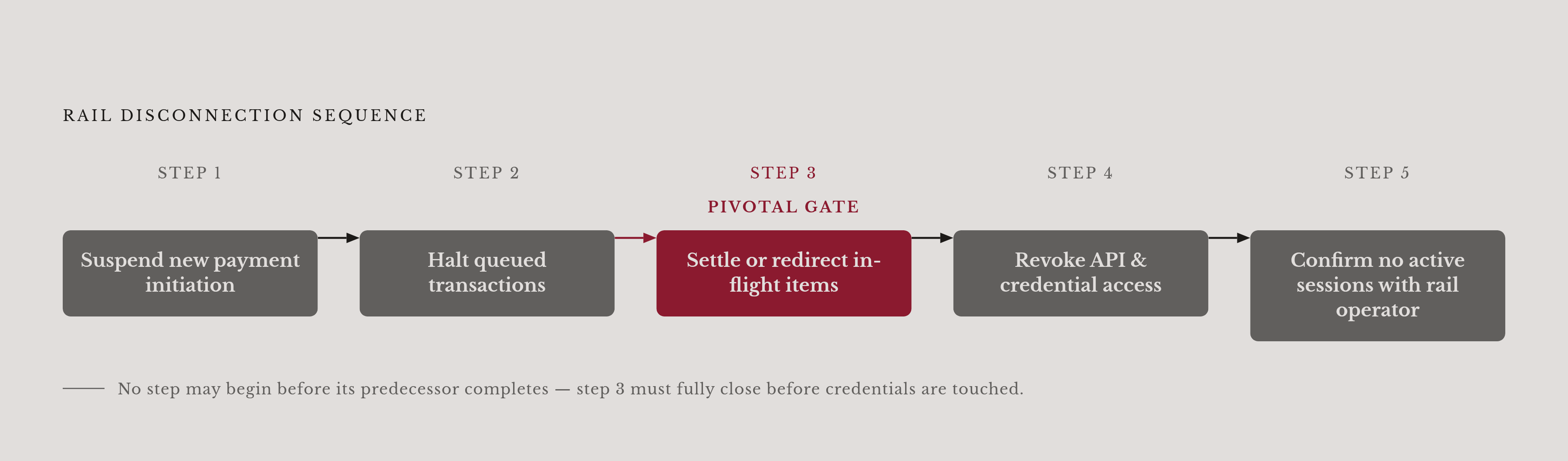
To address those differences, the bank must build four interlocking protocols before go-live and test them before they are needed. The authority-revocation protocol starts with a complete entitlement inventory, including tokenized credentials, pre-authorized payment mandates, API keys, OAuth grants, and delegated-access tokens issued by the rail or card network. The sequence must be explicit. The bank must stop the agent from starting new transactions, resolve or redirect in-flight transactions, revoke tokenized credentials at the network level, and get confirmation from the payment rail that no entitlements are still active. The contract must require the vendor to help and to certify within a defined SLA that revocation is complete.
The audit-custody protocol must place a replay-capable record of every agent decision and action in the bank’s own environment. A vendor summary is not a substitute. The proposed 2026 Third-Party Guidance names retention and destruction as exit-plan items, requiring clarity about what the vendor deletes, who deletes it, and how deletion is confirmed. For the agent, the bank should get a final log export, check that it is complete against a transaction count kept independently, and get certified confirmation that the vendor’s copies have been deleted. If foundational model providers or orchestration platforms also hold logs, the bank must check what each holds and get deletion confirmation or retention agreements from each.
The rule-set protocol must export every configured control in a machine-readable format that the bank can control without the vendor’s platform. This includes permitted-action sets, spending limits, approval thresholds, escalation paths, and exception rules. The final recertified state is the baseline for the transition. Before granting a successor agent any transaction authority, the bank must migrate and recertify the rules. If there is no successor, it must document the operational gap and establish manual or legacy-system fallback procedures for every workflow the agent handled.
The rail-disconnection protocol must suspend new payment initiation and halt queued transactions before allowing in-flight items to settle or redirecting them to a contingency route. Only then should API and credential access be revoked, followed by confirmation from the rail operator that no active sessions remain. Fallback operation must already have been tested. The bank should maintain an alternate route independent of the agent for every payment type it handled. The FSB’s sound practices and the OCC’s Supervisory Framework for Bank Use of Super Intelligence address fallback and continuity requirements for agentic systems, whereas the proposed third-party guidance does not name fallback operation as a pre-adoption design requirement.
Why most banks are not ready to execute these protocols today, and what the gap looks like in practice
A Wolters Kluwer survey of banking professionals published May 28, 2026 found that nearly three in four banks cannot say with confidence that they can shut down an AI model that malfunctions or report an AI failure to regulators. That finding concerns basic incident controls, which are less demanding than the task of withdrawing an embedded payment agent. It signals an early market’s unfinished infrastructure. Regulatory reporting and examinations made AI governance, kill switches, and vendor risk regular topics in routine bank examinations in 2026. Some banks have responded to uncertainty by asking vendors to remove or disable AI features.
A bank may have a direct contract with its AI vendor but no direct governance over the foundational model provider on which that vendor depends. The FSB identified third-party dependencies and service provider concentration as one of four AI vulnerabilities that could raise systemic risk. Clean custody cannot simply be assumed here. If agent logs sit across layers the bank cannot directly inspect, an exit plan’s promise to recover or delete them may exceed what the bank can execute.
Credit unions face a compounded version of this problem. Older systems, tighter budgets, and a more cautious approach to putting AI chat assistants into use have slowed their adoption, so they are less likely to have built the governance infrastructure needed for an agent exit. Yet waiting has a competitive cost too. As consumers handle more of their finances through AI-driven interfaces, the institutions that control those interfaces could leave traditional providers serving only as back-end infrastructure.
Could a bank avoid responsibility by saying it did not know its supplier used agentic tools? Some participants at the CBA symposium argued that it should. Regulators have explicitly rejected that position. The FSB’s report states that firms remain accountable for AI outcomes even when the technology comes from a supplier. Lack of visibility into the supplier’s system is therefore a governance problem the bank must address.
How banks that have built AI governance infrastructure approach exit readiness, and what the design principles look like
TD Bank Group’s Responsible AI Principles and Trustworthy AI team show how governance infrastructure can help a bank keep deployment under control. Its approach includes model risk and privacy impact assessments, independent oversight reviews, and post-deployment monitoring of fairness, performance, and explainability. Retrieval grounding and human oversight apply to colleague-facing assistants. They illustrate the assessments, oversight, and monitoring on which a clean exit can be built.
NatWest’s AIDE process triages every AI use case, while an AI Steering Committee reviews what the bank aims to do with AI and how far it has come. Its Board Risk Committee agreed that AI risks would be reported through a consolidated AI dashboard in 2026. Visibility comes before a reliable shutdown inventory. A bank cannot know what must be wound down if it cannot see the AI systems it operates and the risks attached to them.
For banks preparing to deploy an agent, five design principles translate that governance logic into exit readiness. First, define a narrow, enumerated permitted-action set before deployment so the scope of revocation is known. Second, establish mandatory human-approval points before material or customer-impacting actions, creating checkpoints for the last-known-authorized-state record. Third, log every decision and action from day one in a replay-capable store that the bank controls. Fourth, set up exception escalation paths with named reviewers and SLAs that also apply during termination, and fifth, recertify permitted-action sets at intervals as capabilities change so the final record shows the authority the agent actually has.
The contract must make those design choices executable. The proposed guidance says that a smooth exit may depend on terms agreed in advance, but it sets no expected contract terms that apply across the board, even for higher-risk relationships. Banks must tailor provisions to their risk assessments. The minimum evidence is concrete, including export and portability proof, an alternate payment route, data-return or deletion certification, and a tested transition plan. A drafted plan does not demonstrate that the bank can perform the exit.
A platform operating on existing bank rails with configurable controls, complete audit trails, and institutional governance is structurally better positioned to support termination than a general-purpose tool around which those controls must be built. Enumerated permissions, human checkpoints, bank-controlled logs, escalation paths, and recertification cycles give the bank something it can withdraw, retain, or transfer when the relationship ends.
Sources
- Global Payments Report 2026: Transaction Banks Must Architect for an Agentic Future
- Agentic AI Payments: Navigating Consumer Protection, Innovation, and Regulatory
- How Agentic AI Will Reshape Payments in: IMF Notes Volume 2026 Issue 004 (2026)
- NOTE/2026/004 How Agentic AI Will Reshape Payments
- Why Operationalizing Governance Gives Banks an Advantage in Scaling AI: AI Safety and Governance in Banking 2026