Operational Risk Capital Implications of Agentic AI in Basel III Frameworks
Banks deploying autonomous AI agents face capital requirements that don't measure the actual risks.

A national banking regulator put out three proposals on March 19, 2026, and together they mark the biggest rewrite of a major economy's bank capital rules in more than ten years. Buried inside that rewrite is a quiet problem: the math meant to price operational risk has no way to see what agentic AI actually does inside a bank. Autonomous agents now execute payments, approve loans, and flag fraud with far fewer human checkpoints than the old models assumed. The capital framework built to measure that risk still counts business volume, not whether the machine running the business is under control.
That gap is what this piece walks through. What these agents actually do, why the new capital math misses them, how supervisors will probably close the hole, and what a bank needs on file before it turns the agents loose at scale.
What agentic AI does in banking and how fast adoption is moving
Older AI tools in banking mostly gave people information. A model flagged a transaction, a dashboard surfaced a risk score, and a person decided what happened next. Agentic AI skips that last step more often than not. These systems plan, adjust their approach mid-task, and act directly on connected systems. They initiate payments, approve credit exceptions, and route compliance decisions without waiting for a human to click "confirm" at every stage. The agent chases a goal across multiple systems, and the checkpoints that used to catch mistakes along the way are thinning out.
Adoption is moving fast, though unevenly, and that unevenness is the story. A substantial share of companies, with financial services out in front, have moved past basic AI productivity tools into something more structural. Yet only around 25% of financial institutions have advanced AI actually built into their strategic planning, even as banking and fintech show the highest concentration of AI leaders of any industry. The gap is discipline. It's discipline. Chatbot adoption across retail banking, a category that sat flat for years, has tipped sharply upward in a short span.
Spending backs this up. Institutions broadly have been raising AI spending and calling AI usage a high strategic priority, a pattern visible across multiple industry surveys.
Production results are already on the books, and none of it is speculative anymore. Independent Bank in Michigan cut integration pipeline development time by 12 times while catching ATM fraud in real time. BNY Mellon runs Eliza, an AI platform that includes a sales recommendation tool orchestrating 13 specialized agents, giving sales teams instant client insight. A major UK bank embedded AI agents into loan approval workflows and saw loan fraud drop 35%. Bank of Singapore cut compliance drafting time by 20 to 50% using generative AI. Early deployments point to productivity gains above 60% in some cases, with annual savings north of $3 million, and leading banks report loan approvals running 25 to 40% faster alongside a 45 to 65% cut in manual trade finance processing, running in production at named institutions right now. This is running in production, at named institutions, right now.
Why the Business Indicator proxy cannot see AI-specific operational risk
The metric supervisors are leaning on wasn't built for this, and pretending otherwise is the mistake most institutions are quietly making. The Enhanced Risk-Based Approach, the ERBA, drops internal operational risk models (the old Advanced Measurement Approaches) in favor of something standardized, called the Business Indicator. It's a three-year rolling average of business activity, split between interest-related and noninterest-related income. The logic is simple enough: more business volume supposedly means more organizational complexity, and more complexity supposedly means more operational risk exposure.
But watch what happens when a bank scales autonomous payment and credit operations through agentic AI. Income volume goes up. The Business Indicator goes up. Capital charges go up accordingly. A bank that built real controls around its agents gets treated the same as a bank that just turned them loose. Both banks show identical income growth. Only one of them is actually exposed, and the Business Indicator can't tell you which.
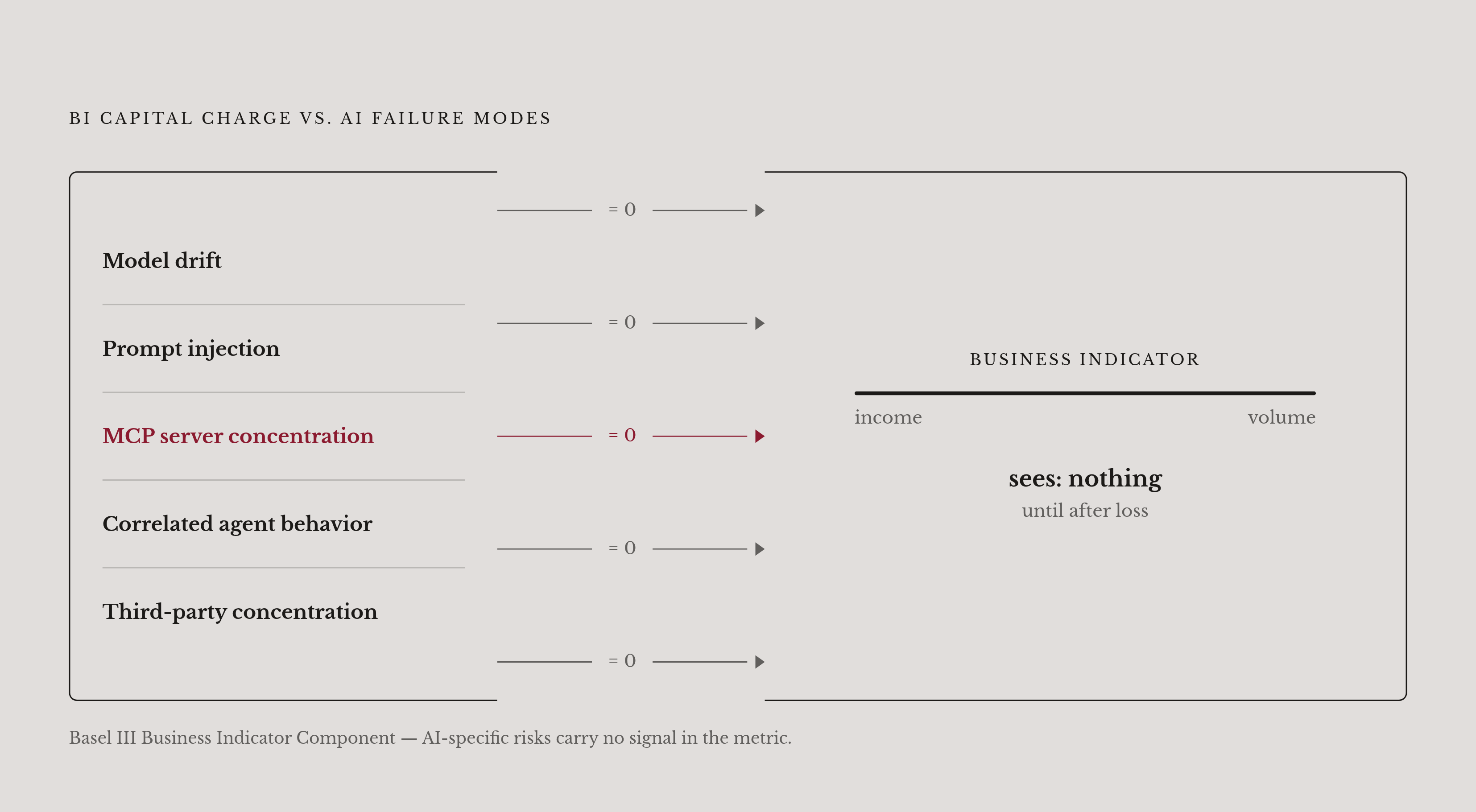
Consider the specific ways an agent can fail. None of them appear as an income signal anywhere in performance data.
Model drift is the quiet one. A credit or fraud model can degrade between validation cycles without anyone noticing, and a production agent acting on a drifted model might approve or reject thousands of transactions before anyone catches it. Business volume gives a supervisor no warning that this is happening.
Prompt injection is the adversarial one. OWASP ranks it as a top risk for large language models. In an agentic setup, an injected instruction doesn't just produce a bad answer, it can change what the agent actually does: move funds, approve an exception it shouldn't, expose account data. That's a different category of harm than a chatbot giving a wrong response.
MCP server concentration is the plumbing risk. The Model Context Protocol acts as the standard connective layer between AI agents and core banking systems. A published vulnerability analysis found roughly four in ten MCP servers examined were open to command injection, and some documented cases involved hidden prompts that quietly exfiltrated sensitive data. One compromised server, given how these protocols are wired together, can reach several core systems at once.
Correlated agent behavior is the systemic one. Analysts have warned that automation now links trading, credit, and compliance systems through continuous data exchange across institutions. Correlated agent responses to a shock can start to look like algorithmic herding, amplifying volatility instead of dampening it. Synchronized payment flows triggered by similar agent logic across banks could strain intraday settlement capacity in ways nobody designed for.
Third-party concentration rounds it out. A bank whose agentic workflows depend on one large language model provider, one cloud vendor, or one orchestration layer carries a concentration risk that has no Business Indicator signal.
If any of these failure modes cause financial loss, customer harm, legal exposure, or service disruption, they become operational risk events by definition. But the standardized capital charge reflects none of it before the loss happens. That's the actual gap. The rest of this piece is about who closes it, and how.
How supervisors are likely to address the gap: Pillar 2, stress overlays, and model risk buffers
Three mechanisms look like the most plausible paths forward, though none of them is fully built out yet, and the honest answer is that supervisors are still catching up to what banks have already deployed.
Pillar 2 supervisory add-ons are the most direct route. Regulators already have authority to impose institution-specific capital add-ons when Pillar 1's standardized charge looks insufficient for a bank's actual risk. AI governance maturity, or the lack of it, is a reasonable basis for that kind of add-on, even though it isn't written into any rule yet.
Stress testing overlays are the second lever. The Federal Reserve's 2025 stress testing revisions interact with the Basel III proposal in ways the agencies themselves describe as "largely offsetting" on operational risk. That leaves room, at least in theory, to sharpen stress scenarios around AI-specific events: a model failure, an agent cascade, correlated payment flows hitting several institutions at once.
Model risk buffers are the trickiest piece, because there's a gap inside the gap. SR 26-2 updates model risk management guidance to address an AI context, but the OCC, Federal Reserve, and FDIC jointly excluded generative AI and agentic AI models from that guidance's scope. So the highest-autonomy systems, the ones actually executing transactions, sit outside the framework built to govern model risk. That exclusion is something supervisors will need to revisit, and probably sooner than the rulemaking calendar currently suggests.
Other regulators offer a preview. A regional central bank, inside its multi-year supervisory priorities, has sharpened its focus on generative AI specifically, moving past the prudentially familiar models like credit scoring and fraud detection that used to be the main concern. In 2025 it stepped up monitoring through dedicated data collections and targeted supervisory engagement with banks, which may be a preview of where other supervisors head next.
The open question regulators are circling is whether existing sound practices can handle emerging categories like generative and agentic AI, or whether something new needs building. The answer shapes whether Pillar 2 dialogue stays the primary tool or whether new Pillar 1 refinements eventually get written into the rule itself. The broader regulatory signal, meanwhile, points toward folding AI oversight into existing enterprise risk structures with documented controls, suggesting supervisory dialogue rather than a brand-new standalone capital charge.
Governance frameworks that double as capital management (the three lines and the 2026 principles)
A striking share of banking leaders acknowledge they could not confidently pass an independent review of their AI controls on short notice, a number that, however measured, says something sharp about industry readiness. McKinsey's survey found roughly a third of organizations report mature governance overall. Neither number suggests the industry is ready for what Pillar 2 dialogue will eventually ask of it, and that gap is the real story here.
The three lines of defense structure still holds, and it maps directly onto capital readiness, not just operational tidiness. The first line, the business units actually running the agents, has to own real-time controls: configuration limits, transaction guardrails, the boundaries an agent isn't allowed to cross on its own. The second line, risk and compliance, has to challenge the model's assumptions, watch for drift, and keep documentation current, and half of banks already cite governance and compliance gaps as a reason AI deployments underperform or fail. The third line, internal audit, has to test AI controls independently of the teams that built them. That readiness gap is a supervisory risk as much as it's an operational one.
A useful reference point comes out of the 2026 Singapore Consensus: ten principles for managing agentic risk, covering least privilege, traceable identity, auditability, validated deployment, resilience against adversarial manipulation, stability across multi-agent systems, runtime assurance, interruptibility, legibility, and human oversight. Treat that list as an early practitioner standard, one that lines up well with what Pillar 2 readiness probably ends up looking like in practice.
SR 26-2 replaces SR 11-7 as the model risk anchor starting April 17, 2026. Every institution now has to ask whether its model inventory, its validation cycles, and its documentation actually cover AI agents, or whether the OCC's exclusion of generative and agentic AI leaves a hole that internal policy has to fill on its own, ahead of any regulatory requirement forcing the issue.
Agentic payment and transaction execution's meaning for operational risk in practice
Agentic payments aren't the same animal as the rule-based automation banks have run for years. A rules engine fires when a condition is met, full stop. An agentic system, given a goal and some delegated authority, decides how to get there and adjusts along the way as conditions change. 2026 is shaping up as the year this category took hold in production.
Removing human latency from a payment chain lowers transaction costs, tightens liquidity management, embeds compliance logic right at the point of decision instead of bolting it on after the fact, and cuts fraud that used to slip through in the gap between detection and action. Capital moves faster. That's not a small thing, and it's the whole reason banks are racing toward this.
But every checkpoint removed is a control that used to catch an error before it settled, and now doesn't. AML and KYC compliance agents show the tradeoff clearly: applying regulatory logic programmatically, right when a decision gets made, is genuinely powerful. But a reference architecture in the academic literature makes a pointed argument here: explainability and traceability have to be built in from the start, not bolted on once something goes wrong. Without them, a compliance failure inside an agent stays invisible to regulators and internal audit until it becomes visible after the fact, if it ever becomes visible.
Visa's real-time risk-scoring tool for account-to-account payments shows what this looks like at network scale: transactions scored in milliseconds against live contextual data, then automatically approved, declined, or flagged. That's compliance logic running at the speed of the payment itself, and it changes the operational risk profile of the entire flow, not just the one bank sending the transaction. PayPal launched agentic AI commerce services in October 2025, opening integrations across AI systems at the merchant level, a sign that agentic execution is spreading into payment chains with several parties involved, not staying contained inside one institution's walls. A financial technology vendor partnered with one AI model developer to bring agentic AI into banking starting with financial crimes detection, naming two banks as early participants. That's a live deployment, not a pilot running quietly in a lab somewhere.
It circles back to capital here. Payment volume feeds directly into the Business Indicator. A bank that scales agent-driven payment throughput will raise its standardized capital charge simply through volume growth, full stop, regardless of how good its controls are. The quality of the controls wrapped around those payments stays invisible to the charge itself. That's the exact gap laid out earlier in this piece, occurring in a different part of the business.
Steps banks and credit unions should take before deploying agentic AI at scale
Adoption numbers make deploying agentic AI look mostly settled already. It isn't, because how a bank deploys it, in a way that holds up when a supervisor asks to see the controls, is the actual question, and the capital framework quietly sets specific preparation expectations that most institutions haven't met. How a bank deploys it, in a way that holds up when a supervisor asks to see the controls, is the actual question, and the capital framework quietly sets specific preparation expectations that most institutions haven't fully registered yet.
Start by mapping every agentic AI workflow against the failure modes covered earlier: drift exposure, injection surface, third-party concentration, correlated behavior risk. Do this before deployment, not after the fact. That mapping becomes the foundation for internal capital allocation decisions, and it gives a bank something concrete to bring into a Pillar 2 conversation with a supervisor instead of showing up empty-handed.
Next, build the audit trail infrastructure the current rule doesn't require but supervisors will expect anyway. The Business Indicator won't penalize a bank with weak AI controls. A supervisor exercising Pillar 2 judgment will. Configurable controls, full transaction visibility, and complete audit records are the evidence that a bank's real risk profile sits lower than what the standardized charge implies here. They're the evidence that a bank's real risk profile sits lower than what the standardized charge implies, and institutions that can actually demonstrate tested, well-designed controls walk into supervisory dialogue from a position of strength.
Finally, align model risk management to SR 26-2, and don't wait for regulators to fix the exclusion gap first. The OCC's revised guidance explicitly leaves generative and agentic AI outside its model risk scope. Every bank running these systems has a choice: extend SR 26-2's discipline to agentic models voluntarily, through internal policy, or leave a hole in the model inventory that eventually gets found, either by an auditor or by a loss event. Given how fast adoption is moving and how thin the current governance numbers look, waiting isn't much of a strategy.
Sources
- Agentic AI in Banking: 2026 Implementation Guide with Real Bank Case Studies, DORA Compliance, and Generative AI Comparison
- Bank Regulatory Capital
- Agentic Artificial Intelligence in Finance: A Comprehensive Survey
- Agent-to-Agent Finance: Blockchain Payments and Trust Infrastructure for Autonomous AI Agents
- Basel III and AI Operational Risk Management: Integrating AI Risks into Banking Frameworks
- bankingsupervision.europa.eu
- Mind the gaps: Scaling agentic AI in financial compliance
- How Agentic AI Will Reshape Payments in: IMF Notes Volume 2026 Issue 004 (2026)