Audit Trail Standards Examiners Expect for AI-Initiated Banking Actions
Regulators expect banks to document exactly how AI agents make decisions, not just what they decide.
On April 17, 2026, the Federal Reserve, the OCC, and the FDIC issued SR 26-2 and OCC Bulletin 2026-13, the first rewrite of model risk management guidance in fifteen years. It replaces SR 11-7. And buried in the fine print is a decision that sounds like it lets banks off the hook: generative and agentic AI are explicitly carved out of scope, described as too novel and too fast-moving to regulate under the new framework yet.
But before any compliance officer breathes easy, worth asking: does an exemption from a rule mean an exemption from scrutiny? Examiners walking into a bank running AI agents are still going to raise safety-and-soundness concerns, including questions about governance, vendor oversight, and operational controls. The guidance itself applies mainly to institutions above $30 billion in assets, with smaller banks pulled in under certain conditions related to the nature and scale of their AI use. None of that changes what happens in the exam room. A bank that reads the carveout as permission to skip documentation is going to find out, the hard way, that examiners came prepared anyway.
What examiners are actually looking for when they review AI-initiated actions
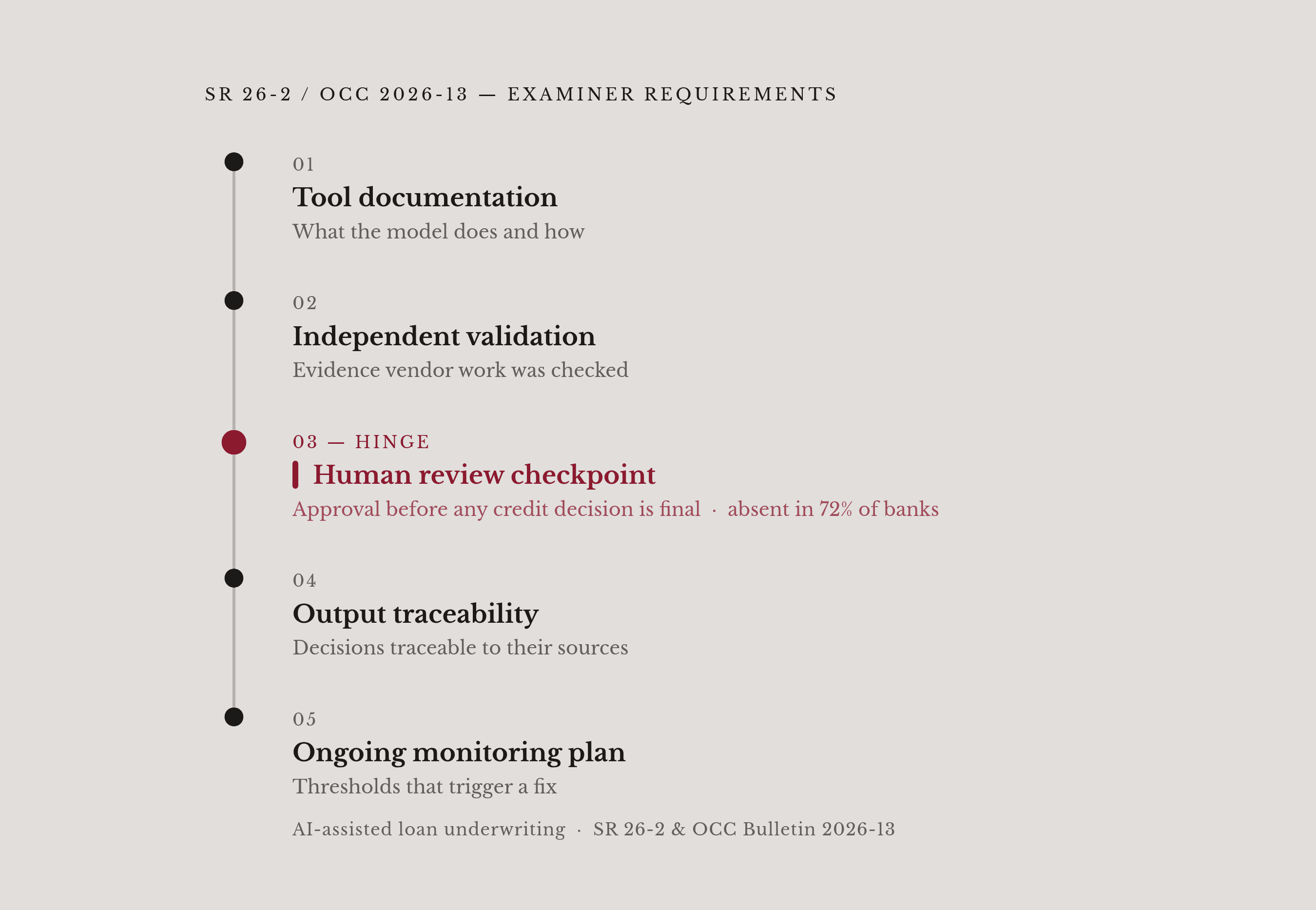
Take a bank using an AI tool to help underwrite loans. Under SR 26-2 and OCC Bulletin 2026-13, an examiner walks in wanting five specific things: clear documentation of what the tool does and how, evidence that someone checked the vendor's own validation work, proof that a human reviews the output before a credit decision goes final, outputs that trace back to their sources instead of arriving as an unexplained number, and an ongoing monitoring plan with thresholds that trigger a fix.
The guidance doesn't dictate the format of the answer. It just insists an answer exists.
That gap between "no fixed template" and "must have something" is where a lot of banks are getting caught. American Banker reported that 72% of banks lack AI model kill switches and failure reporting; that single figure has become a go-to question in SR 26-2 conversations. Examiners are also expecting alignment with two standards outside the banking rulebook: the NIST AI Risk Management Framework, built around Govern, Map, Measure, and Manage, and ISO/IEC 42001, published in December 2023 as the first AI management standard an outside auditor can actually certify against.
For banks with any European or UK exposure, the picture gets more layered. The EU AI Act (Regulation (EU) 2024/1689) will likely treat autonomous agents executing financial transactions as high-risk, and while the high-risk provisions under Annex III were pushed to December 2, 2027 by a later regulation, the direction is clear: human oversight, auditability, and formal conformity checks are coming. DORA, in effect since January 17, 2025, already requires continuous monitoring and logging of ICT systems, AI included. A Bank of England and FCA survey from November 2024 found that 46% of firms had only a partial grasp of the AI technologies running inside their own operations, mostly because those tools came from third parties. That's the number examiners reach for when they start asking pointed questions about vendor oversight.
Put it together and the pattern is obvious. Examiners aren't grading the technology itself. They're testing whether the bank can pull up any AI-driven action, months later, and explain exactly what happened and why.
What an audit trail for an AI-initiated banking action must actually contain
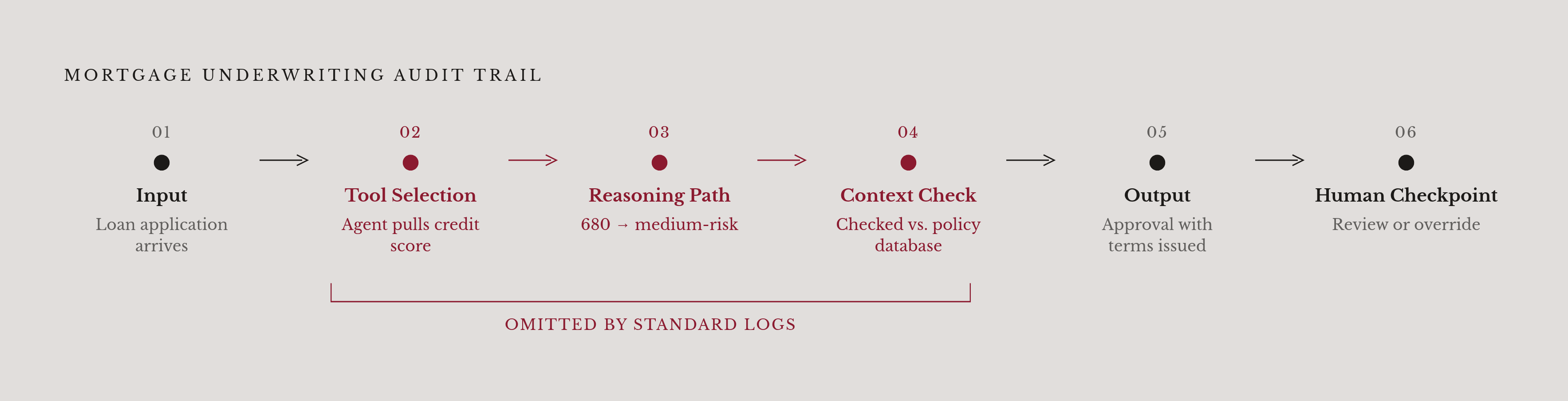
An audit trail, in this context, is not a system log. It's a full, chronological account of how an agent got from an input to an action, with nothing skipped.
Picture a mortgage-underwriting agent. A loan application comes in (that's the input). The agent decides to pull a credit score (tool selection). It reads that 680 score and classifies the file as medium-risk (reasoning path). It checks that classification against the underwriting policy database (context). Then it issues an approval with specific terms (output). An examiner should be able to reconstruct every link in that chain, not just the first and last one, and platforms like PaymanAI, which runs AI agents on existing banking rails with configurable audit trails, are designed around exactly that expectation.
Sardine.ai's compliance playbook lays out the standard plainly: any output that informs or executes a regulated decision needs to be logged with the exact inputs (redacted where appropriate), the model version and configuration in play at the time, and a rationale a human can actually read and understand. Those logs have to hold up under an ECOA or FCRA adverse action notice, and they need to be retrievable fast when a complaint comes in or compliance runs a review.
Every regulated process an agent touches needs its role mapped to the obligation governing it:
- SAR filings: outputs reviewed by compliance staff, logs retained in line with applicable BSA recordkeeping requirements.
- ECOA/FCRA: model rationale and input data on hand for adverse action disclosures.
- UDAAP: no automated communication that ends up unfair, deceptive, or abusive.
- GDPR (for EU/UK operations): a real right to human intervention and to contest decisions made entirely by machine when they carry legal or similarly serious weight.
What examiners actually want to see is a chain: the rule that governed the action, linked to the data the agent used, linked to the authorization that permitted it, linked to the human checkpoint that reviewed it or could have stopped it. A standard application log captures input and output. An agent audit trail has to preserve everything in between, the sequence of reasoning, the tool calls, the moments the system reached out for more context. Skip that middle layer and the trail is basically useless the moment someone asks "why."
How production-grade logging systems are built to meet this standard
Treat every action an agent takes like flight data. That's the mental model worth borrowing from aviation, and it's showing up in how banks structure their logging. OpenTelemetry handles structured event emission in a way that isn't tied to one programming language, and JSON logging avoids the mess of searching through unstructured text after the fact.
Some teams call this the "flight recorder" approach: a chain-of-action recorder that captures prompts, tool calls, and the intermediate reasoning steps in between. Worth a clarification here, since the terms get mixed up: MCP (Model Context Protocol) is an open standard for connecting AI systems to outside tools and data. It is not a logging framework, and treating it like one is a mistake.
Immutability matters more than it sounds like it should. Logs need tamper-evident storage with cryptographic signatures, because a record that could theoretically be edited after the fact carries no weight in an exam or a legal dispute. On the storage side, most of the volume can sit in immutable object storage with lifecycle rules that age records out of expensive, searchable indexes and into cheaper write-once storage, roughly a third of the cost of keeping everything hot and searchable.
"Log everything" isn't actually a strategy, it's a way to drown in noise. A better approach:
- Capture the moments that matter: prompt inputs, response outputs, and the tool calls tied to real decisions.
- Redact personal data on ingestion, not after the fact, while keeping enough context that the log still means something analytically.
- Batch logs asynchronously to minimize the performance impact on live systems.
- Roll out logging to existing production agents gradually, mirroring traffic through a shadow pipeline before flipping it on for real.
Feed those logs into a SIEM or SOAR system so anomalies get flagged in real time, with automated playbooks ready to fire when something looks off. At minimum, every single agent action needs inputs, outputs, timestamps, the model version in use, and a record of any external API call it made.
The failure pattern shows up again and again: teams bolt audit logging onto an agent after it's already live. Prompt versions go missing. Source attribution gets spotty. Timestamps don't line up. None of it looks deliberate, but all of it makes the log indefensible the moment someone in a suit starts asking questions.
Governance controls that make the audit trail enforceable, not just archival
A log by itself is just a record. It becomes accountability only when it connects to who authorized the action, who has the power to stop it, and who owns the outcome when something breaks.
The governance stack examiners expect to see today has a few non-negotiable pieces. A full inventory of every agent running in production comes first, because examiners ask what exists before they ask how it's logged. Monitoring needs to be built around how these systems actually fail, hallucination, drift, adversarial prompting, not just whether the servers stayed up. Every output has to trace back to the exact data, model version, and policy that produced it. A human needs a real checkpoint at every decision that matters. And when a model version changes, that change needs its own timestamped record, linked to whatever audit entries it affects downstream.
Kill switches deserve their own line. Examiners are asking, directly, whether a bank can halt a specific agent mid-operation without dragging down every system connected to it. Given that 72% of banks reportedly can't do this as of mid-2026, per American Banker, this has stopped being a hypothetical and started being an exam question with a wrong answer attached.
There's also an independence principle at play, the same one that's always governed model risk: whoever builds or runs the system can't be the same party validating it. That doesn't change just because the system in question is an agent instead of a static model.
Vendor contracts need specific teeth. Audit rights that let internal teams and regulators inspect logs, version history, and data lineage. Security certifications, SOC 2 Type II and ISO 27001 at minimum, backed by real penetration testing. A firm commitment to notify the bank quickly if something goes wrong. And a guarantee that data can be pulled out and deleted if the relationship ends.
The Bank of England and FCA's 2024 survey found that 84% of firms had a named, accountable person for their AI framework. Worth sitting with that number for a second: having someone whose name is on the framework and having a governance structure that actually functions are two very different things. One is a title. The other is a system. The FS AI Risk Management Framework, published in February 2026 by the Cyber Risk Institute with input from more than 100 financial institutions and released by the U.S. Treasury on February 19, 2026, gives banks a sector-specific structure to build against, alongside NIST's framework.
What happens when the audit infrastructure is missing or retrofitted
The scariest failure isn't a fine. It's a bank that genuinely believes its logging is fine, right up until an examiner asks for the reasoning path behind a specific decision and gets handed nothing but an input and an output, with the entire chain in between missing.
Fines for AI governance failures averaged $5 to $10 million in 2024 and 2025, per one industry source. But the fine is often the smaller problem. The bigger one is showing up to a customer dispute or a lawsuit and having no way to defend a decision the bank itself made, or getting hit with operational restrictions that slow everything down.
Retrofitting a logging system after an agent is already live tends to leave the same fingerprints every time: prompt versions that were never captured, source attribution with gaps in it, timestamps that don't quite line up across systems. Each one becomes its own point of failure the second an examiner starts pulling threads.
Banks that built strong audit architecture from the start report meaningfully faster regulatory response cycles and fewer model risk exceptions, somewhere in the range of 30% fewer, according to industry reporting. The infrastructure that satisfies an examiner turns out to be the same infrastructure that makes internal compliance work faster day to day. That's not a coincidence, it's the same evidence chain serving two audiences at once.
Here's the number that should worry the industry more than any single fine: 99% of companies say they plan to put AI agents into production, but only 11% actually have, and governance concerns are among the reasons most cited for the gap. Separately, only 15% of CFOs say they feel ready to deploy agentic AI, and they name the same three barriers: governance, traceability, human oversight. Those aren't obstacles standing between a bank and deployment. They're the exact things an examiner is going to check for, which means the bank that skips them isn't avoiding friction, it's just moving the friction to exam day.
Compliance infrastructure isn't a coat of paint applied after the agent ships. It's a decision made before the first transaction ever runs.
What a bank deploying AI agents on existing rails needs in place before the next exam
Most banks aren't ripping out core infrastructure to deploy AI agents. They're layering agents onto rails that already exist, which means the audit trail has to work inside that constraint rather than assume some clean, greenfield build that nobody actually has the budget or time for.
A few questions worth running through before the next exam, organized around what an examiner is likely to ask first:
- Agent inventory: Is there a complete list of every agent in production, what each one does, and which transactions it touches?
- Decision lineage: Can any AI-initiated action be reconstructed on demand, prompt, tool selection, reasoning, authorization, output, start to finish?
- Kill-switch capability: Can one specific agent be shut down without taking neighboring systems down with it?
- Vendor oversight: Do the contracts actually include audit rights, SOC 2 Type II certification, incident notification, and a clear data exit clause?
- Human oversight: Is there a documented point where a person could have reviewed, overridden, or stopped each material action?
- Regulatory mapping: Are agent outputs tied to SAR, ECOA/FCRA, UDAAP, and whatever else applies?
- Change documentation: When a model version changes, is that change timestamped and linked to the records it affects?
SOC 2 Type II certification is worth treating as a floor, not a finish line, when evaluating any AI agent vendor. It's the minimum independent evidence that a vendor's logging and security controls hold up to outside scrutiny, nothing more.
One detail that gets overlooked: voice and text interfaces carry the same obligation as any other channel. If a customer or employee gives an instruction by voice or by text that leads an agent to execute a real transaction, that instruction needs to land in the audit trail with the same completeness as anything typed into a screen.
Strip away the acronyms and the exam boils down to one question: can the bank show, not just claim, that every automated action was governed, traceable, and sitting under a human's watch at some point along the way? The banks that walk out of that exam clean are the ones answering with documentation already sitting on the table, not with a promise to go build it.