Human-in-the-Loop Control Design for High-Value AI Payment Approvals
Banks are building layered human controls to catch AI payment errors before money clears.

Payment AI breaks the usual playbook for human oversight because payments don't forgive mistakes the way most software does. Once money clears, there's no undo button, no patch release, no quiet rollback. That single fact changes what "human in the loop" has to mean, and this piece works through how institutions are actually building that control: thresholds, kill switches, audit trails, and what's holding up (or falling apart) in live deployments so far.
The structural tension that makes payment AI different from every other AI use case
The IMF's April 2026 note on agentic AI in payments states the problem: AI reasons in probabilities, but payment rails run on finality. A transaction clears, and that's the end of the story. There's no rollback the way there's a patch for buggy code.
That gap matters more than it sounds. A recommendation engine that gets something wrong just serves a bad suggestion, and someone shrugs and moves on. A payment agent that gets something wrong sends real money out the door, and depending on the rail, getting it back ranges from mildly annoying to functionally impossible.
Stack an authorization problem on top of that. When an agent starts, authenticates, and settles a transaction with no human touching any step, who actually authorized it? The user who deployed the agent, the model underneath it, or the bank that built the thing? It is a practical compliance and liability question, not a philosophical one for a conference panel.
Then there's the systemic layer, and this is the part that should worry people more than it currently does. If a large number of agents trained on similar data all respond to the same market signal at the same moment, the result is correlated behavior no single bank's internal controls were ever built to contain. That's a market-wide failure mode hiding inside what looks, from any one bank's seat, like a series of separate, reasonable decisions.
Human-in-the-loop isn't automatically the safe choice, and that's the part that trips people up. Analysis from 2026 points out that payment delays caused by human approval steps can themselves raise liquidity risk and blunt hedging strategies that depend on speed. Slowing everything down for review has a real cost. So HITL can't work as a blanket pause button. It has to be calibrated so review lands on the transactions that actually need a second look, without choking the ones that don't.
The IMF's April 2026 note draws a useful line for where that calibration should happen, distinguishing between the stages where AI can act with autonomy, where safeguards must hold firm, and where finality lives. AI can run with real autonomy in the first layer. The second layer is where rule-based safeguards need to hold firm, no exceptions. The third is where finality lives, where a mistake stops being a mistake and becomes a fact.
What threshold-based approval actually means in practice
India's CERT-In Digital Threat Report for 2025-26 gives the clearest regulatory language published so far: mandate human-in-the-loop controls for agentic AI actions above defined financial thresholds, with full audit trails attached. That single sentence carries a lot of weight, and most of the interesting work sits in what "threshold" actually means once you get past the dollar figure attached to it.
A threshold is a range shaped by context. It's several signals stacked on top of each other, and getting any one of them wrong undercuts the rest:
- Transaction size, capped per transaction, per day, and per month, an approach Nikhil Pahwa has floated for AI agents operating on UPI.
- Counterparty familiarity, whether the recipient is a known, established vendor or a brand-new payee showing up for the first time.
- Velocity, a burst of payment activity that doesn't match the account's normal rhythm.
- Context mismatch, a payment type that doesn't line up with what the agent was actually told to do.
Put those together and the result is a risk score, not a dollar cap. And a risk score needs a subject to attach to, which is where agent identity stops being optional. Without a distinct identity for the agent, separate from the human account holder, there's no clean line to enforce a threshold against. Pahwa's proposal for delegated UPI handles, something like agent-nixxin@ybl, answers that gap directly: give the agent its own address, its own wallet, its own PIN, and default-on spending limits, so its blast radius is bounded from the start instead of inherited wholesale from the human's bank account.
Thresholds have to be configurable, not baked into code, and treating them as fixed is where most designs go wrong first. A community bank's comfort level with a $50,000 wire has nothing to do with a multinational's comfort level with the same number. One-size-fits-all threshold logic fails the moment it meets a real risk committee.
How escalation paths turn a threshold into a complete approval workflow
A threshold by itself just stops the agent. Nothing happens next unless someone has designed where the stopped transaction goes, and that routing, the escalation path, is what separates a working control from a decorative one.
Good escalation design answers a specific set of questions, and skipping any of them is how these systems quietly fail. Who receives the flagged transaction: a named person with real authority, or a shared inbox nobody checks on weekends? What do they see when it lands: a wall of raw logs, or a short, readable summary of the agent's reasoning? How long do they have to respond, and what happens by default when that window closes with no answer: does the payment clear, get rejected, or sit on hold? Does routing scale with size, so a $25,000 payment goes to a department head while a $500,000 wire needs two signatures?
AWS's multi-agent architecture work offers a useful parallel here. In a hierarchical, or graph, pattern, a supervising agent sits above specialized agents handling credit assessment, fraud detection, and risk modeling. Human escalation chains can mirror that same shape: a named authority sits above the workflow, not buried somewhere inside it.
Explainability is where a lot of escalation designs quietly collapse. Regulators want clear justification behind adverse algorithmic decisions, and that requirement cuts both ways. If the person receiving an escalation can't understand why the agent flagged the transaction, their approval is a rubber stamp with extra steps. The audit trail behind it is hollow too, because "a human approved it" means nothing if that human had no real basis to judge what they were approving.
AWS's sequential workflow pattern, built for AML checks and other heavily regulated processes where getting it right matters more than getting it fast, models this well: step-by-step checkpoints, each one legible to a human reviewer. That's exactly what high-value payment approval needs. The emerging framing of agentic systems as entities with their own identities, permissions, and audit trails fits neatly here too. An escalation path is really just the org chart for how much authority an agent gets to hold before a person has to sign off.
Kill switches and circuit breakers as system-level controls, not just agent-level ones
Bank of England Deputy Governor Sarah Breeden signaled that existing regulatory frameworks might not stretch far enough to cover agentic AI in finance. That's a real break from the long-standing assumption that current rules could just absorb this. Among the options under discussion: market-wide kill switches that could halt trading if a faulty model starts a meltdown, plus what's being called "enhanced recovery," where one bank could step in and take over another's core functions if things go sideways.
The concern behind this isn't abstract. A Cambridge survey found 52% of finance firms already using agentic AI in some form. That's more than half the industry exposed to a kind of correlated failure that no single firm's controls were built to stop. The Financial Stability Board made a similar call in June 2026 for tighter safeguards, so multiple regulators share this worry, and it's showing up in parallel across bodies that don't usually move together.
Kill switches need scope, and scope is a design decision, not a default setting. An agent-level switch pauses one misbehaving agent. A workflow-level switch pauses every payment agent running a particular process. Institution-level pauses everything AI-initiated across the bank. Market-level is the coordinated halt regulators are now actively discussing. Each level needs its own trigger (unexpected agent behavior, detected model drift, a counterparty anomaly, a direct regulatory order) and each needs a recovery path that's been rehearsed, not just assumed to exist on paper.
Federal examiners are already asking about this directly. As of June 2026, the Fed, OCC, and FDIC are pressing lenders on a specific question: can the bank shut down a system that starts behaving unexpectedly? That's an exam question now, not a hypothetical for next year's planning cycle. And a June 2026 survey found 72% of banks unprepared for an AI failure. That gap, between what examiners are asking and what banks can actually demonstrate, is the whole problem in one number.
None of this works if decision-making and execution are welded together in the same system. A kill switch needs a clean seam to cut along, and that's exactly why separating reasoning from execution, a principle the IMF's April 2026 note addresses, matters. Without that separation, there's no place to actually step in before the payment clears.
Audit trails as the mechanism that makes every other control accountable
Thresholds, escalation paths, kill switches: none of it means anything without a record proving the control worked the way it was supposed to. That record is the audit trail, and regulators across jurisdictions have converged on the same demand: log everything, and make it explainable.
CERT-In's 2025-26 report pairs its threshold mandate directly with a call for full audit trails, treating the two as one requirement, not two. DORA, effective across the EU since January 17, 2025, requires financial institutions to log, classify, and report ICT-related incidents, including ones tied to AI, with management held accountable, not the vendor, not the model. The EU AI Act treats high-risk systems the same way, requiring logging, documentation, and human oversight, with transparency obligations for customer-facing AI taking effect August 2, 2026. BaFin, meanwhile, is watching AI use across regulated financial activity and has issued non-binding guidance touching governance, risk management, data security, and operational resilience.
What does a payment agent's audit trail actually need to capture? Five things, at minimum: the intent the agent received, the reasoning chain behind the payment decision, which threshold rule applied, whether escalation triggered and what the human decided, and the final execution record tied to the agent's own identity, not folded invisibly into the user's account.
Explainability is a core requirement here. It's a live compliance obligation. Auditors have to explain to a regulator why an agent flagged, or approved, a specific transaction. "The model decided" isn't an acceptable answer, and opacity in the reasoning chain isn't something regulators are inclined to wave through as a technical limitation.
Model drift adds another wrinkle. A payment model that worked fine at launch can start behaving differently months later with no obvious break in service to flag it. Continuous logging is the only real way to catch that kind of silent drift before it turns into a pattern of bad approvals nobody noticed until the damage was done.
A governance gap causes all of this. SR 26-2, issued April 17, 2026 by the Fed, OCC, and FDIC, updated model risk standards for traditional quantitative models but explicitly carved out generative and agentic AI from that update. A separate request for information is planned but hasn't been issued yet. So banks running agentic payment AI right now are filling that gap with their own internal audit infrastructure, ahead of formal guidance rather than in response to it. The Financial Stability Board's list of AI risk priorities, including model risk and governance, third-party dependency, and cyber risk, maps almost exactly onto what a serious audit trail has to cover.
What live deployments reveal about HITL design choices that work
Theory only goes so far. What are institutions actually shipping?
Santander and Mastercard completed what's described as Europe's first live AI-agent payment inside a regulated banking environment in 2026. The reported design choice was to work within existing authenticated banking infrastructure rather than route around it. The agent sits on top of proven rails instead of routing around them. BBVA with Visa and Nordea with Mastercard are reportedly building similar setups, which suggests this pattern, an agent layer above existing authenticated infrastructure, is becoming the default architecture, not one bank's one-off experiment.
BNY Mellon's system, called Eliza, coordinates 13 specialized agents to give sales teams fast insight and speed up client service. Same hierarchical shape again: a supervising layer, specialist agents underneath, human-readable output at the top instead of raw model chatter dumped on someone's desk.
The efficiency numbers coming out of early deployments deserve a close look, because they cut against the assumption that control and speed trade off against each other. Independent Bank in Michigan cut integration pipeline development time by a factor of 12 while detecting ATM fraud in real time. A major UK bank saw loan fraud drop 35% after embedding AI agents directly into existing loan approval workflows, not replacing the workflow, folding into it. Lincoln Savings Bank in Reinbeck, Iowa, piloted a compliance and third-party oversight tool from Kobalt and reported measurable gains, proof this isn't purely a story about the largest banks. And Ant International's Agentic Machine Payment protocol cuts the number of steps needed to link a payment agent to a digital wallet by half compared to traditional card-binding, an efficiency win that came from better protocol design, not from stripping out authorization steps to save time.
Across all of it, the pattern holds: agents get narrow, traceable, revocable authority, a principle the IMF's April 2026 note addresses. What changes from one deployment to the next is how that narrowness gets defined and enforced, not whether it exists.
What's missing is just as telling as what's there. None of the publicly described deployments has published its full threshold and escalation matrix. Institutions are building these frameworks behind closed doors, with no shared industry standard yet for what a "good" threshold table or escalation tier actually looks like. That will likely change as regulation catches up, but right now, each institution is solving the same problem from something close to scratch.
How to structure a HITL framework across low-, medium-, and high-risk payment categories
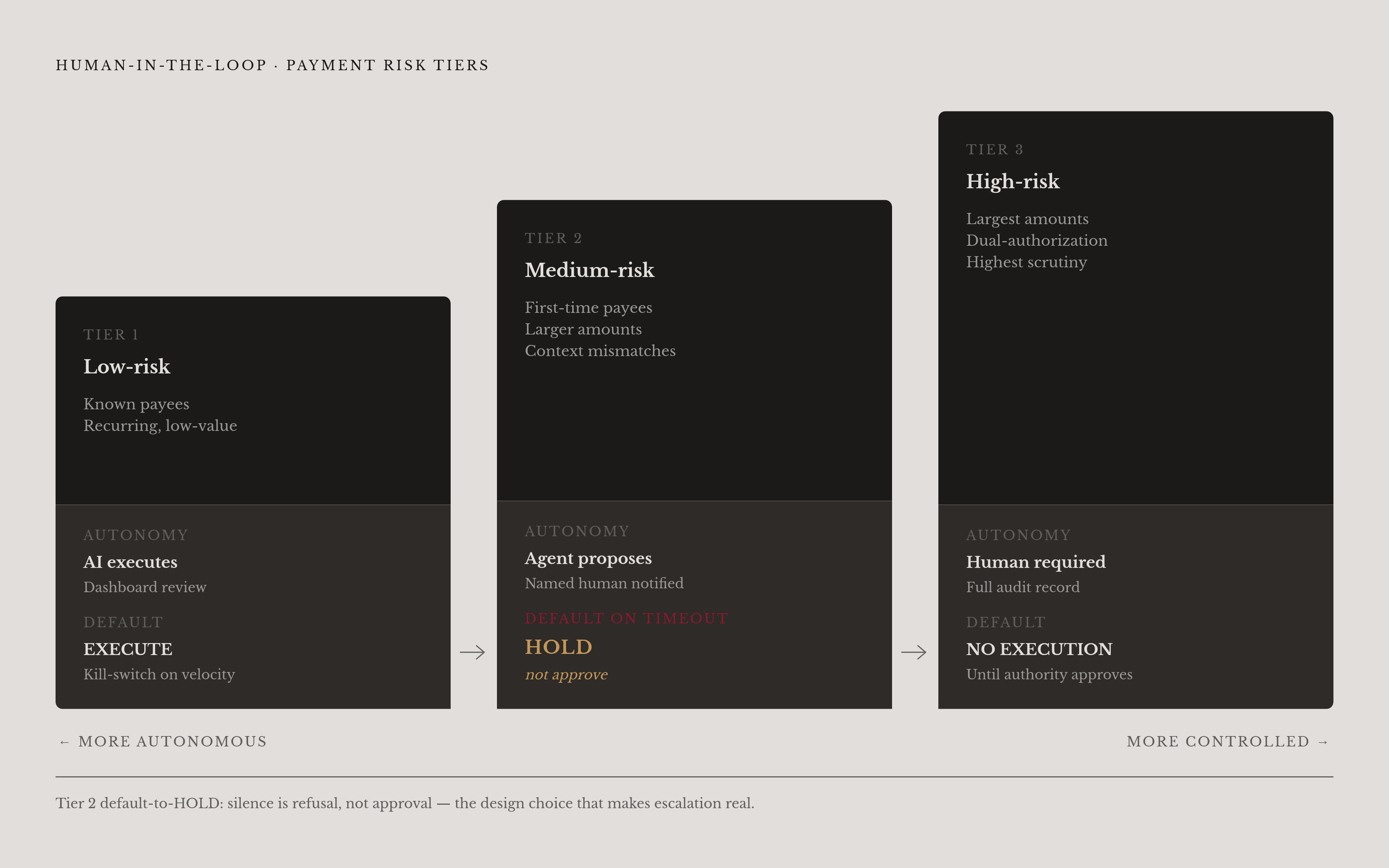
HITL is a spectrum of involvement. It's a matrix, where each risk tier gets its own combination of threshold, escalation path, kill-switch trigger, and audit depth, and treating it as a single on/off setting is exactly how institutions get this wrong.
Low-risk tier covers routine, recurring, low-value payments to counterparties the system already knows well. Here, AI can execute on its own within pre-authorized mandate limits, no real-time sign-off required. A full audit trail still generates automatically on every transaction, and a supervisory dashboard gets reviewed periodically rather than checked transaction by transaction. The kill-switch trigger at this tier stays narrow: a velocity spike or an unexpected counterparty change is enough to pull the transaction out of autonomous execution and into review.
Medium-risk tier picks up first-time payees, larger amounts, or any payment whose type doesn't line up cleanly with what the agent was told to do. At this level, the agent proposes the payment along with a short reasoning summary, and a named human authority gets a notification with a defined approval window. If nobody responds in time, the default is to hold, not to approve automatically, since the entire point of this tier is that something about the transaction doesn't fit the pattern the system already trusts.
High-risk transactions, the largest amounts, dual-authorization wires, anything flagged as needing the tightest scrutiny, sit above both tiers and deserve the most conservative default available: assume the payment doesn't go through until a human with real authority says otherwise, backed by a complete, explainable record of why the agent proposed it in the first place.
The lesson from where this field stands right now isn't complicated, even if the engineering underneath it is. HITL works as a spectrum, a set of graduated decisions, threshold by threshold, tier by tier, each one calibrated to how much damage a mistake at that level could actually cause.
Sources
- MeitY proposes mandatory human checks for agentic AI payments
- How Agentic AI Will Reshape Payments in: IMF Notes Volume 2026 Issue 004 (2026)
- AWS and Microsoft Present Agentic AI’s Banking Business Case | PYMNTS.com
- Agentic AI in Banking: 2026 Implementation Guide with Real Bank Case Studies, DORA Compliance, and Generative AI Comparison
- Agentic AI Payments: Navigating Consumer Protection, Innovation, and Regulatory Frameworks - consumerbankers.com
- Agentic AI Gets Its Own Payment Protocol | PYMNTS.com
- When AI overwhelms the human in the loop
- backbase.com