AI Governance Maturity Models for Community Banks and Credit Unions
Most community banks have deployed AI but lack governance to match the risk.

A substantial share of community banks and an even larger portion of credit unions have already put generative AI into production, according to recent industry survey data. That's a "this is already running" number, not a pilot number, and yet almost none of these institutions have a governance structure that matches the scale of what they've deployed, which means the real story isn't adoption — it's the gap between what's live and what's actually being watched.
What "governance" actually means when AI executes real financial actions
Governance isn't a binder sitting on a compliance officer's shelf. It's an operating system, one that spans how AI gets approved, watched, corrected, and reviewed across its whole life, from the day someone spins up a pilot to the day the model gets retired.
That distinction matters most with agentic AI. A dashboard that recommends a product to a member is one thing. A system that actually initiates a payment, flags an account for review, or routes a transaction is acting, not merely advising, and once software is taking actions with real money attached, accountability stops being something you check after the fact. It becomes a live question, asked in real time, every time.
A synthesis of work from CLA, CCG Catalyst, and Backbase lays out thirteen governance components that financial institutions need running at once: accountability, regulatory risk assessment, a use-case inventory, data quality, fairness and accessibility checks, reliability and safety, transparency and explainability, human checkpoints, privacy and retention rules, security, a model lifecycle registry, ongoing risk management, and a way to actually measure the value AI is producing. These run together, all the time, as an ongoing habit rather than a project with a finish line, which is exactly why so many institutions find governance harder than they expected.
Shadow AI makes this worse before it gets better. Recent industry research found that many organizations didn't have policies strong enough to stop employees from using AI tools outside approved channels. Someone in operations pastes member data into a free chatbot to draft an email faster, nobody signed off on it, and nobody's tracking it. That's a Tuesday at a lot of institutions right now.
And the stakes go beyond the exam room. A January 2025 report from the XM Institute found only 26% of consumers trust organizations to use AI responsibly. Governance isn't just about satisfying an examiner; it's about whether the person on the other end of the phone believes you're handling their money and their data the right way. For this piece, here's the working definition: governance is the set of controls, visibility, and accountability that let an institution answer, at any moment, to any examiner or board member, what its AI is doing, why, and who's on the hook for it.
The regulatory ground has shifted, and the gray zone is now where community banks operate
On April 17, 2026, the OCC, the Federal Reserve, and the FDIC issued updated interagency Model Risk Management guidance, replacing SR 11-7 after fifteen years on the books. That's a big deal on its own, and buried inside it is something smaller but just as important for community institutions: the update says a bank's model risk sophistication should match its size and risk profile. Smaller banks aren't expected to run the same playbook as the largest institutions in the country, and that's a real concession that matters.
But here's the catch. Generative AI and agentic AI are explicitly left out of the new guidance, and regulators said, plainly, that the old framework doesn't fit these tools, with a separate request for information coming down the road. So what does that mean in practice? You can't file your GenAI deployment under your existing model risk binder and call it governed. The agencies want "broader risk management and governance practices," but they haven't said what that looks like yet. Institutions are left governing this risk in a gray zone, even as exam expectations are already taking shape around them.
Ask a practitioner what examiners are requesting before a visit these days, and you'll hear some version of: show me how your institution governs the AI you use. That question is showing up before the rulebook that's supposed to answer it.
Layer state law on top of that. California, Colorado, Florida, and Texas are each pursuing their own AI rules, and a December 2025 executive order aimed for a national standard but didn't resolve the interim mess. Credit unions face their own version of this: the NCUA has hired AI officers and put out an AI Compliance Plan, a clear signal that supervisory attention is coming their way too.
So what's the honest read here? Institutions building governance structure now are getting ahead of an exam environment that's forming in real time, without a finished rulebook to follow. A governance policy written in 2023 has no chance of covering what AI can do in 2026, so it has to be reviewed every year, not because the institution is unstable, but because that's what a living policy looks like.
How a maturity model turns governance from an aspiration into a progression
Ask most compliance officers whether their institution needs accountability, auditability, and control over its AI, and they'll say yes without hesitating. Ask them how to get there from where they stand today, and the answer gets a lot fuzzier. That's the real problem: a missing map, not a lack of intent.
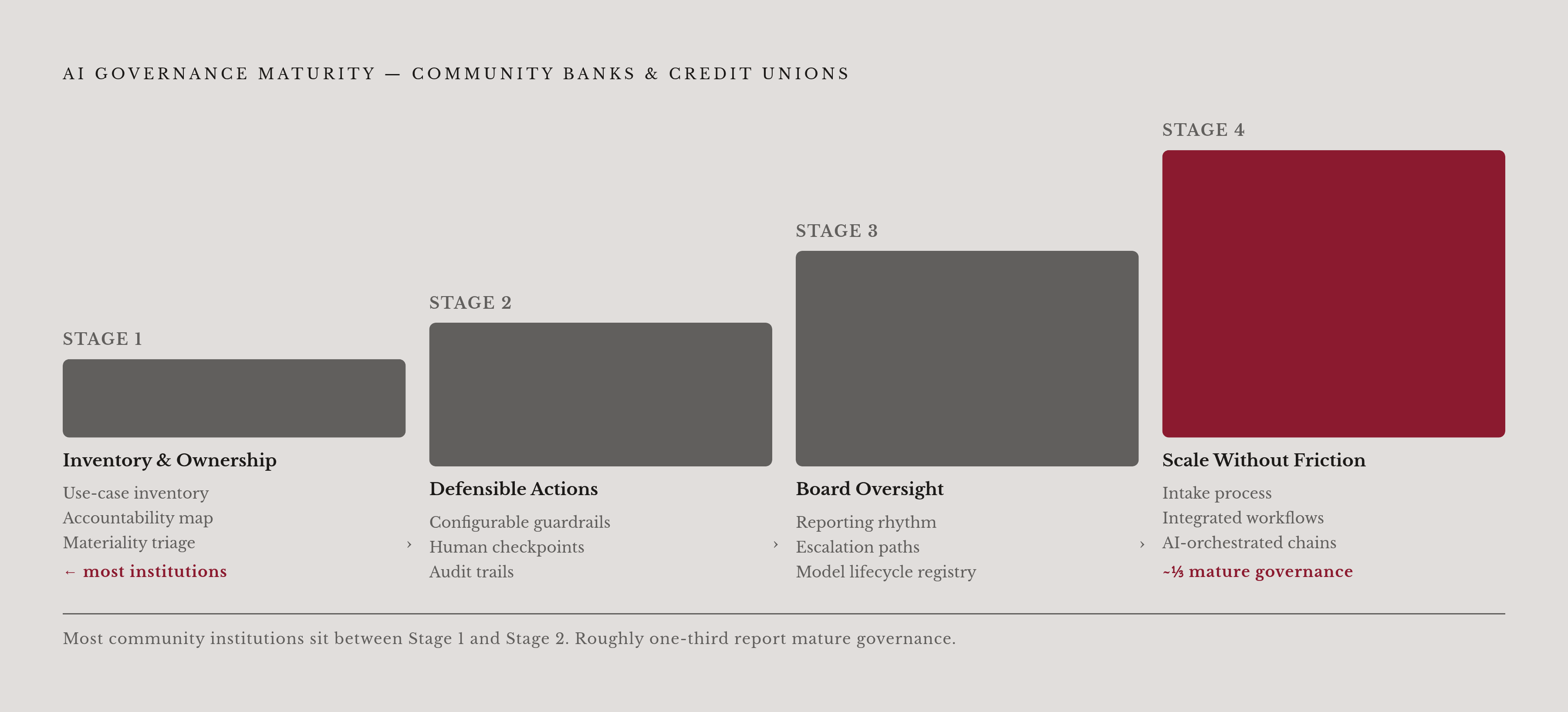
Recent industry analysis found only about a third of organizations report mature AI governance. The rest sit somewhere in the middle, often without a clear sense of where exactly. A maturity model fixes that by doing two things at once. First, it's a diagnostic: where are we right now, which governance pieces are solid, which are half-built, which don't exist at all? Second, it's a roadmap: what does the next stage actually require, in concrete terms, instead of a vague sense that "we should do more"?
CLA's AI Governance Maturity Curve is a working example of this logic applied directly inside financial services. The point of a maturity model isn't to demand everything at once. It sequences the work, so what you build in stage one becomes the foundation stage two needs to function.
That raises a question worth sitting with: what separates a maturity model from a checklist? A checklist tells you a control exists, while a maturity model tells you whether that control is integrated, consistent, and actually owned by someone. Those are different questions, and only one of them tells you if governance will hold up under pressure.
Community banks and credit unions actually have an edge here that they don't always use. Flatter decision structures mean a governance change can move from a board resolution to an operating policy a lot faster than at a large regional or national bank, as long as the stages are clear enough to follow.
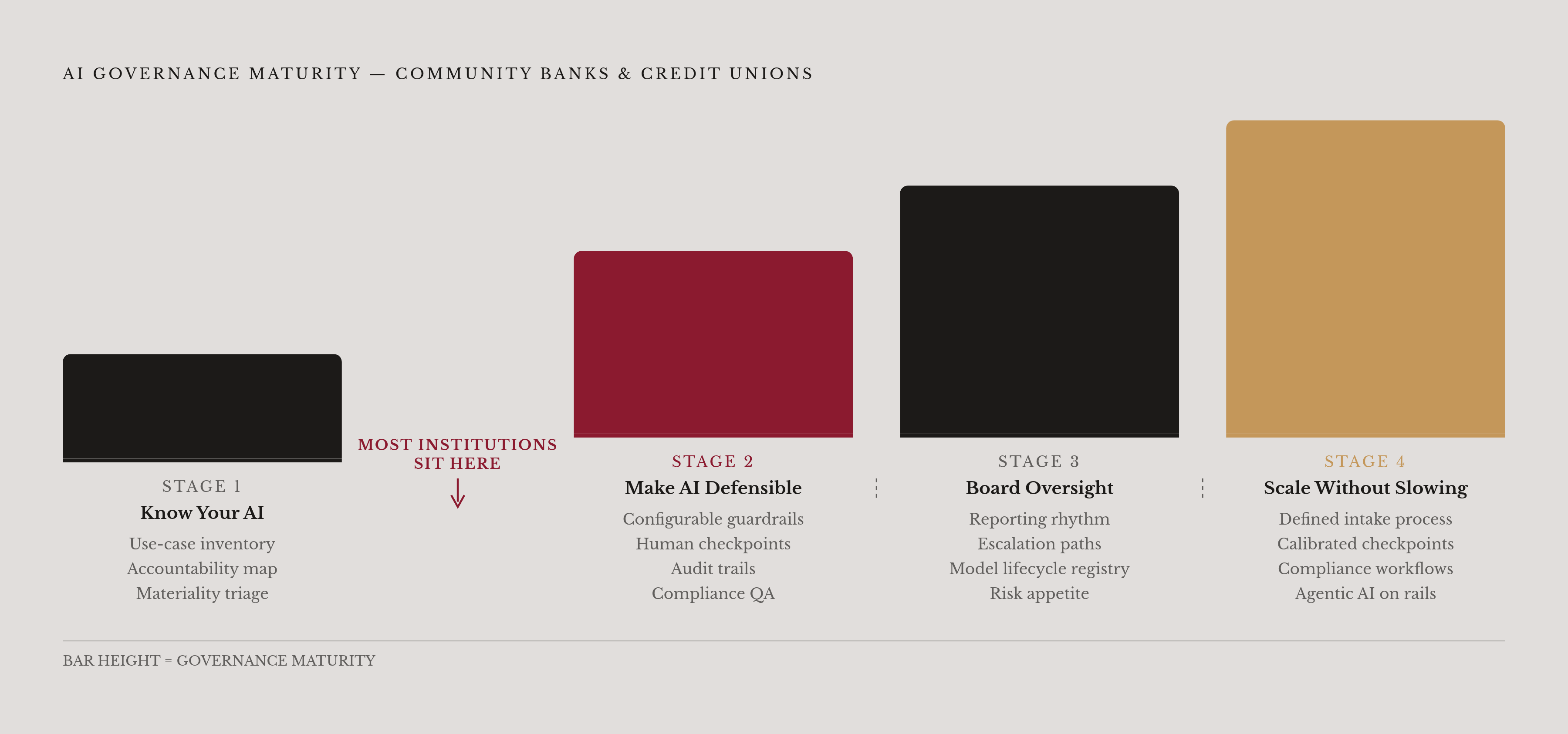
Stage one — knowing what AI the institution actually has and who owns it
The most common governance failure isn't a bad policy. It's the absence of any record, anywhere, of what AI is actually running, where it's running, and who's responsible for it. Ask five people at a mid-size community bank to name every AI tool in use across the institution, and you'll usually get five different, incomplete answers.
Shadow AI makes this worse. Tools adopted outside formal channels are invisible to governance until something breaks and someone has to explain what happened.
Stage one comes down to three deliverables. A use-case inventory: every AI application in production or pilot, named, tied to a business unit, a vendor, and a deployment date. An accountability map: a named person, not a department, responsible for each application's behavior and its risks. And a materiality triage: which of these tools touch credit decisions, payments, member data, or compliance workflows, since those need deeper governance in the stages ahead.
None of this is a one-time exercise. The inventory needs a refresh schedule and an owner who keeps it current as new tools show up, because they will keep showing up, and skipping this stage means everything built afterward sits on a shaky foundation. It's worth saying too: the ICBA's AI Governance Policy template gives community banks a real starting point for the accountability layer, without needing custom legal work from a blank page.
Stage two — building the controls layer that makes AI actions defensible
Once you know what AI you have, the next question is whether you can actually constrain it, watch it, and correct it while it's running, not after the fact.
For agentic AI, this isn't optional architecture. It's the line between automation and accountability. A system that initiates payments or flags transactions without a controls layer underneath it isn't governed — it's just fast.
Four things belong here. Configurable guardrails: thresholds and rules that limit AI behavior without needing an engineer to rewrite code, so operations and compliance staff can adjust them directly. Human checkpoints: defined transaction types or risk levels that trigger a person's review before the action goes through. Audit trails: full, unchangeable records of what the AI did, when, under whose authorization, and on what data, which becomes the backbone of both internal review and any conversation with an examiner. And automated compliance QA: catching policy violations, missing disclosures, or bad outputs before they reach a member.
Fraud detection makes this argument concrete. The Financial Brand's September 2025 survey found 56% of banking executives report high capability in fraud detection and 51% in security, some of the highest-rated AI use cases in banking. But capability without configurable thresholds is just a risk sitting there, waiting.
The same survey found 95% of executives believe AI can advise and 92% believe it can assist, but only 38% believe today's technology is ready for full autonomy. That 62% gap is exactly what the controls layer is for, turning "we trust AI to help" into an actual operating rule, instead of a hope.
SOC 2 certification is worth calling out here too. When evaluating a vendor or platform, it's a real signal the controls layer has been checked by someone outside the building, not a line on a sales deck.
Stage three — embedding governance into risk management and board oversight
Stage two gets you controls. Stage three is the shift from "we have controls" to "our board can talk about AI risk the same way it talks about credit risk or liquidity risk," and that's a different conversation that a lot of institutions haven't had yet.
CCG Catalyst's analysis is blunt about this: AI governance is a board responsibility now, not a future one. Institutions treating it as a 2027 problem in 2025 are finding out it's a 2026 problem instead.
What does board-level oversight actually require? A regular reporting rhythm, so the board sees AI risk on a schedule that matches how it sees other enterprise risks. Clear escalation paths, so everyone knows when an AI incident or a compliance flag needs to move from operations up to senior management and then the board. Policy ownership, meaning the board formally signs off on the AI governance policy and sets how often it gets reviewed, treating it as a living document rather than something filed away. And a stated risk appetite: which AI use cases the institution is comfortable with, and which ones need extra sign-off, especially anything agentic that's actually moving money.
Model lifecycle management belongs here too. Not just a list of what's deployed, but a registry showing where each model sits, in development, validation, production, or retirement, and who owns each handoff between those stages.
Here's the honest part: this is where most community institutions currently sit, stuck between stage two and stage three. They've got controls on individual tools, but what they don't have is a single view of AI risk that actually reaches the board table.
Stage four — scaling AI operations with governance that doesn't slow down the institution
There's a fear that runs through every early conversation about AI governance: won't all this slow things down? At stage four, institutions find governance is what lets AI scale, because trust has been built and exceptions have become rare instead of routine.
At this point, governance stops being a layer bolted on top of operations and becomes part of how the institution runs. New AI deployments go through a defined intake process, materiality assessment, risk classification, controls assigned, before anything launches. Audit trails feed straight into existing compliance and exam workflows instead of getting stitched together by hand each time. Human checkpoint thresholds get calibrated over time using actual incident data, easing up on low-risk actions while keeping oversight tight where it matters.
The practical model here is agentic AI running on top of existing banking rails, not replacing them. Payments, transfers, account operations, all executing through the systems already in place, with AI handling orchestration and automation while the audit trail underneath makes the whole thing defensible.
ISO 20022 matters at this stage too. Its structured data format improves fraud management and cuts down manual review, and institutions that have migrated to it are simply better positioned for AI-orchestrated payment workflows than those still running older formats.
Emerging analysis of agentic AI in payments shows what stage-four capability looks like when it's working: AI agents handling the full payment chain, initiation, routing, compliance checks, settlement monitoring, with governance supplying the audit trail that makes the whole chain defensible to a regulator. Credit unions are closing ground here too, with agentic platforms now serving large parts of the credit union market for member-service automation and back-office work.
One more thing worth sitting with at this stage: as agentic AI runs across many institutions at once, correlated responses to the same market event become a new kind of risk. S&P Global's 2025 analysis flags this as an emerging concern, one that mature governance frameworks will need to account for as more of the industry reaches this stage together.
Where most community institutions actually are on this progression — and the honest path forward
Most community banks and credit unions sit in the gap between stage one and stage two. Some AI is running, accountability is informal, maybe a name attached to a project, nothing more, and there's no enterprise-level framework connecting whatever controls exist to actual board oversight.
McKinsey's finding that roughly a third of organizations report mature governance means two-thirds are somewhere in the early or middle stages, and community institutions, working with tighter budgets and smaller teams, tend to sit toward the earlier end of that range.
The stakes aren't abstract. CSI's 2026 survey found 68% of community banking leaders expect AI-driven fraud to increase significantly over the next five years, and AI-enhanced social engineering came up as the top cybersecurity worry. Governance maturity isn't a separate track from fraud response; it's the same track. An institution that can't account for its own AI has a harder time defending against AI being used against it.
So what's the honest next step? Finishing stage one, all the way through, because that's what makes stage two possible in the first place, rather than jumping ahead to stage four. An incomplete inventory means nobody can actually verify controls cover what needs covering. Unclear ownership means board reporting comes out garbled, half-formed, missing the names that matter. Get the foundation right first, and everything after that gets easier, not harder.