NACHA Operating Rules Compliance for AI-Initiated ACH Entries
AI agents must prove authorization and leave audit trails to meet NACHA's 2026 fraud rules.

I've sat through enough ACH compliance reviews to know where people's eyes glaze over, so let's skip past the throat-clearing. NACHA Operating Rules set legal duties for everyone in the network: ODFIs, RDFIs, Originators, Third-Party Service Providers, Third-Party Senders. The rulebook covers formatting specs, entry descriptions, return reason codes, audit requirements, and a set of enforcement appendices that give it real teeth, not just guidance that sits on a shelf.
Authorization is the center of gravity. An Originator needs valid, verifiable authorization from the account holder before submitting an entry, and that duty doesn't get lighter just because an algorithm is doing the submitting instead of a person at a desk.
Standard Entry Class codes stack another layer on top. Each SEC code carries its own rules on authorization, formatting, and fraud monitoring. WEB debits have drawn tighter scrutiny for years compared to other entry types, and Company Entry Descriptions matter beyond mere convenience. NACHA's newer standardization rules require terms like "PAYROLL" and "PURCHASE" to mean the same thing everywhere, so RDFIs get a clean signal when they're screening inbound credits for anything off.
Once a year, every participant sits down and formally reviews its ACH compliance process. Sounds simple on paper, but it gets a lot harder to defend when there's no paper trail behind it. That gap is exactly what AI-driven origination is about to expose if institutions don't get ahead of it.
The 2026 fraud monitoring rule change that resets the compliance bar for every originator
The old standard, "commercially reasonable," is gone. NACHA replaced it with "risk-based processes and procedures," tailored to an institution's role, its volume, its own risk profile. That's a real jump in what's expected, and what counts as enough looks different at a credit union than at a top-20 bank.
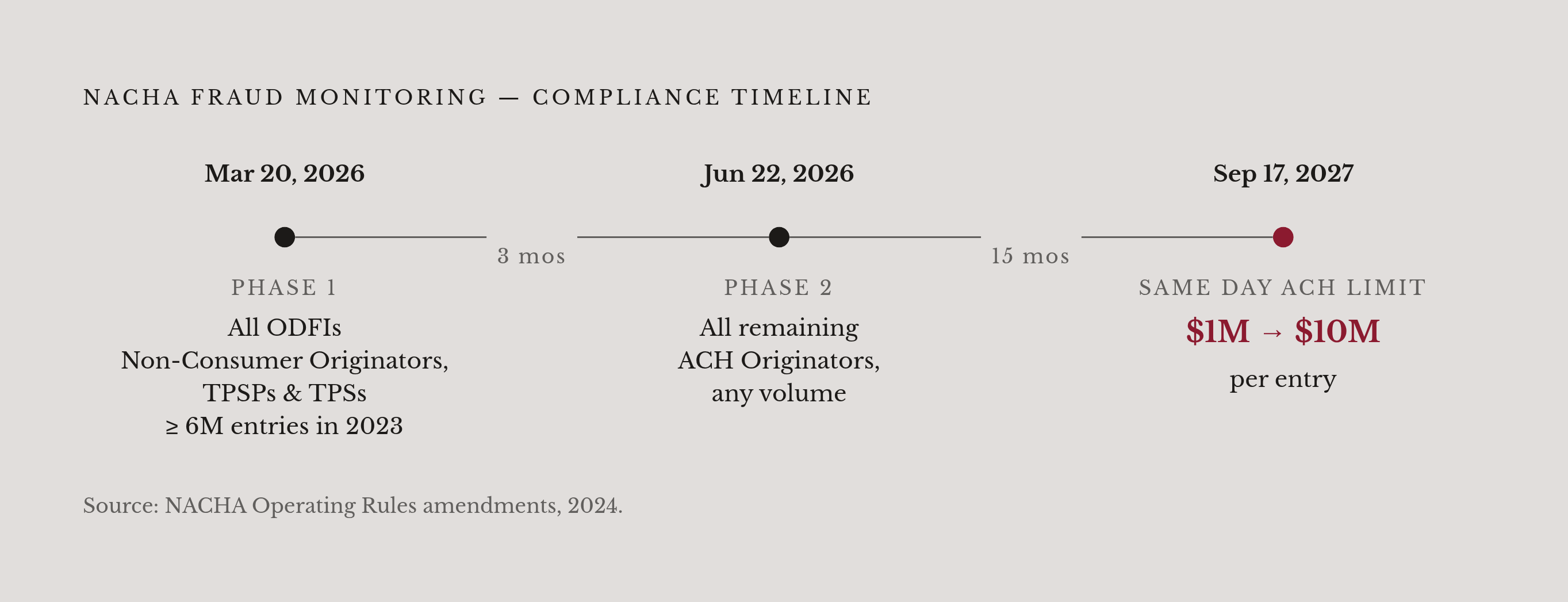
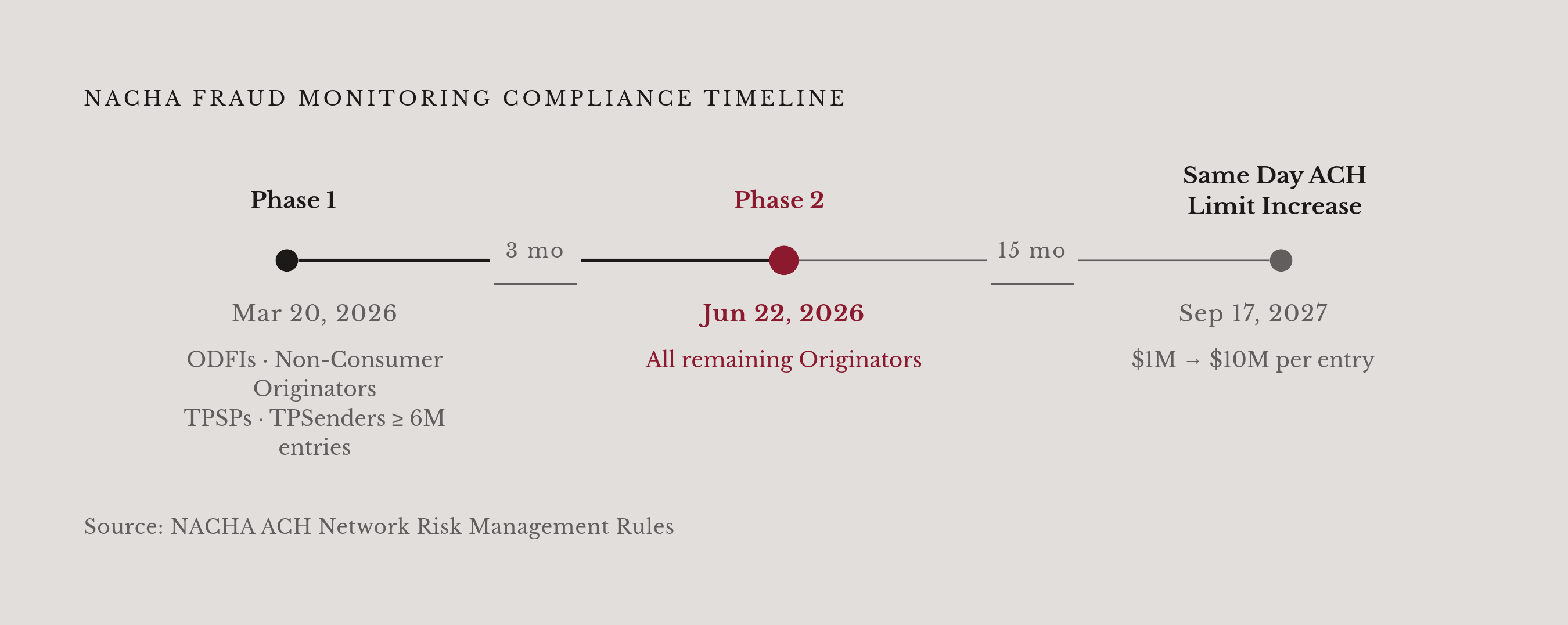
Two phases carry the rollout. Phase 1 lands March 20, 2026, and covers all ODFIs, plus non-Consumer Originators, Third-Party Service Providers, and Third-Party Senders that originated 6 million or more ACH entries in 2023. Phase 2 hits June 22, 2026, and picks up everyone else. By that date, every ACH Originator falls under the new standard, regardless of size, and no one gets to sit this one out.
RDFIs get a new job too. Receiving institutions now have to run risk-based monitoring on inbound ACH credit entries that look fraud-initiated, so both sides of a transaction carry active watch duty now, not just the side sending the money.
The definition of fraud itself got wider as of March 20, 2026. It now covers payments authorized under false pretenses, so social engineering scams count as fraud under the rule. For the first time, originating and receiving institutions share responsibility for catching that kind of scheme, right alongside outright unauthorized transactions.
Why the urgency? FBI IC3 data from 2024 put cyber-enabled fraud losses at $16.6 billion, with 38 percent of those losses moving through ACH or wire. That's the number that pushed NACHA off a passive standard and onto an active one. NACHA also doesn't let anyone set a policy once and walk away: fraud monitoring procedures need a formal review and update at least once a year. A policy written once, filed, and forgotten no longer clears the bar.
Why these rule changes compound in complexity when an AI agent is the originating party
None of what I've covered so far mentions AI by name. The rules apply no matter who, or what, initiates the entry. But drop an AI agent into the origination process, and each requirement gets harder to satisfy cleanly. Why does that happen?
Start with authorization. NACHA wants a clear, traceable line between what the account holder actually agreed to and what got submitted. When an AI agent interprets a voice command or a text message and turns that into an ACH entry, that chain of consent still has to hold up. Who verified what the customer really asked for? What happens if the agent read the intent slightly wrong? The audit trail has to answer both questions convincingly, not just plausibly.
Identity checks hit a similar wall. Traditional KYC and multifactor authentication assume a human sitting there, approving one transaction at a time, and an autonomous agent acting under delegated authority doesn't fit that mold at all. Regulators are starting to ask whether AI agents initiating financial transactions need their own verifiable identities tied to a legal entity, something closer to Know-Your-Agent than Know-Your-Customer. NACHA didn't write its rules with that question in mind, but the underlying logic (prove who's acting, and on whose authority) still holds.
The IMF floated a structural fix in 2026: split the system into two layers. A decision layer where the agent proposes or initiates an action, and a separate, deterministic execution layer that runs compliance checks before anything actually goes out. Agent actions get tied to cryptographically verifiable mandates spelling out scope, dollar limits, permitted conditions. Clean idea on paper, and worth watching as institutions figure out how to actually build it.
A stubborn technical wrinkle sits underneath all this: non-determinism. Generative AI models can produce different outputs from similar inputs, run to run. Fine for drafting an email, but much harder to defend when a NACHA auditor asks why a specific entry got initiated, or why one entry got flagged while a nearly identical one sailed through. You need a real answer for that. "The model just did that sometimes" isn't one, and no examiner is going to accept it as one either.
The stakes are also about to get a lot bigger. Same Day ACH's per-entry dollar limit jumps to $10 million starting September 17, 2027, up from the current $1 million cap. An AI agent that misreads authorization or misroutes one high-value entry under that new ceiling creates exposure an order of magnitude larger than anything possible under the old limit.
What "risk-based processes and procedures" must look like in practice for AI-initiated ACH
Risk segmentation is the floor NACHA's new standard stands on. Monitoring has to fit the institution's actual role, volume, and mix of payment types, calibrated to that specific profile rather than borrowed wholesale from whatever the bank down the street runs.
A large originator, one clearing the 6 million entry threshold, probably needs baseline behavioral profiles for each originator and transaction type, anomaly detection tuned for spikes or shifts in pattern, and controls calibrated to specific SEC codes and entry descriptions. A PAYROLL entry and a PURCHASE entry carry very different risk profiles, and the monitoring should treat them that way instead of lumping them together into one generic bucket.
Community banks and credit unions, most of which land under Phase 2 instead of Phase 1, don't need to match that scale of tooling. NACHA's own intent here is worth pausing on: the ask centers on intentional, repeatable process and clear documentation, something achievable without exotic infrastructure. A smaller institution needs to know what normal looks like for its own originator base, and have a defined process for what happens the moment something deviates from it.
Exception handling deserves its own line of attention. What actually happens when an AI agent flags a suspicious entry? Who gets the alert? Under what conditions does a human step in? Those questions need documented answers sitting on file, not assumptions everyone hopes are shared but nobody's ever written down.
Return reason codes carry more weight than they used to. Expanded use of R17, effective October 2024, and R06, effective April 2025, give institutions sharper tools for rejecting suspected fraud entries. If an AI agent is going to act on those codes, it has to interpret them correctly, which sounds obvious until you think about how often return code logic gets bolted onto some legacy system as an afterthought.
None of this holds up without clean data. If vendor records or banking data are inconsistent or stale, an AI model will either miss real anomalies or throw false alerts nonstop, and neither outcome builds trust in the system. Data quality is a compliance input here, not a side concern.
Governance needs graduated intervention too, not one big kill switch. Layered controls that contain a problem locally, without shutting the whole system down, while keeping the audit trail intact, mark the difference between mature governance design and a panic button bolted on after something already went wrong.
The audit trail obligation and why AI-initiated entries must generate more documentation, not less
NACHA's annual review mandate asks institutions to show fraud monitoring got evaluated and updated, not just claim it happened. For an AI system, that means documented model behavior: actual records, not a summary someone wrote from memory a week before the deadline.
Every validation step in an AI-initiated ACH workflow should get logged automatically: timestamps, source data, the logic behind each decision. Compliance evidence becomes something you pull up on a screen, not something you scramble to reconstruct the night before an exam.
The three-lines-of-defense model still applies here, just mapped onto AI. The first line is the business and operations team that owns the AI's configuration; they own the risk that comes with it. The second line, risk and compliance, checks whether the AI's controls actually work as designed and reviews how exceptions get handled. The third line, internal audit, independently verifies the first two are doing their jobs and that the documentation clears the regulatory bar.
Every model touching ACH origination, no exceptions, belongs in a centralized model inventory with version history and performance records attached. A static annual review doesn't cut it for a system that can drift in behavior between formal check-ins. Real-time alerts need to fire the moment a model starts acting outside expected parameters, instead of waiting for the next scheduled review to surface the problem months later.
Human oversight carries real regulatory weight here too, beyond being a comforting talking point on a slide. The EU AI Act, under Article 14, and the NIST AI Risk Management Framework both call for human oversight that's trained, measurable, and provable for high-risk systems. That means an auditable process you can walk an examiner through step by step, not a bullet point buried in a deck nobody reads twice.
The audit trail is what makes a compliance claim believable to an examiner sitting across the table from you. Institutions treating it as something that falls out of the process on its own, rather than something they design on purpose from day one, are going to struggle proving risk-based compliance once the new standard fully takes hold.
How institutions of different sizes should calibrate AI-initiated ACH governance to the rules
NACHA built the phased rollout because ACH fraud doesn't look the same at a regional bank as it does at a mid-size credit union, and the compliance framework accounts for that difference. The institutions applying it should too.
Large banks and high-volume originators, those above the 6 million entry mark, are already under Phase 1 as of March 20, 2026. At this scale, AI-initiated ACH justifies real investment: behavioral monitoring running live, automated return code analysis, ongoing tracking of model performance over time. Early deployments of agentic AI in financial operations have cut manual workloads by 30 to 50 percent, according to McKinsey research. The efficiency gain is real at that scale, so the compliance infrastructure needed to keep it in check has to be just as real. In 2025, 50 of the world's largest banks announced more than 160 agentic AI use cases between them. AI-initiated ACH has moved well past the fringe pilot stage at this tier; it's operational infrastructure now.
Community banks and credit unions face Phase 2, effective June 22, 2026. NACHA's intent for this group is spelled out plainly: intentional, repeatable process and clear documentation, scaled well below the tooling stack a money-center bank runs. For a smaller institution, "risk-based" means knowing its own originator population, writing down what normal activity actually looks like, and having a clear escalation process for when an AI agent raises a flag. Credit union delinquency data gives a sense of the pressure driving adoption here: overall delinquency sat at 95 basis points in the third quarter of 2025, with 30 to 59 day delinquencies at 1.13 percent that September. That's real operational strain, and it's part of why agentic tools are showing up at smaller institutions now too, not only at the top of the market.
Vendors and Third-Party Service Providers don't get to sit outside this conversation either. Phase 1 already applies to TPSPs above the volume threshold, so any fintech initiating ACH entries on behalf of bank clients is directly in scope. AI governance is a shared responsibility here, not one the bank carries alone. Institutions need to understand what their vendors' AI systems are actually doing under the hood, and whether those systems produce the documentation NACHA now requires.
That raises a practical question for anyone evaluating a platform: does the vendor's system generate auditable records by default? Can controls be configured by institution type? Does it run on the banking rails already in place, or does it demand a rebuild just to get off the ground? Platforms built specifically for financial institutions, carrying SOC 2 certification and plugging into rails banks already use, tend to answer those questions out of the box better than general-purpose AI tools retrofitted after the fact for banking.
The compliance monitoring loop that keeps AI-initiated ACH defensible as rules continue to evolve
NACHA's rule changes aren't a one-and-done event. The 2024 to 2026 cycle alone brings a wider fraud definition, new entry description standards, updated return codes, broader RDFI obligations, and the coming jump in Same Day ACH's dollar limit to $10 million in 2027. The compliance surface keeps expanding, and nothing suggests it stops growing once Phase 2 lands.
That's exactly why real-time compliance monitoring matters more than periodic review at this point. AI agents can flag potential NACHA violations, OFAC concerns, or suspicious activity the moment it happens, working more like a compliance co-pilot sitting next to the origination process as it runs than an end-of-day report someone reads over coffee. Real-time decisioning is already replacing batch review in early AML and fraud deployments, and the same architecture carries over directly to ACH-specific monitoring.
Picture the loop running in practice. An AI agent screens or initiates entries against current rule parameters as they're submitted. Exceptions get flagged, escalated, and logged automatically, with the full decision logic attached rather than a vague note scrawled after the fact. Human attention shifts toward interpretation and governance instead of manually reviewing routine transactions one at a time, not unlike how multi-agent copilot systems are already showing up in credit operations. Come annual review time, the institution isn't reconstructing a year of activity from scattered notes; it has a year of automatically generated records sitting there to draw on. Between formal reviews, the system keeps watching itself, and alerts fire the moment a model's performance starts to drift or its patterns shift somewhere unexpected.
The fraud side of this equation isn't standing still while institutions get their systems in order, and that's worth sitting with. FBI IC3 data points to AI enabling more convincing social engineering and account takeover attempts by the day. The same technology making AI-initiated ACH possible is being turned against it, which is exactly why NACHA moved toward a risk-based, annually reviewed standard instead of a fixed checklist that fraudsters would eventually map out and exploit.
Institutions treating NACHA compliance for AI as a box checked once during deployment are going to fall behind the rule cycle instead of keeping pace with it. The ones building a living governance loop, configurable controls paired with continuous monitoring, documented escalation paths, annual reviews backed by automated records, will absorb whatever NACHA amends next without scrambling to catch up. Adoption of AI across financial services is already wide: 81 percent of firms have adopted it at some level, with 40 percent at advanced stages of deployment. The real question left standing is whether the governance wrapped around AI agents actually meets the standard NACHA has now set, as those agents initiate ACH entries at growing scale.