NCUA Regulatory Expectations for AI Deployment in Credit Unions
Credit unions face examination scrutiny on AI governance whether formal rules exist or not.

A January 2025 GAO report, GAO-25-107197, found NCUA missing two tools that other banking regulators already have: real model risk management guidance and direct authority to examine third-party AI vendors. GAO told NCUA to fix both.
This matters now, not in some future version of NCUA. Staff looked at a model-risk-only approach and decided it doesn't cover every AI use case a credit union might run, and a binding requirement would need formal rulemaking. As of mid-2026, that rulemaking still hasn't happened.
So there's no binding AI-specific rule on the books, and that absence is easy to misread as a lack of scrutiny. That reading doesn't hold up, because when a regulator can't examine your vendor directly, the pressure doesn't disappear; it just moves. Examiners lean harder on the vendor management and risk rules that already apply, because those are the only levers they have. Any credit union treating the absence of a rule as a green light is misreading what GAO's findings actually signal. The practical result is more scrutiny, not less.
What examiners will actually look at: the four domains NCUA's guidance points to
NCUA's published guidance and its 2026 supervisory priorities point examiner attention at four places.
Board oversight. A written policy on AI use, governance, and risk tolerance is expected, with a governance update to the board at least once a year. Incident response plans need to cover AI-specific scenarios: a biased decision discovered after the fact, an AI system outage, data exposure, member complaints tied to an AI interaction.
Vendor due diligence. NCUA's AI resource hub links straight to existing third-party guidance, letters 07-CU-13 and 01-CU-20. The message is blunt: a vendor's AI tool carries the same accountability as anything built in-house. Due diligence, ongoing monitoring, and SLAs covering accuracy, update cadence, security controls, and contingency planning are all part of what's expected.
Regulatory compliance by use case. BSA/AML, fair lending under ECOA and FCRA, and data privacy obligations attach to AI the same way they attach to any other process. Wrapping a decision in a model doesn't change what the law requires of it.
Model risk management and ongoing monitoring. Quarterly reviews of AI systems and vendor disclosures show up as documented best practice in NCUA-aligned guidance. Even without a formal rule, examiners want proof the institution understands what its models actually do.
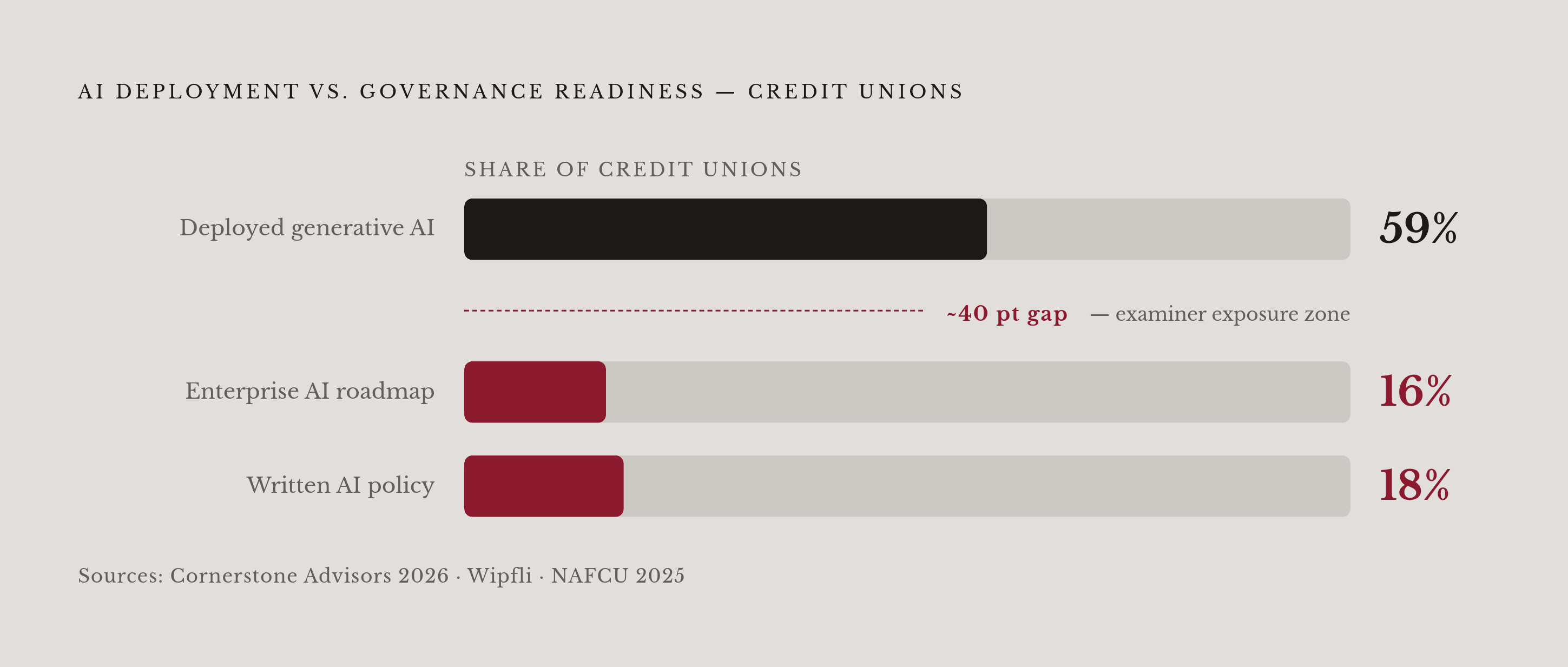
The three-lines-of-defense structure still organizes all of this: the business line owns the risk, risk management watches the controls, and internal audit checks independently. A 2025 NAFCU survey found only 18% of credit unions have a written AI policy. That's not a rounding error; it means board oversight is missing at the vast majority of institutions already running AI in production.
The vendor accountability trap: why "the vendor's model did it" is not an accepted answer
Here's the principle that trips people up: the credit union owns the risk no matter where the model runs. Buying AI from a vendor doesn't transfer regulatory liability, and it never did. Treating a vendor contract as a liability shield is the single most common mistake showing up in exam findings, and it deserves to be named plainly. If a vendor's model produces a bad outcome, the exam finding lands on the credit union's desk, not the vendor's.
So what does an examiner actually want to see on paper? Proof the institution understood what the AI does before it went live, boundaries and configurable controls the institution set itself and can explain in plain language, monitoring that catches drift, bias, or failure as it happens, and SLAs covering accuracy, updates, security, and what happens if the vendor relationship ends.
GAO found NCUA can't examine third-party AI providers directly, so the documentation burden lands on the credit union's own files. Examiners weigh what the institution kept on record more heavily than anything a vendor claims in a sales deck.
Agentic AI raises the stakes further. Picture an AI agent that starts a payment, updates an account flag, and fires off a member notification, all in one sequence, with no human touching any of the three steps. An examiner needs an audit trail that makes each step in that chain clear on its own, with a stated reason behind each decision.
Institutions running AI on their existing core banking rails have a real edge here, since the core system's audit and control setup can stretch to cover AI-driven actions too. That edge only holds if the AI vendor is actually built to work inside those existing controls, instead of routing around them. A vendor that bypasses the core to move faster is handing the credit union a harder exam.
Fair lending and BSA/AML: the compliance obligations AI touches most directly in credit union operations
Fair lending first. Any AI touching underwriting, pricing, or member-facing decisions falls under ECOA and FCRA, full stop, no matter what's happening inside the model. NCUA names algorithmic opacity as a specific risk: a model producing disparate impact with no explainable reason carries fair lending consequences well past a technical glitch. Adverse action notices require a reason a person can understand, and "the algorithm said no" doesn't clear that bar. Regular bias testing and demographic impact analysis need a permanent seat in the monitoring cadence, not a one-time check at launch.
BSA/AML runs on similar logic. AI-assisted transaction monitoring is already live at credit unions, and examiner expectations here are well worn. The model still needs validation: what does it flag, what does it miss, and can compliance staff explain and defend the thresholds it's using? SAR decisions need documentation showing a human reviewed and approved the filing, and payment automation tools, covering transfers, real-time payments, account-to-account movement, need BSA screening built into the process from the start, not bolted on after.
Both domains land on the same requirement: a human sits at the decision point that carries regulatory weight, and that oversight gets written down somewhere an examiner can find it.
Cybersecurity requirements that apply specifically to AI systems, not just general IT controls
NCUA's AI resource hub calls out security challenges that go past standard IT controls: protecting model weights, securing API implementations, keeping continuous monitoring running. Financial institutions remain a prime target for AI-powered cyberattacks, and credit unions of any size sit inside that target zone.
A few attack surfaces worth naming directly: model inversion or extraction attacks that pull training data back out, including data that may include member information; prompt injection or adversarial inputs that push an AI agent to behave in ways it shouldn't; and API endpoints that connect the AI system into core banking infrastructure. Each one is a potential doorway in, and each one needs its own answer, not a shared shrug.
NCUA's own internal AI Compliance Plan requires the ability to shut a non-compliant AI system down fast, and credit unions should build the same muscle: clear escalation paths, fallback procedures, a plan for the moment an AI system misbehaves. CISA's secure deployment guidelines, linked right from NCUA's resource hub, give IT teams a practical starting checklist. One figure from a 2025 report is worth sitting with: 63% of breached organizations had no AI governance policy in place. Governance gaps and security incidents track together, and that's not a coincidence, that's cause and effect.
What responsible AI deployment looks like in practice: the governance behaviors examiners want to see documented
Start with an inventory covering every AI system in use, including what it's for, its risk classification, and who owns it. This mirrors what NCUA requires of itself internally, which is a decent sign it's the right bar to clear.
Building outward from there, a written AI policy the board has actually approved should cover governance structure, risk tolerance, prohibited uses, and escalation steps. The 18% of credit unions that already have this are ahead of the curve before an examiner walks in the door. Add documented pre-deployment review for each system: vendor or internal assessments, bias testing results, a clear answer to which regulatory frameworks apply. Then a monitoring rhythm: quarterly reviews of performance and vendor disclosures, annual board reporting on governance status.
Audit trails need specific attention for anything agentic. Whenever an AI agent carries out a transaction or makes a decision touching a member, the record needs to show what it did, on what basis, and that a human with real authority had visibility and could step in before it went wrong.
Incident response plans need to stretch past outages. A biased decision found after deployment, a data exposure through an AI interface, and a member-facing error from an automated interaction all belong in that plan, not as afterthoughts.
Platforms built on existing banking rails, with configurable controls, full audit trails, and a human in the loop by design, cover most of this by construction rather than by policy memo. That distinction matters, especially given that Cornerstone Advisors' 2026 survey found 59% of credit unions have already deployed generative AI, while Wipfli found only 16% have an enterprise-wide AI roadmap. That gap, between what's live and what's actually governed, is exactly where examiner exposure sits.
How to read NCUA's signals going forward: what the current trajectory suggests about near-term supervisory evolution
GAO's two recommendations, model risk guidance and third-party examination authority, are still active policy items. Build a governance program that would hold up under both, whether or not NCUA ever turns them into a formal rule. Waiting for the rule before doing the work gets the sequence backward: the rule is likely to just write down what good practice already looks like.
NCUA's alignment with the NIST AI Risk Management Framework is a useful tell. If future guidance takes shape, it will probably follow NIST's four functions: Govern, Map, Measure, Manage. Institutions already organized around that structure have a shorter road to whatever comes next.
Worth noting too: regulators in other jurisdictions have begun moving toward explicit human-oversight requirements for AI-driven credit and account decisions. These aren't U.S. rules, but they point at where regulatory thinking seems to be headed more broadly, since regulators tend to watch each other closely.
NCUA hiring three AI officers and publishing its own internal AI Compliance Plan says something plain: the regulator is building AI know-how on its own side of the table. Examiners will get faster at spotting good governance when they see it, and just as fast at spotting its absence.
So what's the actual move for credit union leadership? Build the governance work now: written policy, documented monitoring, vendor accountability, audit trails that hold up under scrutiny. Don't wait on a formal rule to set the floor; by the time it lands, the credit unions still catching up will be the ones examiners remember. Agentic AI that executes real transactions, payments, transfers, account actions, sits at the top of examiner attention for a reason. Deployed with full auditability and controls the institution actually configured and understands, that same category can also become the clearest proof that AI and accountability run well together, on the same rails.