FinCEN Recordkeeping Rules for AI-Initiated Wire Transfers
Banks must verify human identity before AI executes wire transfers.
FinCEN's recordkeeping rules and Travel Rule obligations don't care whether a human or a machine pushed the button on a wire transfer. Every field that must be collected, every record that must be kept, every piece of data that has to travel with the payment order still applies when an AI agent is the one initiating or processing the transaction. The obligation stays fixed; the burden shifts to proving you met it, when the party doing the collecting is software, not a teller.
That's the gap this piece walks through.
The "true name" rule and why it matters more when no human touches the transaction
The Travel Rule has always banned coded names and pseudonyms as originator identifiers. Abbreviated names are fine, DBA names and trade names are fine, but the bank has to know, and record, who the real person is behind the transfer.
There's a related rule for joint accounts that's easy to miss but tells you everything about how the regulation thinks: if a transfer comes out of a joint account, the person who's identified is whichever account holder actually gave the order, not the account itself. The account is a container. The order came from a person, and that person's name goes in the originator field.
In a normal wire, this happens without anyone thinking hard about it. The bank's system pulls the originator's name and address from the customer record the second the order is entered, because getting that name right is one of the most closely watched controls in the whole compliance stack. Nobody's improvising it at the counter.
Now put an AI agent in the loop. Say the agent executes a transfer because of an instruction given three days earlier, or because a scheduled rule fired, or because the agent made an autonomous call based on conditions it was told to watch. The system still populates the originator field from the customer record. But there's no human sitting there confirming that the name attached to this specific transfer is correct, at the moment it matters most.
Here's the point worth sitting with: the name that belongs in that field is the human principal's verified identity, never an agent ID, a session token, or a system label that says "automated transfer 4471." This isn't a new interpretation of the rule. It's the same true-name requirement that's existed for decades, and it just doesn't enforce itself anymore. Somebody has to design the system so it can't drift.
The definitional gap FinCEN has not closed: who is the "originator" when an AI agent executes
Go back to how this framework was built. A person shows up with a payment order, the bank collects that person's information, the bank sends it down the chain. Every rule assumes a human is standing at the start of that chain, saying "move this money."
An AI agent breaks that assumption in a way FinCEN hasn't directly addressed. Ask yourself: when an agent executes a transfer, who's the originator? There are three plausible answers.
It could be the human who told the agent to do this, maybe hours or weeks before the transfer actually fires. It could be the AI system itself, since it's the one generating the payment order right at execution. Or it could be the bank, since it's the bank's agent acting on the customer's behalf. FinCEN has not issued guidance picking one of these. That's the load-bearing question the rest of the compliance chain depends on, and it's still open.
Working from the joint account logic, though, there's a defensible answer: the human principal is always the originator. The AI is the mechanism, not the party who ordered the transfer, in the same way the joint account itself isn't the party who ordered the transfer. If that's right, originator identity gets resolved the moment the customer instructs the agent, not the moment the agent executes. Which means that identity data has to be locked in and verified up front, then carried forward and attached to whatever payment order eventually comes out the other end. It can't be re-derived at execution time, because there's no human present then to catch an error.
Why does this actually bite? Agentic systems don't just fire one transfer and stop. They can run multi-step payment workflows on their own: pick a routing path, run a compliance check, watch settlement, adjust. Each one of those steps is a place where the link back to the original human instruction can get thin or drop entirely.
And there's a structural mismatch underneath all of this that's worth naming directly. AI models operate on probabilities; they weigh likely outcomes and pick the best one. Payment infrastructure, meanwhile, whether it's RTGS, card networks, or instant payment rails, runs on binary finality. Money moved or it didn't. A probabilistic system is inserting itself into a chain that demands legal certainty at the exact moment of settlement. That tension doesn't resolve itself. It has to be designed around.
What "collect and retain" means when the collecting agent is software
Under the existing rules, "collect" means the sending bank has to actually obtain the required information from the originator. That's straightforward when a person fills out a form. It's less straightforward when that "collection" happens through a conversational AI interface, spread across multiple sessions, days apart, with no single moment where a form gets signed.
The fields still required, though, don't change:
- Verified originator name, the real one, not a session ID
- Originator address on file
- Transfer amount as the human principal specified it
- Execution date, meaning the date the bank accepts the AI-generated payment order, not the date of the original instruction
- Payment instructions as received
- Beneficiary bank identification
- Beneficiary name, address, and account number, if the originator supplied them
The hard part is keeping the chain from collection to retention unbroken. If a customer gave instructions to an AI interface over voice or text last Tuesday, that information can't just sit in a conversation log somewhere while a separate, thinner record gets attached to the actual payment order on the day it executes. Those two things have to be formally tied together. One record, one transaction, fully linked.
Retention is five years from the date of the record, same as it's always been. That means the AI system's logs, its conversation history, its decision traces: all of it sits on the same five-year clock as a paper wire slip from 1998.
Most banks today keep identity verification, document processing, and agent decision logs in separate systems that don't talk to each other well. Stitching them into one chain that a regulator can pull up by a single transaction ID isn't something that happens by accident. It takes deliberate engineering, and it takes it before deployment, not after an exam finds the gap.
This is also where SR 11-7, the Fed's model risk management guidance, comes into play. Any AI model influencing a material compliance decision needs validation, documentation, and ongoing monitoring. An agent executing wire transfers is about as material as it gets.
The Travel Rule's transmission requirement applied to AI-generated payment orders
Collecting the information is half the job. The Travel Rule also requires the originator's bank to send that same information forward, in full, to the next institution in the chain, with no summary and no pointer to a database record somewhere. The whole set of fields, attached to the transmittal order itself.
When an AI agent generates that payment order, the order is the document of record. Whatever fields it's carrying at the moment it leaves the building are what the next bank in the chain gets to work with. There's no fixing it after the fact.
The rules do give some room on format. Information doesn't need to appear in any particular standardized layout, as long as every required field shows up somewhere. That flexibility is useful here, since an AI system's structured data output isn't going to look like a form filled out by a human teller. But flexibility on format is not the same as flexibility on completeness, and the burden is on the institution to check that every field is populated before the order goes out, not to discover a missing field during an audit six months later.
Intermediary banks carry their own version of this obligation. Whatever information they receive, they have to pass forward. It doesn't matter that the transfer originated from an AI agent instead of a person; the intermediary's job stays the same. But if the AI-generated order that reached them was incomplete to begin with, that gap doesn't stay contained. It travels with the transfer, all the way down the chain, and every bank that touches it afterward inherits the same hole in the record.
So the validation step, checking that required fields are all there, has to be built into the AI's execution workflow itself. Treating it as something compliance reviews after the fact is too late. By then the money's already moved.
FATF Recommendation 16 runs the same logic internationally. A bank processing a cross-border AI-initiated transfer isn't just meeting the U.S. Travel Rule; it's meeting FATF's parallel wire transfer standard at the same time, with the same underlying requirement to have originator and beneficiary data ready above the threshold.
The proposed threshold change for cross-border transfers and what it would require of AI systems
There's a proposal on the table from the Federal Reserve and FinCEN that would lower the threshold for international wire transfers from $3,000 down to $250. Domestic transfers would stay at $3,000. The stated reason is preserving information that law enforcement and national security investigators rely on.
The proposal has not landed quietly. It drew thousands of public comments, most of them opposed, and the American Bankers Association pushed back specifically on the idea of lowering a threshold that's been sitting at $3,000 since 1995. As of mid-2026, the rule still hasn't been finalized.
But consider what a $250 threshold would actually mean for AI-driven payment flows. Small, automated, cross-border payments, the kind an agentic system might process by the hundreds in a single day, would suddenly need full Travel Rule data collection and retention on nearly every single one. Right now, a lot of that volume slides under the $3,000 line and skips the heavier compliance lift. At $250, almost none of it would.
That's a real jump in per-transaction overhead for any bank building high-volume, low-value international payment automation. Retrofitting Travel Rule logic into a system that's already live and processing transactions is a much bigger job than designing it in from the start, so the sensible move is to build for it now rather than wait for finalization. Banks building agentic cross-border payment tools now should be architecting for the $250 threshold today, even with the rule still pending.
Enforcement exposure when AI-initiated transfers have incomplete records
FinCEN's civil penalty for a willful, continued violation of BSA recordkeeping requirements can run up to $219,156 per day. That's not per violation. That's per day the violation continues. And aggravated recordkeeping failures have, in the past, been referred for criminal prosecution. None of that history is specific to AI, but all of it applies fully once AI is the thing generating the records.
Here's where the exposure compounds in a way that's specific to agentic systems: a single misconfigured agent isn't going to produce one bad record. It's going to produce the same bad record over and over, dozens or hundreds of times a day, because that's what automation does. It repeats. A human clerk making a recurring error might generate a handful of bad transfers before someone notices. An agent running on a flawed rule can generate that same error at a scale no manual process ever could, and each instance is its own potential violation.
FinCEN's April 2025 proposal included language saying institutions that responsibly experiment with new technology "will not incur any additional risk of enforcement actions." That's about as close as the agency has come to giving AI compliance work a nod. But notice the qualifier: responsibly experimenting. That phrase is doing real work. It points to documented governance, not just the fact that a bank deployed an AI tool. The safe harbor, if you want to call it that, attaches to demonstrable controls, not to the technology itself.
The 2025 to 2026 FATF evaluation cycle is looking directly at this. Examiners are checking the quality and consistency of ongoing transaction monitoring, the accuracy of beneficial ownership identification, and whether institutions have real governance frameworks around AI-assisted compliance decisions. That means an exam isn't just going to ask whether the transfers cleared correctly. It's going to ask for the paper trail behind the AI model that helped decide they should clear.
Credit unions aren't exempt from any of this either. The NCUA has already published its own AI compliance plan and brought on dedicated AI officers for the 2025 to 2026 period. Same recordkeeping law, same examiner scrutiny, different regulator's letterhead.
The governance architecture that makes AI-initiated wire transfers auditable
Step back and the core principle is simple enough to say in one sentence: everything that applies to a human-initiated wire transfer applies, without modification, to an AI-initiated one. What changes is how the institution proves it did the work.
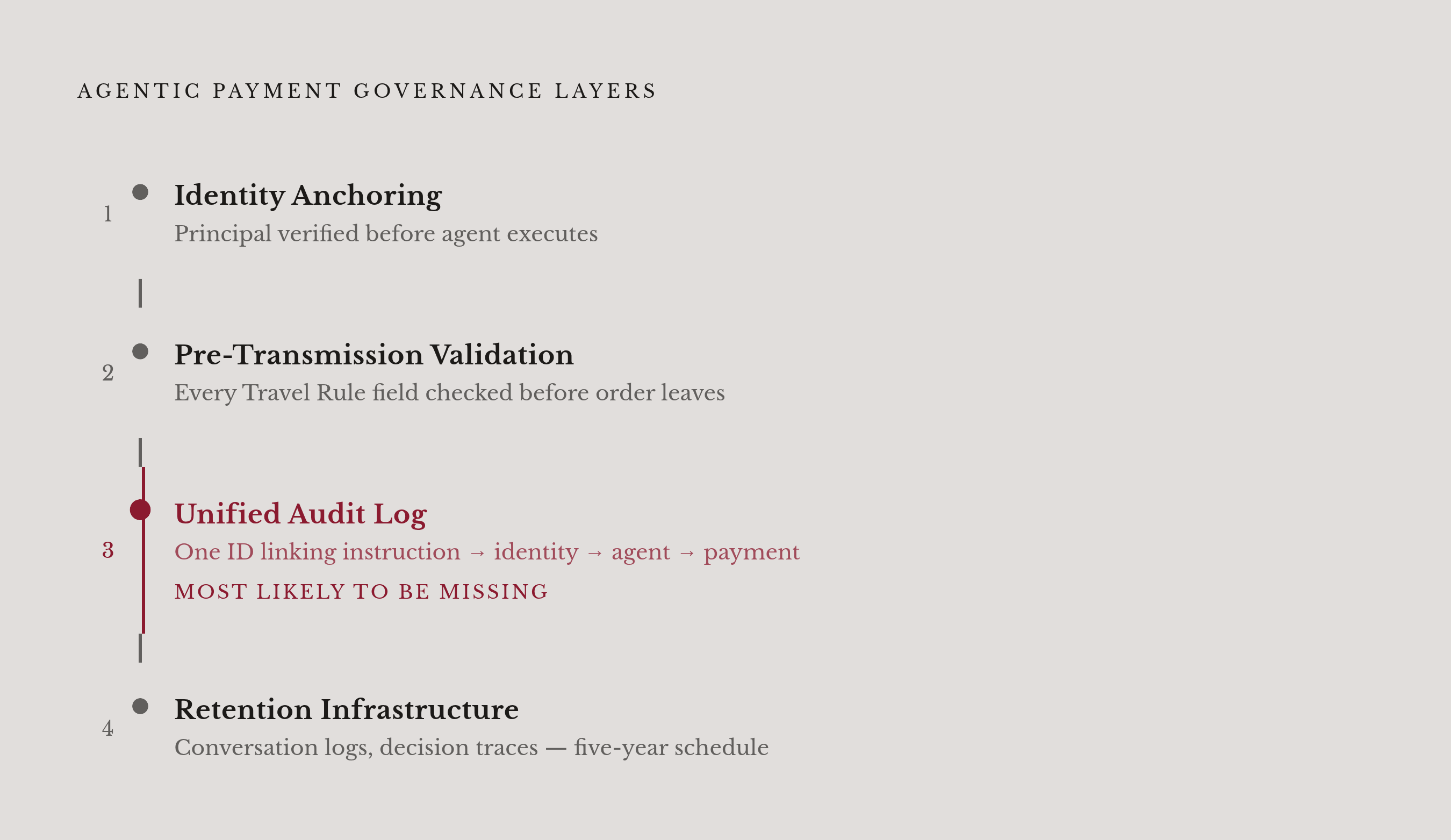
A compliant agentic payment system needs four things sitting underneath it.
First, identity anchoring. The human principal's verified identity gets resolved, locked, and attached to the payment instruction before the agent ever executes, not scrambled together at the moment of execution when nobody's there to check it.
Second, pre-transmission field validation. An automated check that confirms every required Travel Rule field is populated in the payment order before it leaves the bank. Not a spot check after the fact.
Third, a unified audit log. One record, tied to one transaction ID, that links the customer's original instruction, the identity verification, the agent's decision, the payment order it generated, and the transmission itself. If a regulator asks for the full history of a specific transfer, the answer should be one query away, not a scavenger hunt across four systems.
Fourth, retention infrastructure built to hold conversation logs, agent decision traces, and payment records on the same five-year schedule that's always applied to traditional wire documentation.
Layered on top of all four: SR 11-7 model risk management still applies. The model has to be validated, documented, and monitored on an ongoing basis, not deployed once and left to run. And at a baseline level, SOC 2 Type II certification and PCI DSS compliance are what tell you the controls around a given AI system have actually been tested by someone other than the vendor selling it.
The efficiency case for building this well is genuinely strong. Research from Oliver Wyman found that automating a large share of manual compliance work, up to 70% of it, can improve risk detection accuracy by as much as four times over. That's a meaningful number, but it only holds if the governance layer described above is actually in place first. Automation without the audit trail underneath it is faster exposure, not compliance.
The industry's already moving this direction regardless. Survey data from 2026 puts 78% of AML transaction monitoring teams either using AI agents already or actively planning to, with 71% expecting those agents to speed up alert resolution and cut down investigation backlogs. That trend isn't slowing down to wait for a compliance framework to catch up. It's worth asking, then, whether your institution's governance architecture is being built alongside the AI deployment, or after it.
One practical note for banks and credit unions weighing how to build this: deploying agentic execution on top of existing payment rails, rather than ripping out core infrastructure to make room for something new, keeps the audit history and operational controls that are already embedded in those rails intact. That's not a small advantage. It means the compliance build is about connecting new decision layers to systems that already know how to keep a record, rather than starting the whole recordkeeping problem over from zero.