API Tokenization Standards for Sensitive Banking Data in Transit
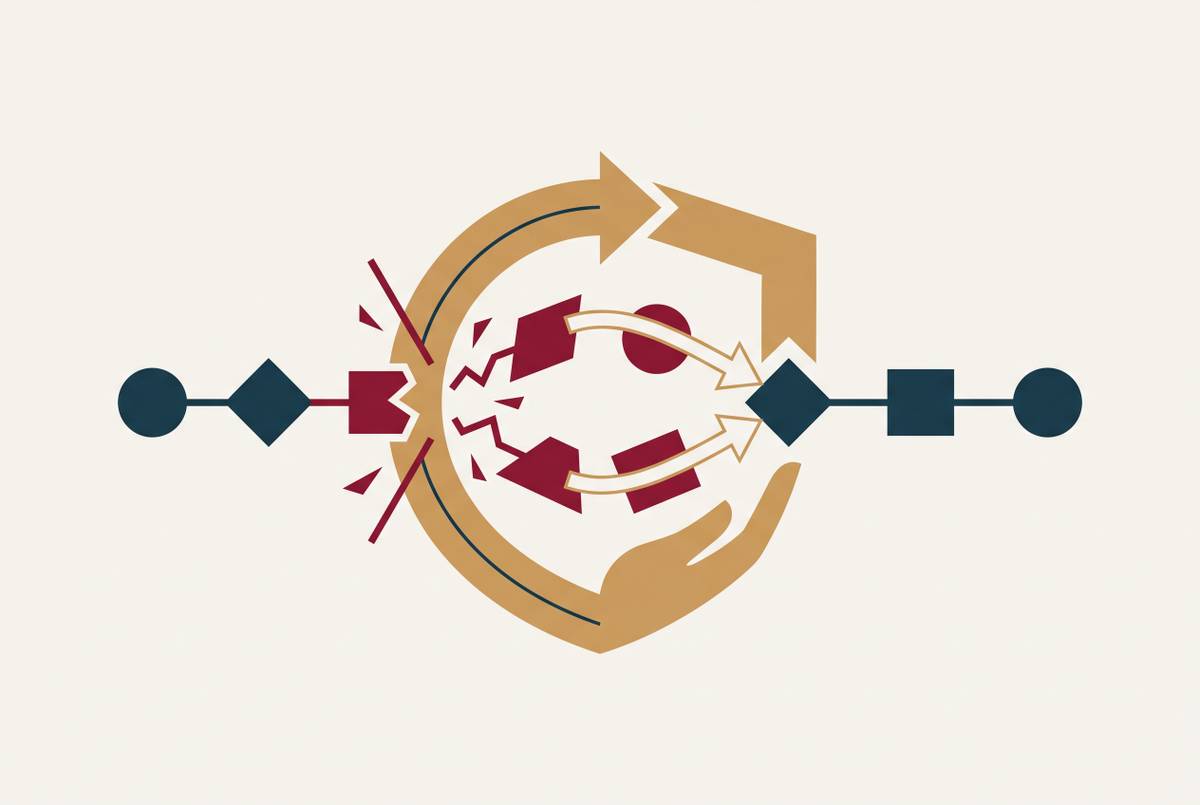
Tokenization, TLS, and FAPI each cover a gap the others leave.
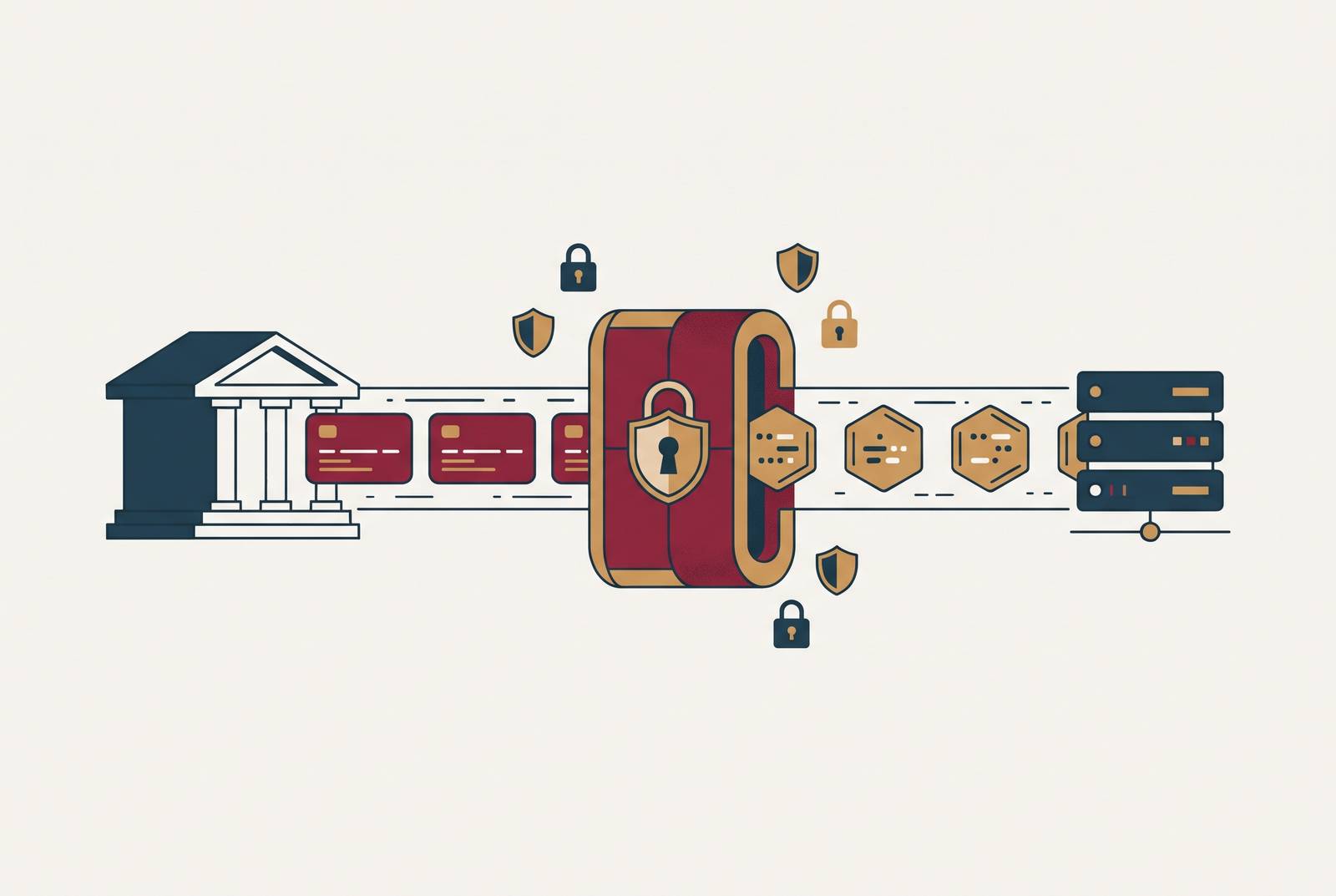
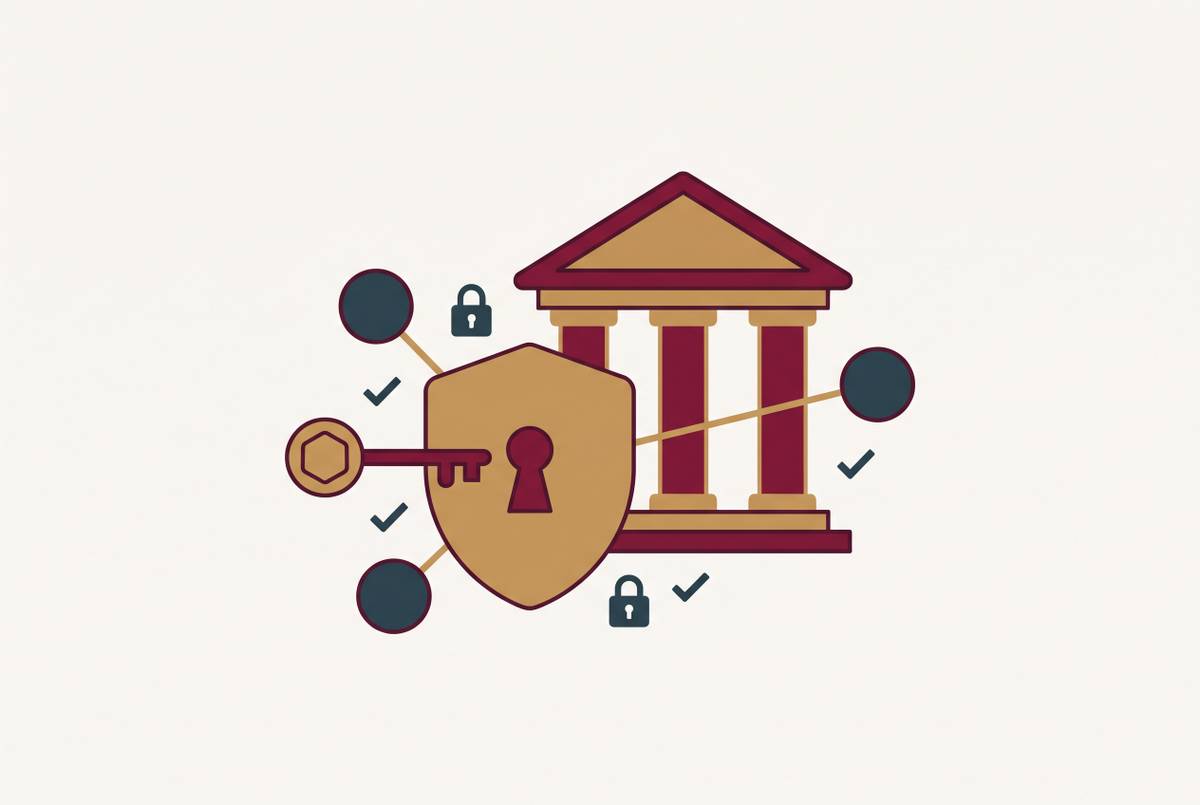
Protecting sensitive banking data in transit takes more than encrypting an API connection. Tokenization protects the data, transport encryption protects the channel, and sender-constrained authentication limits who can use a credential. API tokenization standards make sense only as part of this interlocking stack. For the architecture to comply, those layers must work together, including when AI agents use the connection.
Why sensitive banking data in transit needs more than a single control
An attacker swaps one account ID for another in an otherwise valid request. The request passes the perimeter checks but reaches the wrong account. Nothing about its format exposes the problem. The failure lies in checking the caller’s permission to access that particular account.
OWASP places Broken Object Level Authorization, or BOLA, at the top of its API Security Top 10. That distinction exposes a weakness in treating OAuth as the whole answer. OAuth handles authorization, but it does not by itself stop injection attacks, broken access controls, or leaked tokens. A valid credential is not permission to retrieve every record.
More data is at risk as account numbers, payment credentials, identity data, and transaction histories move across dozens of integrations at the same time. Those checks must hold at each connection. Partner integrations and internal microservices also use service credentials, so human-login protections cover only part of the system. The architecture must protect the data, connection, caller, and requested action as well as authenticate API access.
What tokenization actually does to sensitive data before it moves
Tokenization replaces sensitive values, including card numbers, account identifiers, and personal identifiers, with randomly generated tokens that have no inherent value. The token moves in place of the original value. This reduces exposure at the data layer before the request crosses a network.
Why is that different from encrypting the value? Encryption produces data that someone with the key can decrypt, while a token has no mathematical relationship to the original value and cannot be reversed without access to the token vault. The vault therefore becomes a critical boundary. Cryptographic keys must be stored in hardware security modules, or HSMs, and rotated regularly, because weak key management undermines the vault’s protection.
Data minimization is the companion principle. An API should return only what its workflow requires, and tokenization makes withholding original identifiers part of the design across endpoints.
Tokenization adds latency and integration complexity, which are real design costs. The alternative of transmitting live identifiers without protection creates both security and compliance exposure. GLBA Safeguards requires encryption for data sent over external networks, so sensitive values still need protection as they travel, even after they have been replaced.
Why transport encryption alone does not finish the job tokenization started
TLS 1.3 with Perfect Forward Secrecy protects the connection over which tokenized data moves. Replacing an account identifier limits exposure of the original value, while encrypting the channel protects the exchange between systems. Perfect Forward Secrecy adds protection for past sessions through separate session keys.
The GLBA Safeguards Rule makes encryption an obligation. An API that transmits unencrypted account data between systems can therefore create a regulatory violation as well as a security risk. The legal requirement concerns protecting the data. It should not be confused with a claim that one named protocol alone establishes compliance.
FFIEC’s 2021 guidance says that authentication must also be considered for employees, third parties, and system-to-system communications. It also identifies API use as an authentication risk. That scope puts machine connections within examination expectations.
A bearer token leaked from a client’s storage can still be presented by someone else over another encrypted connection. The transport may be secure in both cases. How does the receiving system tell the intended client apart from a thief with the same credential?
How FAPI 2.0 sender-constrained tokens close the gap TLS cannot
The OpenID Foundation’s Financial-grade API, or FAPI, 2.0 profiles harden OAuth for high-security financial use. Their central protection is sender-constrained tokens. Unlike a bearer token, which works for whoever holds it, a sender-constrained token is bound to the client through proof that the client possesses the associated credential.
Mutual TLS, or mTLS, requires the client to present its own certificate during the TLS handshake. The server can then verify the client as well as establish an encrypted channel. A software-based alternative lets the client sign requests to prove that it has a private key. It binds the token to that key pair without requiring client certificate infrastructure. The choice depends in part on whether the architecture supports certificate-based client authentication or needs the software-based alternative.
These are authentication tokens, distinct from the data tokens that replace account identifiers. The distinction is easy to lose. One substitutes for sensitive data, while the other controls access to an API.
RFC 9700, published in January 2025, updated OAuth 2.0 security best current practices using lessons from open banking deployments. Australia’s Consumer Data Right already uses FAPI as its base, and many providers in the EU and UK use it too.
Where the U.S. regulatory picture stands and what it requires today
GLBA, FFIEC guidance, NCUA regulations, and OCC standards already establish protections for customer data in transit and at rest. Those obligations exist independently of open banking rulemaking. The evolving framework for data access remains uncertain.
The CFPB finalized its Section 1033 open banking rule in October 2024, but a federal court enjoined it while the Bureau reconsidered it. The April 1, 2026 compliance date passed without effect. As of August 2026, the CFPB had sent a revised proposal for federal review. Institutions that are planning for Section 1033 still have a moving target.
Institutions should not wait for that target to settle before hardening API security. The safeguards and examination standards in place already require that protection. At the same time, a technical standard such as FAPI should not be mistaken for a universal U.S. legal mandate simply because it helps address those obligations.
PCI DSS v4.0 adds specific requirements for payment environments. Requirement 6.4.2 has required an automated technical solution, in practice a web application firewall, in front of public-facing web applications since March 31, 2025. Requirement 6.2.4 addresses secure coding practices. These controls supplement the token stack because strong credentials do not eliminate application vulnerabilities.
Why AI agents in banking make the authentication layer structurally more important
Agentic AI changes what an authenticated caller can do. These systems plan and execute multi-step workflows with limited human intervention, including initiating payments, routing transactions, and triggering compliance actions. They are not merely retrieving information for someone to read. Their service credentials can authorize actions across several systems.
That makes weak or over-permissioned service accounts especially consequential. Partner integrations, microservices, AI agents, and tooling that connects AI systems to external services all expand the population of non-human identities using payment APIs. Human-login security models do not cover that whole population. In October 2026, major U.S. banks were blocking third-party AI agents from accessing customer accounts and making transactions, showing how banks were putting limits on what agents could do.
The IMF’s 2026 note on agentic AI in payments identifies authorization traceability as a governance concern. A fast decision still needs an accountable origin. Which credential authorized the action, under which policy, and was the action within its permitted scope?
Sender-constrained tokens strengthen the answer by binding credential use to the intended client. They reduce the opportunity to replay a stolen token from another caller. Beyond identity binding, agentic workflows need policy enforcement to check each action’s permission and audit records that connect the authenticated identity to what it actually did.
What a governed agentic banking architecture looks like in practice
The Financial Stability Board’s October 2026 final report on responsible AI adoption frames the governing principle as actions that are authorized, traceable, and revocable. These properties turn security into operational governance. Encryption can protect an exchange, but it cannot by itself provide a kill switch or explain an agent’s decision.
Fiserv’s agentOS, launched May 14, 2026, illustrates how those additional controls fit together. Banks and credit unions can run Fiserv-built, institution-built, or third-party agents within a governed architecture that includes kill switches, human-in-the-loop checkpoints, identity-bound execution, role-based permissions, and auditability. First Interstate Bank and Boulder Dam Credit Union are running pilots.
In March 2026, Eltropy launched a platform for credit unions to use governed agentic AI under its Safe AI Framework. Its environment provides visibility into what an agent did, why, with what data, and how it reached its decision. FIS also announced work with Anthropic beginning with the Financial Crimes AI Agent. These examples illustrate different applications of governed agentic systems, each with its own security claims.
The common architectural requirement is readable evidence of permitted action. Compliance decisions need deterministic logic rather than probabilistic generation, and privileges must separate reading balances from initiating transfers. When agents call the core through the bank’s existing RESTful integration layer, the same tokenization and authentication controls can protect their access without parallel infrastructure.
The integration gaps that undermine even well-designed token stacks
An undocumented endpoint can bypass an otherwise well-designed stack. Shadow and zombie APIs include deprecated payment endpoints still running in production, pilot partner integrations, and internal services exposed during migrations. They can process live payment data without security teams seeing it. A protection applied only to known connections leaves that blind spot open.
Legacy infrastructure makes closing it harder. Core banking systems from Fiserv, FIS, and Jack Henry historically relied on point-to-point integration patterns that predate modern API security standards. Older integration layers may therefore need modernization before they can support FAPI 2.0 controls. Adding a standard to an architecture diagram does not make the underlying connections capable of enforcing it.
An API gateway provides the consolidation point. It verifies credentials, enforces rate limits, routes requests to the correct backend, and monitors exchanges through a single entry point. Without that shared boundary, each third-party connection can have its own security settings and credentials, along with its own risks. Consolidation addresses fragmentation, though an endpoint outside its visibility remains a problem.
Payment APIs also need protections against repeated instructions. Webhook signature verification with a short replay window helps check that incoming notifications are valid. Idempotency keys on every write that moves money stop a repeated request from carrying out the same payment instruction twice. These controls govern how payments behave in ways that tokenization alone cannot.
What compliance-ready API architecture requires that "good enough" security skips
A compliance-ready design must demonstrate that its controls interlock. The test follows the request. Sensitive identifiers need protection before transmission, the channel needs TLS 1.3 with Perfect Forward Secrecy, and access credentials need sender constraints. Object-level authorization must still check whether the caller is allowed to reach the account it requested.
Continuous monitoring then makes that design defensible over time. It correlates API activity with fraud signals and detects unusual behavior, such as a third party pulling data across many accounts in an unexpected pattern. Logs must record who called which API, what data left, and when. A secure-looking exchange is not enough evidence on its own.
Privilege segmentation must also hold at the API contract level. A balance-reading service must not initiate transfers, and a compliance-data service must not reach payment initiation endpoints. Human-readable records let compliance officers and regulators link those boundaries to the policy and authorization behind an action without needing a developer to explain them.
Agents operating on existing banking rails can use the same protected integration layer rather than require a separate system with parallel controls. Governed agentic deployment then becomes an extension of secured banking operations, with authority bounded and actions open to review.