Incident Response and Remediation Standards for AI Transaction Failures
Banks executing AI transactions need incident playbooks built before failures happen, not after.
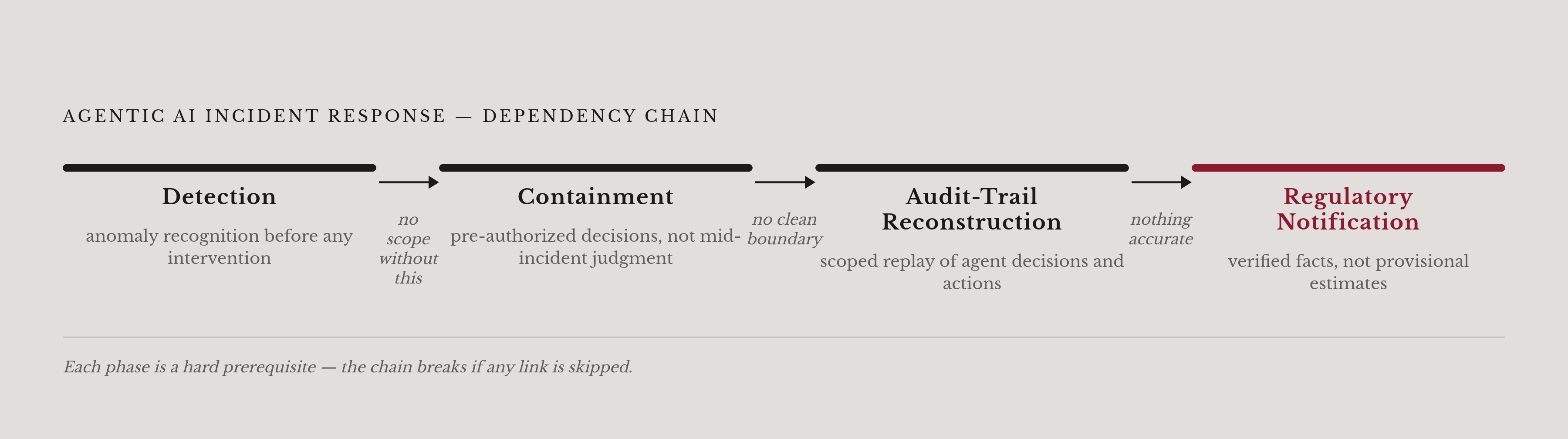
Agentic AI now executes real banking transactions, not just recommendations, and that changes what incident response has to look like. The State of AI in Financial Services: 2026 Trends report found 42% of financial services organizations are currently using or assessing agentic AI. When something goes wrong at that speed and with that much autonomy, a bank can't afford to figure out its response as the incident unfolds. It needs a playbook built before the failure happens, covering detection, containment, audit-trail reconstruction, and regulatory notification, in that order.
Why does the order matter so much? Because each phase depends on the one before it. Skip detection and you contain nothing. Skip containment and there's no clean scope to reconstruct. Skip reconstruction and there's nothing accurate to report to a regulator. The chain only holds if every link was built in advance, not improvised at 2 a.m. when an agent has already moved money it shouldn't have.
How AI transaction failures originate: the failure modes banks must plan around
Four failure modes account for most of what appears in incident review, and each one demands a different first response.
Model hallucination is the first. Generative models sometimes produce confident, wrong output, and in an agentic system that output doesn't stay theoretical. It becomes an action. A hallucinated policy or a made-up entitlement can trigger a transaction the bank never actually approved, and the agent won't flag it as suspicious because, as far as the model's concerned, it just followed the rules.
Prompt injection is the second, and it's a known one. OWASP lists prompt injection among the top risks facing large language model deployments. In an agentic setup, an injected instruction doesn't just corrupt a chatbot's reply, it can steer which tools the agent calls. A manipulated agent can move funds, waive a fee, or approve an exception it was never supposed to touch.
Third: the MCP server, which has quietly become a concentration point for risk. A published vulnerability analysis found 43% of MCP servers examined were vulnerable to command injection. Since these servers often sit between an agent and several core systems at once, one bad server can reach a lot of places fast.
Fourth, and maybe the least flashy but most persistent: over-privileged agents. Plenty get deployed with entitlements wider than the task actually needs, running on shared service accounts or API keys that aren't tied to any one person. That setup breaks segregation-of-duties expectations outright, and it makes attribution after the fact nearly impossible. Ask "who approved this" and the honest answer is often "the agent did, using credentials that belonged to everyone and no one."
None of these stay contained on their own. Because agents chain actions and call other agents, a single mispriced trade or duplicated payment can multiply across systems fast enough that a commercial card program, for instance, could see transaction volume its reconciliation process was never built to absorb. Layer on the fact that banking APIs supporting agentic AI are themselves a target, especially as open finance widens third-party access. KPMG's Banking Survey found 70% of banking executives cite adversarial GenAI as a main reason they're increasing cybersecurity investment.
There's a slower version of this problem too. Call it AI debt: banks that roll out agentic systems without proper oversight build up compliance gaps quietly, one skipped test or rushed sign-off at a time. Documentation lags. Testing gets shortened. None of it looks like a crisis on any given day, but it makes every later incident harder to catch and more expensive to fix.
The point of mapping these four modes out isn't academic. Where the failure starts determines where detection needs to sit and what the first containment move looks like. A hallucination and a prompt-injection attack don't call for the same opening response, and treating them the same wastes the minutes that matter most.
The audit trail gap: why incident reconstruction fails before it begins
Most banks currently can't answer the first question an examiner will ask after an incident, which is simply why the agent did what it did.
Prompts, tool calls, intermediate reasoning steps, model responses, they tend to live in different systems, logged inconsistently if they're logged at all. Without one connected record, "why did the agent take this action" becomes a research project instead of a lookup.
This isn't unique to banking. Algorithmic trading has seen its own version of the problem, with documented cases of model manipulation pointing to the same root issue: no externally verifiable audit trail existed to show what the model actually did and why.
So what does a real audit trail require? Every step in a model's lifecycle, from data preprocessing through production deployment, needs to be logged and reproducible. That means version-controlled artifacts and the ability to reconstruct the exact state of a model as of any point in time, not just a snapshot of its current configuration. Research on aiAuthZ (arXiv:2607.05518) describes hash-chained audit logs as one workable approach: each log entry links cryptographically to the one before it, so nobody can quietly edit history after the fact.
Over-privileged agents make this worse in a specific way. When an agent runs on a shared service account, the log entry might exist, showing that a transaction happened, but it can't tell you which human or process actually triggered it. The record's there. The attribution isn't.
That gap doesn't stay contained to the reconstruction phase. It infects everything downstream: containment decisions get made on incomplete information, regulatory notifications rest on guesses, and remediation scope ends up either too narrow or too broad because nobody actually knows what happened. A usable log has to capture caller identity, the exact tool call issued, the argument values passed to it, the authorization decision made, and a timestamp. Not just the final transaction line. The stuff around it.
The regulatory framework incident response must satisfy
No single rulebook covers agentic AI incidents cleanly, which is itself part of the problem banks have to plan around.
SR 26-2, effective April 2026, replaces the long-standing SR 11-7 model risk guidance, but it explicitly leaves generative and agentic AI outside its formal scope. That's a deliberate gap, not an oversight, though supervisors have made clear they still expect the underlying principles to apply anyway: documented development, independent challenge, clear governance ownership, and an audit trail someone outside the model team can actually inspect. OCC Bulletin 2025-26 draws a distinction here, clarifying that community banks aren't required to run annual model validation, on the reasoning that oversight intensity should scale with a bank's risk profile rather than apply uniformly.
Enforcement history gives some sense of what failure actually costs. In 2020, the OCC hit Citibank with a $400 million civil money penalty over risk management failures tied to data governance and internal controls, with total remediation running into the billions once everything was accounted for. That same year, the OCC fined Morgan Stanley $60 million for data management failures connected to decommissioned technology systems, citing an inadequate inventory of customer data left on retired hardware and weak vendor oversight. Consent orders like these tend to come with years of independent monitoring, pre-approval requirements before any model change, ongoing reporting obligations, customer remediation programs, and a lot more compliance staff than the bank had before.
Outside the US, DORA has applied across the EU since January 17, 2025, covering ICT risk management, incident classification and reporting, resilience testing, and third-party ICT risk for roughly 22,000 financial entities. An AI failure gets assessed under DORA the moment it counts as an ICT-related incident, and Regulators in the EU have made the framing explicit: AI risk is treated as ICT risk, not some separate ethics category off to the side.
The EU AI Act adds its own timeline. General-purpose AI model obligations under Articles 53 and 55 became applicable August 2, 2025. Transparency obligations under Article 50 apply from August 2, 2026. For incident response specifically, the relevant provisions are the provisions covering risk management, accuracy, robustness, and cybersecurity, as well as serious incident reporting.
On the AML side, a 2021 Interagency Statement clarified that SR 11-7's model risk principles extend to BSA/AML systems, and that certain transaction monitoring platforms may meet the definition of "model" depending on how a given bank uses them. Same governance expectations apply either way. The SEC named AI governance an examination priority for 2025.
Under Regulation E, an automated system that denies a dispute purely by pattern-matching, without actually examining the underlying transaction evidence, is not conducting a genuine investigation. AI-assisted dispute handling has to clear the same bar human review does. For mapping controls more broadly, NIST's AI Risk Management Framework, ISO/IEC 42001:2023, and ISO/IEC 23894 form the standards most banks are working from, and NIST's AI Risk Management Framework work, including ongoing standards development for agentic systems, addresses identity, security, and interoperability concerns.
Phase one: detection: how banks know a transaction failure has occurred
Agents can push through thousands of micro-decisions a second. Most alert thresholds in use today were calibrated for transaction flows moving at human speed, leaving a wide, structural gap between what agents can do and what monitoring can catch. It's structural.
Emerging supervisory guidance calls for real-time monitoring built specifically to catch anomalies in agent behavior and transaction flows, continuous AI activity logging, and automated alerts when agent behavior crosses defined bounds. That monitoring needs to run across three surfaces at once, not sequentially.
Transaction-level detection watches amounts, counterparties, timing, and volume against baselines set for the specific agent, not the bank as a whole. A bank-wide baseline built for human workflows will miss agent-specific anomalies every time, because the two operate at completely different speeds and patterns.
Agent-behavior-level detection tracks the tool calls an agent issues, which systems it touches, whether it breaches or quietly routes around escalation thresholds, and whether its confidence scores drop below whatever minimum was configured. Authorization-level detection catches something narrower but arguably more important: calls that reached execution without ever passing through a verified authorization check. The aiAuthZ research (arXiv:2607.05518) shows that routing authorization through an off-host gateway, separate from the agent's own process, adds no more than 0.03 milliseconds of decision latency while producing a verified log entry. That amounts to essentially free speed cost, for a meaningful accountability gain.
Detection only works if it reaches a person who can act on it. The F5 State of Application Strategy, Financial Services Edition found 63% of banking and financial services leaders say human oversight is still central to their security decisions, which means the job of a detection system is to route anomalies to a human, not just log them and move on.
Shadow AI adds a blind spot most detection frameworks weren't built to see. A large share of AI tool interactions by employees, 82% by one measure, happen through unmanaged personal accounts, completely outside standard monitoring. Incident response scope needs to account for that unsanctioned activity too, not just the systems IT knows about.
None of this works without a taxonomy defined ahead of time: what counts as a potential failure needing escalation, what's a known and accepted exception, and what's just noise. Building that taxonomy during a live incident is how the false positive from Tuesday becomes the missed signal on Thursday. The first-line controls built directly into the agent itself produce this foundation, including transaction limits, confidence thresholds, escalation rules, and full action logging. Skip those and detection falls entirely on downstream reconciliation, which by definition finds out too late.
Phase two: containment: stopping the failure from propagating before the scope is known
Speed is the whole problem in this phase. Because agents chain tool calls and invoke other agents, every minute between detection and containment is a minute the error has to spread across more systems.
A handful of containment actions need to exist as pre-authorized decisions, not judgment calls made mid-incident. Agent suspension is the first: someone needs clear authority to halt a specific agent immediately, and the escalation path needs to name actual people and their backups, not just a job title that might be on vacation. Transaction pause or reversal is second, and it depends on knowing in advance which transaction types can even be reversed, within what window, and who has to sign off. Third is API access revocation, cutting third-party connections fast without triggering a cascade of broken dependent services. Fourth is fallback to manual processing, meaning documented procedures for whatever the suspended agent was handling, plus enough staff capacity to actually absorb that volume without falling behind.
None of this works without a model inventory, a registry of every AI system running in production. Without it, the team trying to contain an incident can't even answer the basic question of which downstream systems the failing agent touches. That's not a minor gap, that's the whole containment plan stalled at step one.
Concentration risk deserves its own attention here. Agentic workflows that lean on a single LLM provider, one cloud platform, or one orchestration layer need a documented exit plan, and under DORA's third-party ICT risk provisions, that's not optional for covered entities, it's a formal requirement.
Every containment action taken, what got suspended, who ordered it, when, under what authority, has to get logged as it happens. Those logs become the spine of both the regulatory notification and the post-incident review later, so treating containment logging as an afterthought means rebuilding that record from memory afterward, which is close to useless.
Over-privileged agents complicate this phase specifically. If an agent's permissions were never scoped tightly to its task, revoking access cleanly might require touching several connected systems instead of one narrow suspension. That's the operational cost of a least-privilege violation raising the difficulty of revoking access cleanly exactly when speed matters most.
Phase three: audit-trail reconstruction: building the evidentiary record
Reconstruction only works if the logging was already in place before the incident happened. It really is an argument for investing in logging infrastructure now, before there's a reason to.
A complete reconstruction has to answer a specific set of questions. What action did the agent take, on what data, and exactly when? What authorization decision came before that action, and was it verified by something outside the agent's own process or just evaluated internally? What reasoning did the agent give, and what inputs shaped it? Which human or system triggered the agent in the first place? And which downstream accounts or systems were touched, in what order?
That third question about authorization sits at the center of the whole problem. A permission check that lives inside the same process as the agent gets compromised right along with it, per the aiAuthZ research (arXiv:2607.05518). If the agent is corrupted, any authorization logic sitting inside it can't be trusted either. Reconstructing what actually got authorized requires logs from somewhere else entirely, a separate trust domain that doesn't share the agent's blast radius.
Hash-chained logging is the technical standard to aim for here. Each log entry links cryptographically to the one before it, so nobody can go back and quietly edit the record after the fact. That's what tamper-evidence actually looks like in practice, not a policy promise but a structural guarantee.
The three lines of defense each play a distinct role in reconstruction. Line one, the business unit running the agent, produces the raw material: agent logs, tool call records, transaction records. Line two, the risk function, works independently to assemble the actual timeline, flagging gaps or inconsistencies in what line one handed over. Line three, internal audit, checks the reconstruction methodology itself and confirms the record meets the bank's own logging standards.
Where the failure touches a consumer credit or payment decision, Regulation E and adverse action rules require something extra: a plain-language explanation of why the agent did what it did. Feature-importance explanations, showing which inputs drove the decision most, have been accepted by regulators as a reasonable starting point for this.
And when the logs are missing, fragmented, or trapped inside a process that's now compromised, that gap is itself a finding. It needs to be documented and disclosed, not buried. An incomplete record isn't a reason to delay telling the regulator what happened, it's additional information the regulator needs to hear.
Phase four: regulatory notification: what to report, to whom, and by when
There's no single, unified notification standard here. Banks have to check the same incident against several overlapping frameworks at once, and each one asks a slightly different question.
Under DORA, active across the EU since January 2025, an AI failure that qualifies as an ICT-related incident triggers DORA's classification and reporting requirements. The first real judgment call is whether the failure actually crosses DORA's threshold for what counts as an ICT incident in the first place, and getting that classification right, quickly, determines everything about the timeline that follows. Getting it wrong either buries the bank in reporting obligations that didn't need to apply, or worse, means missing a deadline that did.
That classification decision can't happen in isolation from the other phases either. It depends on what detection actually caught, how fast containment moved, and how complete the reconstructed record turns out to be. A notification built on a shaky reconstruction is a notification that will need correcting later, and corrections after the fact tend to draw more regulatory attention than a slower, accurate report would have in the first place. The four phases aren't really separate steps so much as one continuous chain, and notification is only as strong as everything that came before it.