IT Security Review Checklist for Fintech AI Integration Approval
A fintech AI approval review must cover authority, action, and evidence.

An IT security review for fintech AI integration must establish more than whether software is safe to connect. When an agent can execute banking transactions, approval must cover its authority, its actions, and the evidence it leaves behind. The checklist becomes a governance map, showing how an institution gives agents enough context to act safely without granting unchecked power.
Why agentic AI demands a different kind of security review than conventional software integration
A drafting assistant produces text that a person reviews before anything happens. An agent can plan, retrieve customer data, call tools, and complete a multi-step workflow without someone directing each step. That changes the consequence of a flawed integration. It can go beyond giving a wrong answer and take a wrong action, such as calling a payment API or acting without all the customer information it needs.
The review therefore has to follow the action. What did the agent see, which tools did it call, who approved its decision, and what evidence remains? These are already practical questions for banking platforms. Fiserv launched agentOS on May 14, 2026, allowing institutions to deploy its agents, build their own, or run third-party agents within one governed architecture. FIS announced its Financial Crimes AI Agent on May 4, 2026, built with Anthropic, with BMO and Amalgamated Bank among the first in development.
The governance paradox that makes the checklist structurally harder for banking AI than for other software
Limiting access sounds like the obvious way to keep systems safe. Yet an agent with authority to act can also cause harm when it cannot see enough. Consider an agent replacing a debit card after suspected fraud. If it cannot see that the member previously reported the account itself as compromised, it may replace the card without addressing the larger problem.
Core banking systems hold account numbers and transaction histories, while chat, email, and branch conversations explain why a customer acted or raised a concern. These streams typically live in separate systems. Branch conversations create a particularly difficult blind spot when the transaction is recorded but the reasoning behind it is not preserved. Access to more transaction records cannot bring back context that was never recorded.
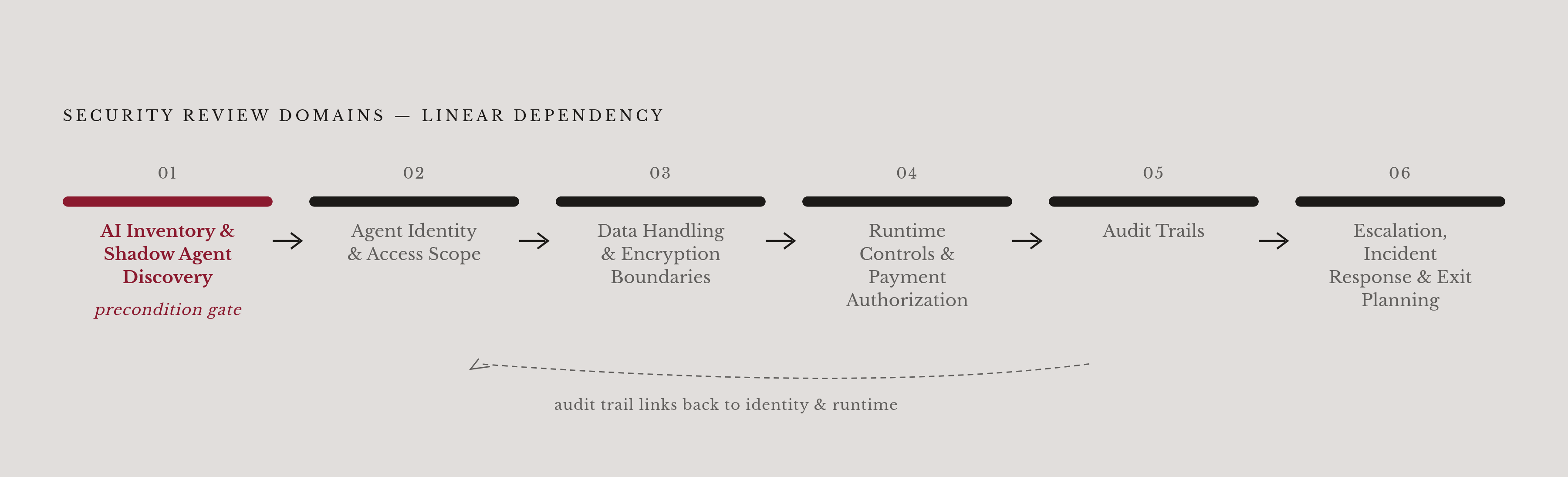
Structured, governed access with explicit controls at each boundary provides an alternative to both blanket restriction and unrestricted access. Building those controls from scratch costs a lot and is hard to do, especially for community financial institutions, so purpose-built banking platforms have a role to play. But a platform still needs review against the institution’s requirements. The domains that follow address connected parts of this tension, from discovering agents and defining their authority to controlling data, enforcing policy, preserving evidence, and handling failure.
Domain 1 — AI inventory and shadow agent discovery before any new integration begins
The first approval question concerns what is already running. An institution needs a map of every agent, including those embedded in core, CRM, and contact-center platforms and those introduced by business teams without IT or risk involvement. Each agent needs an identified owner. Otherwise, a review can approve one carefully bounded integration while overlooking another with similar access but no governance controls.
Vendor updates make this discovery work harder. Agents can come with a platform the institution already uses, without a separate decision to buy them. Fiserv’s agentOS Marketplace, for example, allows third-party agents to run within its architecture. The inventory must also include connectors, because each connector represents an access grant. Recording the agent without recording its connections leaves part of the exposure unaccounted for.
For the security team, the assessment should map sensitive data flows, review identity controls, test vendor safeguards, validate logging, and define incident-response evidence collection. Standard vulnerability tests alone are not enough. AI-specific testing includes prompt injection, sensitive information disclosure, excessive agency, output handling, model poisoning, and unbounded usage. The inventory establishes where those tests and controls belong. Discovery is therefore a precondition for every domain that follows.
Domain 2 — Agent identity and access scope, the control that determines what damage is possible
An agent’s permissions determine the blast radius of failure. The review must establish what each agent can reach and do, with a verifiable digital identity separate from that of its human user. A shared service account or API key does not, by itself, establish which individual directed access to regulated data. Without that distinction, later records cannot reliably show what a person directed and what the agent did.
For each connector, the team should ask which systems it reaches, whether outbound calls can be disabled, and whether permissions are limited to what the workflow requires. Endpoint security needs its own baseline. Mutual TLS, workload identities, and short-lived certificates are controls for agents that connect to banking rails. These controls protect the connection, while a clear access scope limits what the agent can do through it.
Permission is only part of the policy. What must the agent do after an action, and what happens when two rules conflict? AgenticRei research from UMBC and MIT identifies gaps in standard policy engines including XACML, Rego, and Cedar, which address the permit/prohibit subset rather than obligation lifecycle management, dispensations, and meta-policy conflict resolution. The practical approval questions are whether an agent must notify the CISO after specified actions, when an obligation may be waived, and which rule takes precedence. Those answers set the rules that runtime enforcement must apply.
Domain 3 — Data handling, encryption boundaries, and what happens to customer content after the agent uses it
A well-scoped agent can still expose customer content through external logs or retain it on a schedule that conflicts with regulatory requirements. The review should establish where content sits at rest and who holds the encryption keys. It should also identify components that make outbound network calls, whether those calls can be disabled, and what query information the vendor retains. Retention periods need to be explicit.
Decision evidence is part of this data lifecycle. For AI-generated adverse action notices, keeping an output score without the specific factors behind it leaves the record short of what ECOA adverse action requirements and the EU AI Act’s traceability mandate require. The review must separate the data used during processing from the evidence that must be kept for later use.
Voice adds another surface to examine carefully. Financial vocabulary, accented speech, and emotional registers such as frustration or distress can degrade transcription quality, affecting both customer experience and compliance. For a voice integration, the questions are where transcription occurs, who retains it, under what schedule, and whether the institution can retrieve it for a dispute or compliance review. Contract termination needs equally clear answers about customer content. The review should establish the deletion timeline and the evidence of destruction the institution will receive.
Domain 4 — Runtime controls, prompt injection defenses, and payment-specific authorization gates
Policy must be enforced on every invocation at the point of action, through a deterministic layer independent of the LLM. Instructions to the model are not enforcement. The NSA’s MCP security advisory recommends per-invocation rather than startup-time policy evaluation, while AgenticRei addresses runtime governance beyond basic permissions. Approval requires assessing what checks the proposed action before execution.
Prompt injection makes that separation especially important. External content must be isolated from trusted instructions, tool interfaces must be tightly constrained with schema validation, and independent authorization checks must run outside the model’s context window. Sensitive actions also need out-of-band confirmation bound to the cryptographic hash of the exact transaction being approved. Any material change after consent must invalidate approval. In the Arup case, fraudsters used a deepfake video meeting to get someone to make a transfer, showing why the authorization channel itself needs protection through confirmation to registered channels.
Payment execution requires more than general workflow safeguards. The minimum controls include dual control, out-of-band verification, callback to registered channels, transaction limits, segregation of duties, and no-exception workflows for bank-detail changes or urgent wire requests. The IMF’s 2026 notes on agentic AI in payments identify authorization traceability, opacity, correlated agent behavior, cybersecurity, and unresolved legal and liability questions as core risks. Nubank’s Pix with AI shows how a payment can start with natural-language text, voice messages, or images. The review should establish whether each channel has authorization validation or relies on a shared gate that could be bypassed.
Human checkpoints must also work under live conditions. Fiserv’s platform embeds kill switches and human-in-the-loop checkpoints by design, but the institution’s review still needs evidence that these controls have been tested. Documentation alone does not establish that an agent can be stopped. Approval should depend on tested intervention.
Domain 5 — Audit trails that satisfy examiners, not just internal reviewers
Examiners need to reconstruct a banking decision. The record must show what the agent saw, what it decided, what it did, and under whose authority. The record ties identity to data handling and runtime enforcement. If any link is missing, an institution may have extensive logs without a usable explanation of the action. The approval review should test that distinction.
Eltropy’s governed agentic AI platform for credit unions, launched March 2026 and serving 750 community financial institutions, provides visibility into what an agent did, why, with what data, and under what authority. That scope gives teams a concrete standard to probe. Can the vendor’s records reconstruct the full sequence, including human approval and the basis for a decision? Which records are retained, for how long, and can they be retrieved in a form suitable for examination?
The regulatory framework gives that evidence a clear purpose. The EU AI Act’s provisions for high-risk financial sector systems took effect August 2, 2026, mandating transparency, traceability, and human oversight. The Financial Services AI Risk Management Framework, released February 2026, gives institutions a starting inventory they can choose to use, with 230 control objectives aligned to NIST AI RMF. Wolters Kluwer’s Q1 2026 Banking Compliance AI Trend Report found that explainability and transparency were the regulatory issues that financial institutions said worried them most. The institution must establish who controls the records, because an audit trail it cannot access or export does not satisfy examiner requirements, regardless of what the vendor retains internally.
Domain 6 — Escalation paths, incident response, and the exit plan most approvals skip
Approval is a decision, while governance is an ongoing responsibility. A review that leaves escalation and exit planning unresolved defers the hardest questions until something goes wrong. The institution should specify which agent behaviors trigger automatic halt, human review, or incident response, and who has authority to invoke each. A kill switch cannot depend on committee deliberation. Its usefulness rests on a clear path from detection to intervention.
Incident response must preserve more than error logs. The evidence needs to show what the agent saw, which tools it called, what it decided, and what it did. That requirement links response planning directly to the audit trail reviewed in the previous domain. The response plan must name an owner and spell out that person’s authority to step in.
Exit planning tests whether the institution retains control. A complete plan covers data export, deletion timelines and evidence of destruction, contract termination terms, credential revocation, integration removal, and retention of audit evidence. Each element has a different owner and timeline. Wells Fargo’s October 2026 online access agreement changes, set to take effect November 24, 2026, made customers liable for AI agent access. Those changes illustrate why the original integration agreement must preserve the right to restrict or terminate agent access.
Readiness also depends on reviewing access as circumstances change. Checking retrieval scope and the access model against staff movement every quarter, and reviewing the subprocessor list and data processing agreement every year, keeps termination planning in step with the systems and people in place. Purpose-built banking platforms can reduce the burden of assembling controls from scratch, but they do not replace institutional accountability. Filene’s agentic AI primer for credit unions concludes that institutions need a plan.