OAuth 2.0 Scopes and Least-Privilege Access for Banking AI Agents
Scopes alone can't contain a banking agent, so enforcement must sit outside the model.

Banking AI agents need more than permission to reach an account. They need authorization tied to the customer’s task, checked before each action, and enforced outside the model. OAuth 2.0 scopes are the starting point. Fine-grained permissions, short-lived tokens, independent policy enforcement, and verifiable delegation together make an agent’s authority something a bank or credit union can defend.
Why standard OAuth 2.0 deployments were not designed for agents that move money
A human using a banking application chooses the next action. An autonomous agent can chain tool calls, get credentials during a task, and act on the information it gets back without a person approving each step. The difference in judgment between a human and an autonomous agent using the same credential is a structural gap in standard OAuth deployments. The credential grants reach, while the restraint that normally guides its use remains outside the protocol.
OAuth 2.0 was designed for delegated access by human-driven applications. Standard deployments typically grant a handful of broad scopes rather than permissions tailored to each sub-operation. Token exchange also does not, by itself, preserve a verifiable record of the original authorization chain. Nor can a token holder independently narrow its token for a sub-task. Those limitations become more consequential when software decides its own sequence of actions.
Live deployments reveal a more basic weakness as well. Knostic’s security scan of approximately 2,000 MCP servers found every one lacked authentication. MCP adopted OAuth 2.1 as its authorization layer in 2025, with refinements in 2026, making it mandatory for remote HTTP servers but optional for STDIO servers, yet adoption is negligible. Even authentication, however, cannot answer whether an authenticated action belongs to the customer’s request. For real-time payments, that question must be settled before execution because detection after settlement has limited preventive value.
What fine-grained, task-scoped OAuth permissions actually look like in a banking agent context
Least privilege starts with the task. Reading a balance and executing a domestic wire are different operations, even when both concern the same customer and account. A balance-read token should not authorize a wire. A wire authorization should cover the named operation, resource, and user rather than everything the agent might need for later tasks. This rules out the broad service account as the default credential.
OAuth 2.0 Rich Authorization Requests, defined in RFC 9396, let clients request detailed authorization, including a specific account identifier and amount limit. The grant can then be limited to the transaction the customer authorized. Each tool authenticates with permission for its particular operation. Signed JWT claims let the receiving system verify those permissions without a database lookup. The backend needs to distinguish this authorized transaction from another transaction of the same general kind.
Time is another dimension of the grant. For high-risk operations, token exchange can produce a narrowly scoped, audience-restricted token that expires in minutes. Per-user, per-action elevation gives the agent added authority only for that action, then drops it. What returns to the agent should also be limited. A masked account number or a decision instead of underlying credentials reduces what an injected instruction can exploit, while a broad API key exposes everything it can reach.
Why fine-grained OAuth scopes alone cannot govern an agent that reasons over its own permissions
Even a valid permission can exceed the assignment. An agent asked to make a bill payment may hold a credential that also reaches wire-transfer endpoints. The backend can accept a call that the customer never requested. Marc Millstone and his co-authors’ paper on policy enforcement identifies this distinction between what a credential makes reachable and what belongs to the task.
Indirect prompt injection places instruction-like text in a tool response, where the model may treat it as something to follow. The agent can then misuse valid credentials without a conventional network breach. OCC Bulletin 2026-54 explicitly identifies prompt injection and jailbreaking as attacks that can lead agents to misuse connected tools. Asking the same model to interpret that material and enforce its own limits makes the guard depend on the reasoner being guarded.
An otherwise permitted payment may need approval after hours or after several transactions cross a cumulative limit. Narrower scope strings cannot account for changes in the world outside the token. Genliang Zhu and Chu Wang’s runtime authorization paper identifies a further gap when an agent acquires a resource whose capabilities exceed the task’s intent, even though payment and OAuth checks passed. Authorization must cover each action and any new authority the agent gets from that action.
Out-of-band policy enforcement as the layer that makes OAuth safe for banking agents
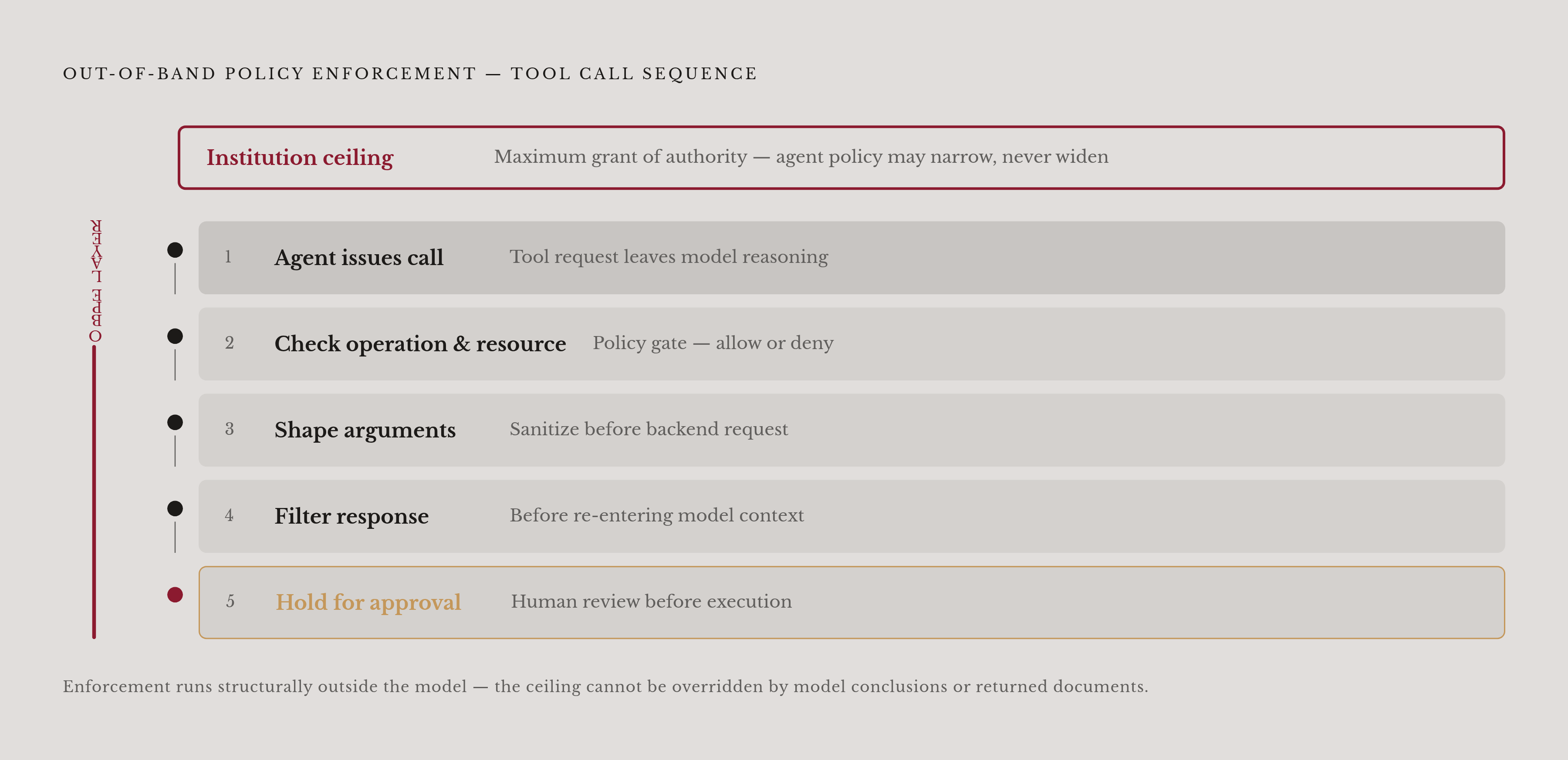
An out-of-band policy layer sits between agent reasoning and tool execution. It mediates every call, checks the operation and resource, shapes arguments before the backend request, and filters the response before it enters model context. It can also hold a call for human approval. Unlike a prompt, this layer does not ask the model to obey a rule.
The institution sets the maximum grant of authority. Agent-specific policy may narrow that grant but never widen it, regardless of what the model concludes or what a returned document tells it. The OBPE paper formalizes this property through staged policy composition. Its semantic gating also permits decisions based on cumulative limits, time-of-day rules, and risk flags. Response filtering and redaction limit what comes back to the model, including sensitive content and text that gives instructions.
Zhu and Wang propose quarantining resources the agent gets, checking what they can actually do against a manifest, and requiring a new decision on activation before the agent can use them. The 2026 Singapore Consensus expresses the broader principle that least privilege includes dynamic capability restriction and execution isolation, with explicit authorization for escalation. A compliance officer can examine who sets them, when they stop execution, and whether the agent can override them.
Verifiable agent identity and delegation chains across multi-agent banking workflows
When one agent delegates to another, who is actually acting? The institution needs to verify the delegator’s authority, restrict the sub-agent to no more than that authority, and preserve the full chain for audit. A self-declared identity in an A2A agent card does not provide that assurance. Standard OAuth token exchange does not provide it either. A fresh token alone cannot explain the sequence of decisions that authorized the final action.
Holder-side attenuation addresses the permission part of this problem. It allows the delegating agent to create a strictly narrower sub-credential without returning to the authorization server. Sunil Prakash’s Agent Identity Protocol paper introduces Invocation-Bound Capability Tokens, which combine identity, narrowed authorization, and provenance in an append-only token chain. Each delegation block can only maintain or restrict the authority of the previous block. The proposal illustrates how identity and permission can remain connected across multiple agents.
This remains an architectural requirement. The same paper found no single implemented protocol combining all the delegation, policy, transport-binding, and completion-record properties it surveyed. For bank leadership, the practical test is simpler than the cryptography. Which authenticated human authorized the original action, which agents participated, and what could each do? The emerging Know Your Agent concept, linking verifiable financial-bot identities to legal entities, reinforces the need for answers that survive beyond one tool call.
What regulators and examiners are already asking about agent authorization controls
As of October 2026, neither the federal banking agencies nor the NCUA has issued an AI-specific regulation. Examiners are nevertheless asking about agentic AI through third-party risk management, BSA/AML, and consumer protection frameworks. Interagency model risk guidance SR 26-2 / OCC Bulletin 2026-13 / FDIC FIL-15-2026, effective April 17, 2026, explicitly excludes generative and agentic AI and targets the largest institutions. Its spirit is still being applied to smaller institutions through those existing frameworks.
Third-party risk is a central route for scrutiny. The three banking agencies and the NCUA proposed new third-party risk management guidance on September 11, 2026, with the comment deadline extended to December 16, 2026. Agents that vendors deploy are part of that third-party risk. The NCUA’s August 2025 resources also support credit unions’ evaluation of AI vendors and third-party services. Authorization scope and policy controls belong in both that due diligence and a technical review after procurement.
Auditability connects these reviews to actual transactions. Policymakers and regulators expect monitoring of agent behavior and transaction flows, activity logs, and alerts for abnormal behavior. A delegation chain supplies attribution, but it does not replace those other controls. The NCUA’s Credit Union AI Resource Center allows AI use while keeping the same compliance responsibilities. The architecture described here helps an institution show how it governs agents but gives it no safe harbor.
What the institutions blocking agents externally reveal about the right place to enforce policy
JPMorgan Chase announced in October 2026 that it would block AI agents from customer accounts, citing rogue agents and security threats. Charles Schwab’s CEO said in an October 2026 interview that the firm was blocking major AI agents’ access attempts in the tens and twenties per week. Those steps make sense when agents have access without enough controls. Blocking removes a route into the institution. It does not resolve how an authorized agent should operate once access is allowed.
JPMorgan’s work with Hyundai Card shows that distinction. Their 2026 Kinexys proof-of-concept used AI agents to carry out simulated foreign exchange transactions without a human stepping in directly. JPMorgan identified governance and transaction limits, rather than technology, as the bigger hurdle to commercial use. Kinexys restricted agents to predefined transaction parameters and automatically rejected requests outside authorized limits. That is the same architectural principle as semantic gating, with execution constrained by rules the agent cannot widen.
An internal agent with coarse credentials retains the same authorization gap as an external one. Customers already ask general-purpose AI questions about their money, even though it cannot see their balances or move their money. McKinsey has argued that retail banks could lose their customer relationships to agents and must choose whether to wait, make their products easy for agents to use, or compete to keep the direct relationship. Governed internal agents offer a way to compete without treating unrestricted access as the price of participation.
How community banks and credit unions should structure an OAuth posture for banking agents they can actually defend
For community banks and credit unions, the lesson is to evaluate authorization as a complete system. Scope each tool to its operation and use short-lived, narrowly scoped tokens for high-risk actions. Keep policy enforcement outside the model and let the institution control it. Require verifiable delegation records wherever agents hand work to other agents.
Every AI action should link back to an authenticated member, employee, or officer through a tamper-evident record that the agent cannot change. The institution should control the maximum grant and the kill switch. It should be able to explain what was permitted, what happened, and who authorized it. That record supports BSA/AML scrutiny and the direction of Know Your Agent expectations without substituting for broader compliance work.
This does not require replacing the core. FIS, Fiserv, Jack Henry, and COCC cores, and digital platforms including Narmi, Q2, Alkami, and Candescent, can be reached through scoped API tools and webhooks that return only needed fields. Fiserv’s agentOS, launched May 14, 2026, illustrates the infrastructure category institutions are evaluating. The governance question remains whether the institution controls what agents access, decide, trigger, route, document, and escalate. A platform’s ability to run agents is not itself an answer.
The purpose of those controls is a trusted relationship. Capitol National Bank’s deployment includes deposit attrition modeling that sends at-risk customer rankings to the CRM so human relationship managers can act. Institutions that can control what agents do are better placed to keep the customer’s trust when AI begins handling money.
Sources
- If Agents Were Angels, No Governance Would Be Necessary: Out-of-Band Policy Enforcement at a Trusted Tool Boundary
- AIP: Agent Identity Protocol for Verifiable Delegation Across MCP and A2A
- Runtime Authorization for Resources Acquired by AI Agents
- The 2026 Singapore Consensus on Global AI Safety Research Priorities