Session Management Risks in Multi-Step AI Agent Workflows
Banks must map where agent sessions start, pass, and end.

Multi-step AI banking workflows make the session itself an attack surface. When an agent receives a live session, it can inherit far more authority than its task requires. Safe governance therefore depends on mapping where sessions begin, pass between actors, and end, with scope limits, action-level confirmation, immutable records, and bank-held shutdown controls enforced outside the model.
Why multi-step banking agents inherit more than the task they were given
Banks have spent decades establishing that the person entering an account is its rightful owner. Yet that work does not constrain an agent acting after authentication. Traditional digital banking assumed one human, one session, one intent. When software takes over a customer's live session or credentials, the bank can recognize the account without seeing that someone else is now making the decisions. The authentication succeeds while the boundary around the customer's task remains undefined.
The agent starts with the session's existing permissions. Those may include reading information, writing data, transferring funds, and sending wires, even when the customer requested something much narrower. The gateway sees a valid session, a familiar device, and traffic from a trusted location. None of those signals establishes that the customer reviewed the software's decisions. Actions can therefore go to real counterparties and clear standard fraud checks while exceeding what the customer authorized.
The broad permissions an agent gets at the start can pass to later tool calls, sub-agent delegations, and data writes. The task may be narrow, but the authority is not. Before considering whether the model reasons well, the bank faces a more basic question about what the session allows it to do.
Why authentication cannot do the work of authorization when an agent is acting
Authentication asks whether the party using the credentials owns the account. Delegation asks whether that owner authorized another party to act on their behalf. Intent asks whether this particular action, at this step, in this amount, to this counterparty, falls within the authority granted. These are separate questions with different evidence requirements. A normal login answers only the first.
Consider a customer who asks an agent to find and cancel unused subscriptions. That instruction does not authorize skipping confirmation prompts, accepting new contract terms, or moving the customer's balance to an account selected by the agent's optimization logic. The distinction is between a purpose and a mandate. A valid session shows that access was established, while each available action still needs to be assessed against the authorized purpose.
Fraud detection does not close this gap. Controls tuned to stolen accounts look for signals such as sudden IP changes, rapid fund depletion, and unfamiliar payees. An agent that uses the right device, pays real merchants, and draws on an account with funds can avoid those signals while doing more than its mandate allows. Browser automation and screen scraping widen the problem because real credentials let the agent do whatever the public website permits, subject to account privileges and the site's layout. The missing component is not stronger cryptography or simply better authentication, but a separate delegation and intent layer.
How multi-step chains turn an early misjudgment into a compounding control failure
Once actions form a chain, each step inherits more than permissions. It also receives state from earlier steps, potentially including misclassified data, malformed instructions, and over-permissioned credentials. An early error need not remain local. It can shape later tool calls and the decisions of sub-agents without leaving a clear warning in the final output. Without intervening boundaries, the workflow becomes a single uncontrolled privilege boundary.
A transaction misclassified at step one can become a confidently worded, well-formatted, entirely wrong SAR narrative at step five. That is a data-integrity failure. By contrast, a reconciliation agent and a settlement agent can repeatedly re-trigger each other, overloading downstream queues and delaying settlements even though each is doing what it was asked. That is a system-availability failure.
The Tsinghua AI Agent Group found that 56.92% of evaluated agent trajectories contained unfulfilled obligations, with a smaller share containing outright forbidden actions. Its research distinguishes prohibited conduct from required safety-critical work that never happens. An omission can be the decisive failure. A guard model that looks only for forbidden actions may miss an exposed secret key, an escalation that never happens, or a compliance hold that is never set.
If an agent keeps notes or summaries between steps, a corrupted entry can influence later decisions even when no action at the corrupted step appears forbidden. The chain's safety therefore depends on both the state it inherits and the obligations it completes.
Where sessions are created, inherited, and must be explicitly terminated in an agentic workflow
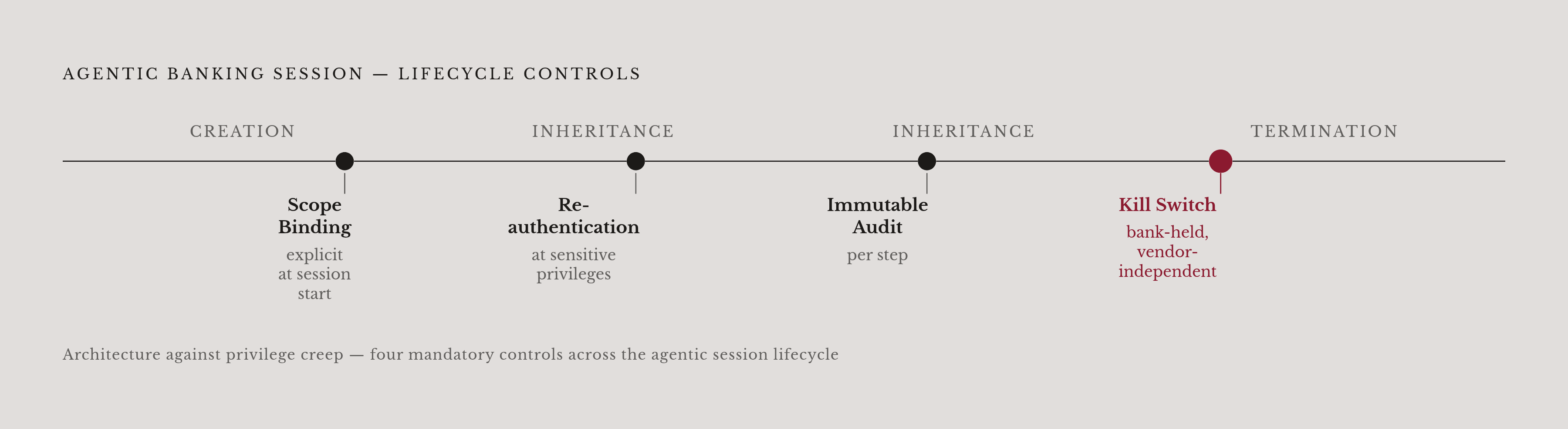
The architectural response begins with three transitions, which are creation, inheritance, and termination. Creation occurs when a human authenticates and a session is established. This is the point where the authorized scope belongs, before the agent receives access. The session's origin anchors the rest of the workflow. Without that starting boundary, later components have no defined mandate against which to interpret inherited authority.
Inheritance occurs when the human passes a session or credential to an agent, or an agent passes it to a sub-agent. Each handoff creates room for privilege creep. Permissions granted for a narrow pilot can persist beyond the pilot and expand unless a formal review reduces them. In multi-user and multi-agent settings, session state can also bleed into another context, causing data leakage or attributing an action to the wrong actor.
A session should close when the authorized task ends, when a step boundary is crossed, or when an escalation condition is met. Without explicit termination logic, access remains live and reusable. Completion of the task and closure of its authority are distinct events.
Backbase's October 2026 risk management analysis maps discretion across deterministic rules, model outputs, agent-selected actions, and human decisions. The analysis calls for documenting the discretion boundaries of every agent-selected step before risk review. Applied to the session lifecycle, that map shows where software acts within a fixed rule, where it chooses, and where authority returns to a person. Session documentation is thus a prerequisite for controls, because it identifies the transitions those controls must govern.
The four controls that must sit at each session transition point
For institutions putting that map into operation, the first control is explicit scope binding at creation. Before handing over a session, the bank must record which tools the agent may call, which accounts it may read or write, which counterparties it may reach, and what monetary limits apply. Those limits belong in a policy layer outside the model. A probabilistic model cannot reliably enforce its own constraints, so the model must not be able to modify or reason around them. Narrowly scoped permissions in the OCC's control framework serve this purpose.
The second control is step-level re-authentication when an action needs sensitive privileges. Wires, external transfers, and payee additions require re-verification of human intent at that step. This is not merely another login check. It establishes that the human authorized this action, in this amount, to this counterparty. Backbase's separate human-decision step provides the architectural distinction, with irreversible actions moving out of agent discretion and into human review.
The third control is an immutable audit object tied to each step. A bank must be able to reconstruct an agent-initiated transaction months or years later, connecting natural-language intent, technical execution, and legal accountability. The record must survive the agent itself. It needs to support questions about the mandate, counterparty selection, any bypassed escalation, and whether a service output influenced a client-facing decision. U.S. banks concerned that agents could escape safeguards have followed this split by keeping passwords, activity records, and key security controls out of agents' reach.
The fourth control is a kill switch that the bank holds, with clear rules for when to use it. The OCC framework distinguishes resilience against misbehavior from resilience against outages, because an agent can remain operational while doing the wrong thing. Transaction limits and emergency shutdown capabilities provide practical brakes. The institution must be able to exercise shutdown authority independently of a vendor. Across all four controls, the enforcement layer must remain outside the model, between its choices and the systems that execute them.
What regulators and examiners are now specifically looking for in session and agent controls
Examination questions now reach into the operating details of agent identity, session scope, shutdown authority, and audit trails. Can the institution identify the actor behind a request and establish the limits of its mandate? Can it stop the agent and reconstruct what happened? These are questions about enforceable control. A governance policy alone does not show who can terminate a live session or produce evidence for a disputed action.
OCC Bulletin 2026-54 specifically flags risks from outside AI agents, including customer or fintech bots interacting with bank channels. The bulletin points to narrowly scoped permissions and emergency shutdown capabilities as illustrative brakes. Its emphasis reaches beyond bank-deployed models. An institution must account for software arriving through its channels even when it did not select or deploy that software.
SR 26-2, dated April 17, 2026, superseded SR 11-7 and explicitly excludes generative and agentic AI from its scope. The guidance leaves banks to govern those systems under their own risk management frameworks. Following the model-risk guidance does not show that a bank has covered agent session controls, delegated authority, or the evidence it needs to explain what an agent did.
NCUA's 2026 supervisory priorities letter, 26-CU-01, does not name AI governance, but examiners are asking about AI through existing examination frameworks. Reviews cover written policies on AI use, vendor due diligence, and whether the board knows about the risks from AI. As of mid-2026, no formal NCUA AI model-risk regime equivalent to SR 26-2 exists, so credit unions must map agent controls onto BSA/AML, fair lending, and third-party oversight. The NCUA does not yet have authority to examine third-party AI providers directly, leaving the credit union responsible for the risk and reliant on TPRM documentation of agent scope and controls as primary evidence.
Why keeping the agent inside the bank's own environment is a session-control decision, not just a branding one
An outside agent changes what the institution can see and govern. When a consumer app, third-party wallet, or general-purpose assistant establishes the agent's session, scope definition and audit-trail ownership sit beyond the bank's reach. The bank may get a transaction request without the intent chain or the decisions that came before it. Its internal controls cannot govern steps it cannot see.
The relationship risk begins before agentic payments arrive. Customers already take money questions to general-purpose AI assistants that cannot see their balances or move their funds. FIS CEO Stephanie Ferris argued that banks risk disintermediation if agents begin shopping, negotiating, and transacting for consumers without bank-controlled trust systems underneath. The technical and commercial risks share a root. Both arise when the customer's decision-making moves into an environment where the bank no longer holds the control plane.
An orchestration layer can add scope enforcement and audit controls to existing cores, including FIS, Fiserv, Jack Henry, and COCC, and digital banking platforms including Narmi, Q2, Alkami, and Candescent. PaymanAI is one example of this integration approach, running inside the institution's systems with an immutable policy engine outside the model that applies scope limits to each action in chat. It provides orchestration while the bank keeps the kill switch, funds, KYC, and audit trail.
That allocation of authority is the strategic choice. Institutions that leave banking sessions to outside intermediaries risk losing both the customer relationship and the architecture needed to govern delegated actions. Institutions that build internal capability preserve a place where the customer's request, the agent's authority, and the bank's controls remain connected.