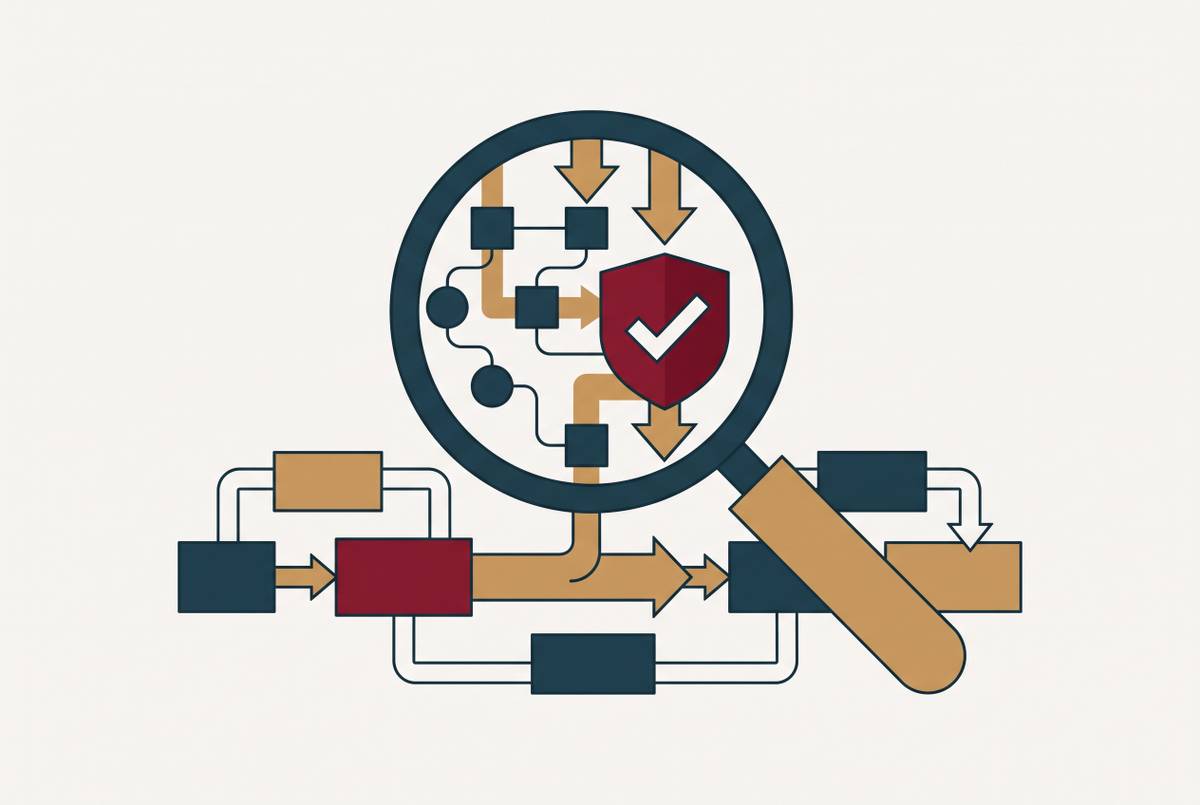
Voice Authentication Standards for Banking Transactions
Banks must separate voice convenience from voice authentication to prevent account takeover.
Voice authentication standards for banking transactions set the rules for when a spoken request can lead to a financial action. They are layers of identity verification, liveness detection, risk-tiered authorization, and audit trails. A system needs enough evidence and authority to act on a customer’s request.
Why voice banking moved from pilot to production in 2026 — and what changed the stakes
In 2026, banks began using voice interfaces to complete transactions as well as route customers and answer questions. A spoken instruction could now complete a transfer or lock a card. That changed the consequence of getting it wrong. An error in an answer may be corrected in conversation, while an error in execution changes an account and creates financial and regulatory exposure.
This shift depended on infrastructure as well as AI capability. Voice agents needed the data foundation to work reliably with banking systems as well as hold a convincing conversation. Once that foundation was available, governance and identity became the bottleneck. Could the agent act, and should it act, became separate questions. Production readiness therefore required more than proof that the voice interface worked.
Why voice convenience and voice authentication are not the same control, and why confusing them is dangerous
The most consequential design error is to treat an easy conversation as evidence that the speaker is authorized. Voice convenience makes it easier to ask for a task to be done. Voice authentication establishes who is speaking before a higher-risk action proceeds. The same channel serves both purposes, but that does not make them the same control.
The trap begins when frictionless interaction becomes the goal for every decision. A balance readout may need only a lighter identity check, but a transfer, profile change, or card replacement needs more proof than voice alone can give. Account recovery is especially sensitive because it can change who controls future access. Allowing it on the strength of a spoken request exposes the institution to account takeover and credential resets.
The bank must first classify the request, then choose what proof it needs. Is voice alone acceptable, is a second factor needed, or must the interaction move to another channel? That decision belongs to the authorization design. It should not emerge from how smoothly the conversation happens to be going.
How voiceprint biometrics work and where their limits begin
Voice biometrics give that design a useful first layer by comparing incoming speech with an enrolled voiceprint. The comparison reaches beyond how a person sounds to another listener. It draws on vocal tract resonance, vocal cord vibration, and behavioral features such as rhythm, cadence, and pitch modulation. These features create a pattern associated with the speaker. The system extracts them from incoming speech, compares them with the stored pattern, and calculates a similarity score.
Active enrollment asks the customer to speak a dedicated phrase, while passive enrollment builds the voiceprint across natural calls. A hybrid approach starts with a short passphrase and refines the model through later interactions.
A match shows that the incoming voice is like the enrolled voice. Liveness requires evidence that the account holder is speaking live at that moment. Voices are not secrets, and audio captured in public or semi-public settings can supply material for synthetic voice attacks. The strength of the biometric pattern does not remove the need to examine how that pattern reached the system.
Why synthetic voice attacks have outpaced voiceprint verification, and what liveness detection must do
Usable voice cloning attacks the assumption beneath voiceprint-only verification by replicating the input the system expects to recognize. A convincing match can therefore be the attack’s objective. OpenAI CEO Sam Altman has publicly warned of significant fraud risk for banks that treat voiceprints as sufficient authentication. The warning comes from within the organizations building the underlying models.
Liveness detection addresses a different question from biometric matching. Is the system hearing a live human speaker, or synthetic or replayed audio? That distinction requires its own anti-spoofing layer. It cannot be inferred merely because the similarity score is high or the caller answers in a familiar voice. Matching and liveness must supply different evidence to the authorization decision.
In 2026, liveness detection is a non-negotiable requirement for U.S. financial applications seeking to mitigate automated fraud. It should be part of the wider authentication and fraud-monitoring processes, especially for wire transfers, digital wallet payments, and ACH activity. The arms race makes this separation essential because a control built to recognize a voice is not, by itself, a control built to detect an imitation.
How risk-tiered authorization maps authentication requirements to transaction types
Risk-tiered authorization connects those technical layers to the consequence of the requested action. It does not demand maximum friction for every interaction. A branch lookup, balance inquiry, or recent transaction read-back can use a lighter identity check, but moving money needs stronger assurance. The request must be classified before execution and before the agent has committed to completing it.
Higher-risk actions include transfers, card replacement, profile changes, credential resets, and payee additions. These require step-up verification through a voice biometric plus a second factor, or escalation to a channel with stronger assurance. NIST SP 800-63 Digital Identity Guidelines provide the formal vocabulary for mapping assurance levels to action types. The bank still has to map its own requests to the required level.
Fraud signals can raise that requirement during a call. Caller behavior, device context, and account history may reveal inconsistencies even when the request starts in a lower tier. Payment workflows also show how an external constraint shapes the path. PCI DSS 4.0 brings the recording path into scope when it touches card data such as PAN or CVV. The suppress-and-tokenize pattern hands off to a PCI-compliant capture pane, pauses recording, returns a token, and then resumes recording.
The compliance surfaces every voice transaction deployment must cover
Compliance shapes what the architecture may record, store, share, and retain from the start. It is not a cleanup task after deployment. Five surfaces give institutions a practical way to examine the design without treating every obligation as an isolated legal question. Each surface shapes a different part of how a transaction goes through. Together, they determine whether the institution can operate and explain the service.
The first surface is vendor risk, where SOC 2 Type II evidence supports assessment of third-party components in the authentication path. A contract term is not the evidence itself. The second is payment card security compliance scope minimization, which requires the design to keep the recording boundary described above. The third is financial privacy regulation that protects non-public personal information. Its audit cadence is annual at minimum, with continuous monitoring required unless the institution substitutes annual penetration testing and biannual vulnerability assessments.
The fourth surface is the law in each state on recording disclosure. Requirements vary across jurisdictions, so institutions must map them to their customer base and call routing. Location also shapes the fifth surface, including GDPR or CCPA obligations for storing, retaining, and deleting voiceprints. Biometric storage laws such as BIPA add their own requirements. These choices belong in the data design as well as in a customer notice.
The American Bankers Association updated its AI Policy Template in June 2026, and the Independent Community Bankers of America released its Community Banker AI Security Readiness Guide on June 3, 2026. Operationally, the decisive requirement is a durable audit trail. Every action must be reconstructable, including who called, when, what they requested, what the agent said, what system calls fired, and what the customer of record now sees. That record must remain usable beyond the call and QA cycle, including for a regulatory request years later.
What the deployment cost structure means for community banks and credit unions
These requirements create a resource gap for community banks and credit unions. They face the same regulatory demands as large banks with leaner teams and tighter budgets. Authentication is only part of the expense. Vendor review, recording controls, durable records, and incident planning all require resources beyond the voice interface itself. A functioning prototype therefore says little about the total cost of compliant deployment.
Credit unions also face demands for omnichannel member support, dispute intake, fraud monitoring, and regulatory workflow automation. Building the whole architecture from scratch is impractical for most. Vendor selection consequently becomes a budget decision as well as a security decision. When governance features are built into a platform, the institution has less to build and maintain itself. Auditability is a cost-reduction factor.
Core providers have committed to this area. Fiserv launched agentOS on May 14, 2026, with governed agents, kill switches, human-in-the-loop checkpoints, permission scoping, and auditability embedded by design. Jack Henry expanded its Google Cloud collaboration in June 2026 to build a proprietary AI security platform for its approximately 7,400 community bank and credit union clients. These commitments make control architecture part of the platform decision. For smaller institutions, the practical comparison is the cost of operating a governed service.
What governance and control architecture must be embedded in a voice banking platform — not bolted on after
An institution weighing a deployment should require controls over the actions the agent takes. Kill switches and permission scoping must let it halt an agent’s ability to perform a class of transactions without taking the whole system offline. Human checkpoints must sit before execution at defined risk thresholds. They are part of authorization. Otherwise, the institution is relying on intervention after the decision it needed to control.
The institution should also determine its risk tiers. That includes which transaction types require step-up authentication and what form that step-up takes. Complete, durable audit trails must keep a record of voice interactions, tool calls, and transaction decisions that can still be used years later. Partial logs that require reconstruction leave the institution with a different task from retrieving an intact record.
PaymanAI is one option that deploys agents to execute banking transactions through voice on existing rails, with configurable controls, approvals, full audit trails, and an institution-held kill switch. Its policy engine checks actions before they reach the core. The institution still needs to check whether those controls fit its authorization rules. Retrofitting governance after deployment is more expensive and less reliable than placing it in that execution path from the beginning.
Why human judgment remains a required layer even after all the technical controls are in place
Even a complete authentication stack cannot establish that an authenticated person has not been deceived. Paul Benda, executive vice president for risk, fraud and cybersecurity at the American Bankers Association, identified this failure mode in deepfake fraud. Customers and employees can authenticate correctly, follow procedures, and still send money to criminals. The deception occurs at the social layer. Proving who approved a payment does not prove that the reason for approving it was genuine.
That limit reinforces the need for mandatory governance. High-value transactions require out-of-band confirmation through a second channel that an attacker controlling the voice call cannot also control. Escalation above defined thresholds must be built into the agent’s authorization envelope. Human judgment needs a protected place to operate. It should not depend on someone choosing to interrupt an otherwise authorized flow.
The ICBA guide places board oversight and incident response planning within that broader responsibility. Governance is an organizational posture as well as a technical configuration. The technology is ready, but deployment still requires clear decisions about where automated authority ends. For an institution choosing a platform, the final test is whether authentication, escalation, and human confirmation are enforceable parts of each relevant transaction path.
Sources
- What is the difference between voice convenience and voice authentication in banking?
- The voice fraud threat to banking
- A Survey of Threats Against Voice Authentication and Anti-Spoofing Systems
- Systems and methods of voice authentication in transactions
- 2026 Top 10 Tech Issues For Regional and Community Banks