Spend Limits for Autonomous Payment Agents
How banks can enforce agent payment limits in policy, not prompts.

Autonomous payment agents need spend limits that define both what they may do alone and when a human must decide. Those limits are the primary mechanism that makes agentic banking useful and safe. For banks and credit unions, the task is to turn existing approval rules into enforceable policy outside the model, under the institution’s control, before an agent can move money.
Why spend limits are the defining question for agentic banking right now
Payment infrastructure has changed faster than bank leaders have come to understand what it lets them do. Fiserv launched agentOS on May 14, 2026, with kill switches and human oversight across its core, payments, issuer processing, and servicing platforms. Eltropy launched a governed agentic AI platform for credit unions in March 2026, serving 750+ community financial institutions under a “Safe AI Framework.” These are production platforms. Their arrival puts questions about delegated authority on the operating agenda, rather than leaving them for a future technology review.
The decisive change is from advice to action. An agent that recommends a payment leaves a person to authorize it, while an agent that initiates one without a human clicking confirm needs an enforceable boundary around that authority. What amount can it move, to whom, and under what conditions? The answers determine which work can proceed unattended and which decisions remain with staff. It may seem that the simplest answer is to put those instructions in the model’s prompt, but that confuses a request for compliant behavior with a control over money movement.
Why telling the model to stay within a budget is not a spend limit
A prompt-level budget looks convincing because it reads like a normal instruction. It is easy to set, clear to a human reader, and apparently part of the agent’s assigned job. But it remains text for the model to interpret. The model can misread it, ignore it, or be manipulated through prompt injection into bypassing it.
The distinction is between instructions and authorization. An instruction tells the agent what it should propose, while an infrastructure-level control decides whether that payment can go ahead. Spending authority therefore has to exist as data in a separate policy layer, checked when a payment is requested. At the wallet or custody layer, an enforced restriction does not depend on the model accepting the rule. The model may produce a request outside its mandate, but it cannot grant itself permission to complete that request.
GLEIF’s working paper distinguishes a static mandate from a runtime policy engine. The mandate defines the agent’s authority in principle, while the engine evaluates the conditions at the moment of execution. That timing is essential for cumulative budgets. The same request that fits within a monthly allowance on Monday may exceed it on Friday because other payments have used the available amount.
MAS and industry members’ SAFR framework, version 1.1 published in October 2026, also calls for a runtime decision each time an agent acts. Authorization must be independent of the model’s reasoning, even with a more forceful prompt. For an institution, that distinction also establishes where responsibility lies. A model that reasons around an instruction has not transferred responsibility for the resulting noncompliance to its vendor.
What dimensions a spend limit must actually cover
A per-transaction maximum answers the most obvious approval question. In a loan operations team, it defines the largest individual payment an agent may initiate without escalating to a person. That is a useful boundary, but an incomplete one. It says nothing about how many permitted payments the agent can make, whether the recipient is approved, or whether the payment belongs to an authorized category.
An aggregate budget caps how much money is at risk over a set period. A teller supervisor would recognize that approving an individual transfer and authorizing the total amount handled over a day or month require separate controls. Without both controls, many small payments can exceed the intended budget even though no single payment breaches its limit. Coinbase’s Agentic Wallets, launched February 11, 2026, illustrate infrastructure enforcement through per-session and per-transaction limits. Bank operations can apply this pairing of controls independently of the deployment model.
A loan operations agent may be authorized to pay only allowlisted counterparties or destinations, regardless of how small the payment is. J.P. Morgan Payments’ 2026 outlook describes autonomous transactions within defined, narrow parameters. Rules on where payments can go help set those parameters, but even an approved recipient can make a request that is not legitimate. An allowlisted merchant’s invoice could still contain fictitious line items, so an allowlist cannot stand in for controls over what is being paid for.
Transaction category sets out the kinds of money movement that the mandate allows. For a teller supervisor, an internal transfer and an external payment need not belong to the same approval tier simply because their amounts match. Internal transfers, bill pay, domestic wires, and external payments can have different risks and regulatory treatment. The Consumer Bankers Association’s January 2026 white paper frames agent authorization as conditional on parameters set in advance.
Time limits complete the scope of that authority. A BSA officer reviewing an agent’s mandate would need to distinguish permission to act now from permission that has expired or applies only during business hours. GLEIF’s proposed mandate has a validity period, and policies for day-to-day work can also set time-of-day restrictions and rate throttling within a session. These controls answer different questions from a dollar threshold. A payment can meet the rules for amount, destination, and category and still be made outside the time when it is allowed.
These dimensions support graduated autonomy. A new agent can begin with a low daily cap and human approval for every transaction, then gain broader authority after demonstrating reliable decisions. Higher values can still require two authorized humans. That approval chain is a separate check, even when the agent’s general mandate allows the transaction.
Where the policy engine must sit and who must hold it
The policy engine belongs between the agent’s payment request and the payment rail. The agent proposes an action or acts within its mandate, while a separate authorization service releases funds only after the relevant checks pass. The model must not be able to rewrite those checks. “Immutable” in this setting means immutable by the model while remaining open to authorized institutional changes. Otherwise, the supposed limit is another instruction the agent can interpret.
Backbase’s AI-native Banking OS, introduced in April 2026, implements an “Authority Layer (Sentinel)” that checks every agent action against bank policy before execution and logs it afterward. Both the check and the log sit outside the model. Fiserv’s platform also embeds kill switches and human-in-the-loop checkpoints in its architecture. These mechanisms give the institution a way to stop action without asking the model to cooperate. Their value depends, however, on who controls their use.
Who sets the policy, who may change it, who can read the log, and who holds the kill switch? The institution needs control over the authority delegated to its agent and the evidence showing how that authority was used. A vendor can run the technology while the institution keeps control of its approval policy. If the institution cedes that policy control, it weakens its ability to demonstrate that a disputed transaction was properly authorized.
SR 26-2, issued April 17, 2026, superseding SR 11-7, leaves generative and agentic AI outside its model risk management scope in a footnote and directs banks toward existing risk management practices. NCUA evaluates AI through existing BSA/AML, fair lending, vendor management, and third-party oversight frameworks. A vendor operating spend controls therefore remains subject to third-party risk management due diligence, contracts, and ongoing monitoring.
The Bank of England’s Sarah Breeden identified dispute settlement and liability for erroneous or fraudulent agent transactions as open questions at the ECB Sintra Forum in June 2026. The association’s April 2026 supplemental letter also warned that consumers may face costly mistakes from agents acting under delegated authority. Neither concern is resolved by a vendor’s assurance. The institution needs its own control over the mandate and a record of its enforcement.
What happens when escalation triggers and a human must decide
A loan servicing agent that sends a transaction to a loan officer has not necessarily failed. It may have reached exactly the boundary its policy intended. The same principle applies when a BSA agent flags an alert for human review. Escalation assigns a decision to the person authorized to make it. Its design therefore belongs in the operating model from the outset.
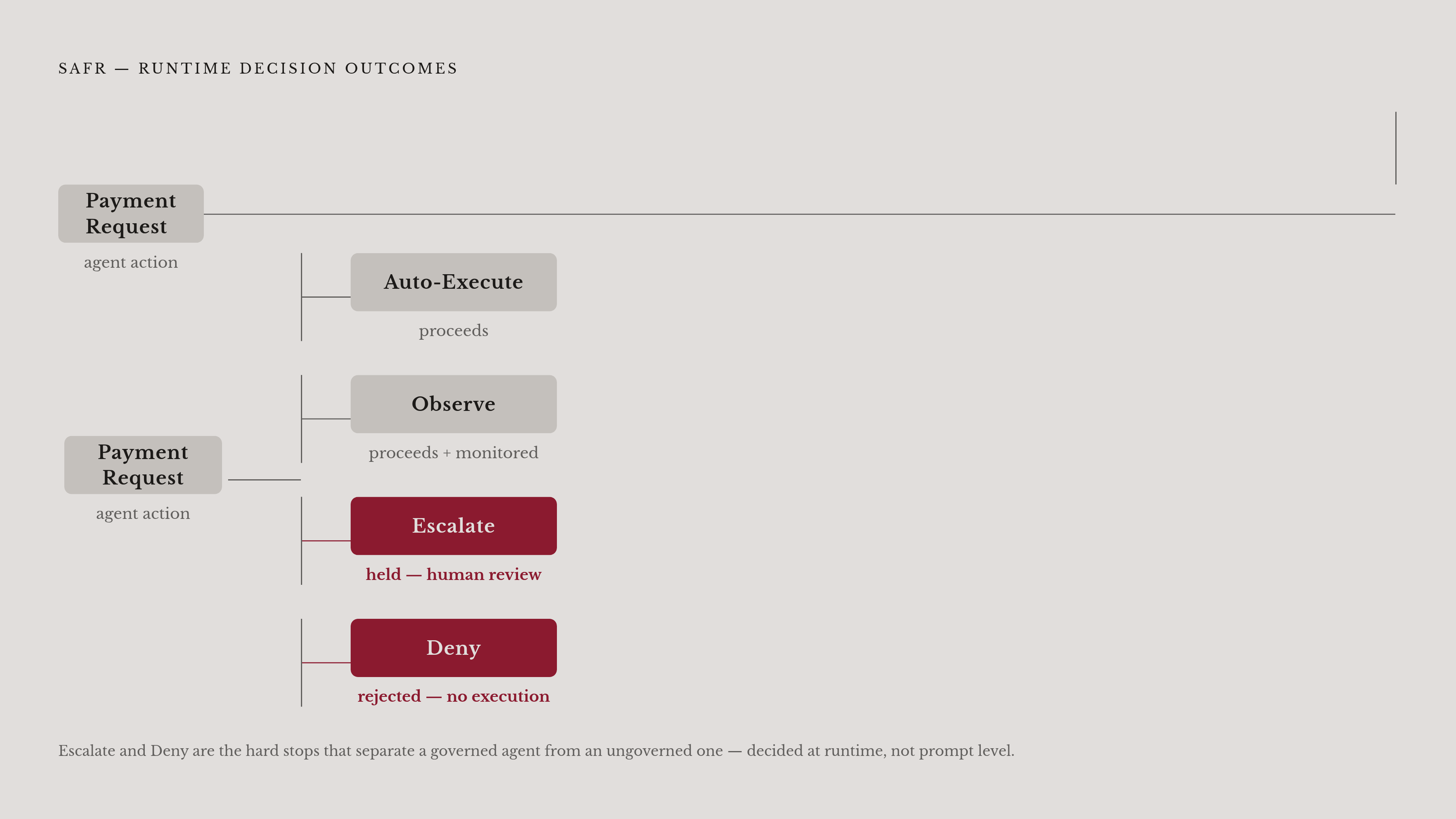
The SAFR framework defines four runtime outcomes, which are Auto-Execute, Observe, Escalate, and Deny. Auto-Execute allows the action to proceed, while Observe allows it to proceed with monitoring. Escalate holds it for human review, and Deny rejects it before execution. Breeden also noted that keeping a human in the loop for every agent action is unlikely to be realistic at scale, making selective escalation essential.
For a loan servicing workflow, the practical questions are straightforward. Which loan officer receives the request, what information accompanies it, how long is the approval window, and what does the agent do while waiting? The escalation path must answer all four. An unanswered request must default to blocking the action. Where policy requires two authorized people, one approval cannot substitute for the complete approval chain.
Human review need not erase the agent’s usefulness. Citi Institute GPS describes a model in which agentic AI handles most tasks but leaves final approvals to humans. The payments outlook also describes agents proposing actions while people have the final say. A loan officer can thus make the decision without having to do all the work to prepare for it. This division of labor is particularly useful for high-value or novel transactions that do not belong on an unattended path.
The approval record must survive the handoff to staff. It needs to show what triggered escalation, who was notified, what they decided, and when. Tamper-evident logging of the policy match and human approval makes the authorization chain reconstructable if an examiner or a dispute later calls it into question.
How banks and credit unions can start with spend limits they already understand
A teller may act up to one amount, a branch manager another, and an executive a third, with dual controls and audit trails where required. Agentic banking expresses those authorities as machine-readable policy evaluated at runtime. The institution needs to specify how an agent fits within the authority structure it already governs.
The institution should start with one high-volume, low-risk transaction category, such as internal transfers, under policies it controls. A new agent can operate with a low per-transaction cap, a tight aggregate budget, a narrow payee allowlist, and human approval for every action. This is supervised operation before broader autonomy. As the decision history accumulates, staff can compare outcomes with the audit trail and relax particular dimensions only where reliability supports the change. A larger daily budget does not have to let the agent pay more payees or use more payment types.
Capitol National Bank’s use of agentic AI in BSA and AML back-office operations shows how a trained employee can catch a wrong answer before it leads to a payment error that affects a consumer. The Fiserv and Eltropy platforms also demonstrate that governed agentic AI can run on existing core and digital banking infrastructure without replacing it. Institution-held kill switches then provide a way to halt action if a policy dimension proves miscalibrated.
Building this capability helps with more than getting ready for an examination. McKinsey’s April 2026 analysis found that a majority of customers would use a third-party AI agent if their bank did not offer one. Those agents operate outside the bank’s spend-limit controls, audit trail, and kill-switch authority. That creates a relationship question as well as an operational one. Enforceable limits give the institution a way to say yes to AI-assisted money movement while keeping the customer’s delegated authority within a banking relationship it can govern.