Approval Tiers for AI-Initiated Transfers
Tiering AI payments by consequence, not model capability, sets which transfers need a human.

Approval tiers for AI-initiated transfers match human oversight to what a mistaken transaction could do. A workable design defines which actions can proceed, which need approval, and which agents cannot execute. Its strength comes from clear thresholds, owned escalation paths, and policy controls outside the model, where the institution sets the agent’s limits.
Why AI-initiated transfers need a different approval model than human-initiated ones
AI agents in banking already carry out real transactions. Unlike a chatbot that supplies an answer, a payment agent changes system state by moving money. That difference changes the cost of being wrong. A poor response can mislead someone, but a poor payment action produces a transaction that may be difficult to reverse. Approval workflows therefore have to govern execution as well as the quality of an answer.
The person initiating the action is also an accountable party, even where further approvals apply. When an agent initiates the transfer, that link is severed unless the institution rebuilds it through policy. Who has authorized this particular action, and within what bounds? A general decision to deploy an agent does not answer that transaction-level question. An existing human approval workflow therefore cannot simply treat the model as another employee.
What consequence-based tiering means and why it replaces capability-based thinking
Consequence-based tiering starts with a different design question. Rather than asking “how capable is the model?”, it asks “how far can a mistake travel?” An internal productivity tool with no customer or financial data exposure has a smaller reach than an autonomous payment agent. The payment agent needs tighter oversight because its actions have broader consequences and are less reversible.
The CSBS AI Supervisory Framework, published September 16, 2026, uses three tiers for state examiners, ranging from internal human-reviewed use to direct consumer outcomes with limited human review. Its structure connects autonomy with consequence. A capable model does not make an irreversible payment reversible, nor does its performance record define who may authorize one.
“Blast radius” gives this principle a concrete scope. It means the systems, APIs, datasets, and customer segments an agent can reach. That reach should be limited to what the task needs. Tiering then governs what the agent may do within those boundaries, with human involvement increasing as the potential consequences grow.
How the four tiers map to specific transfer types and what each tier requires
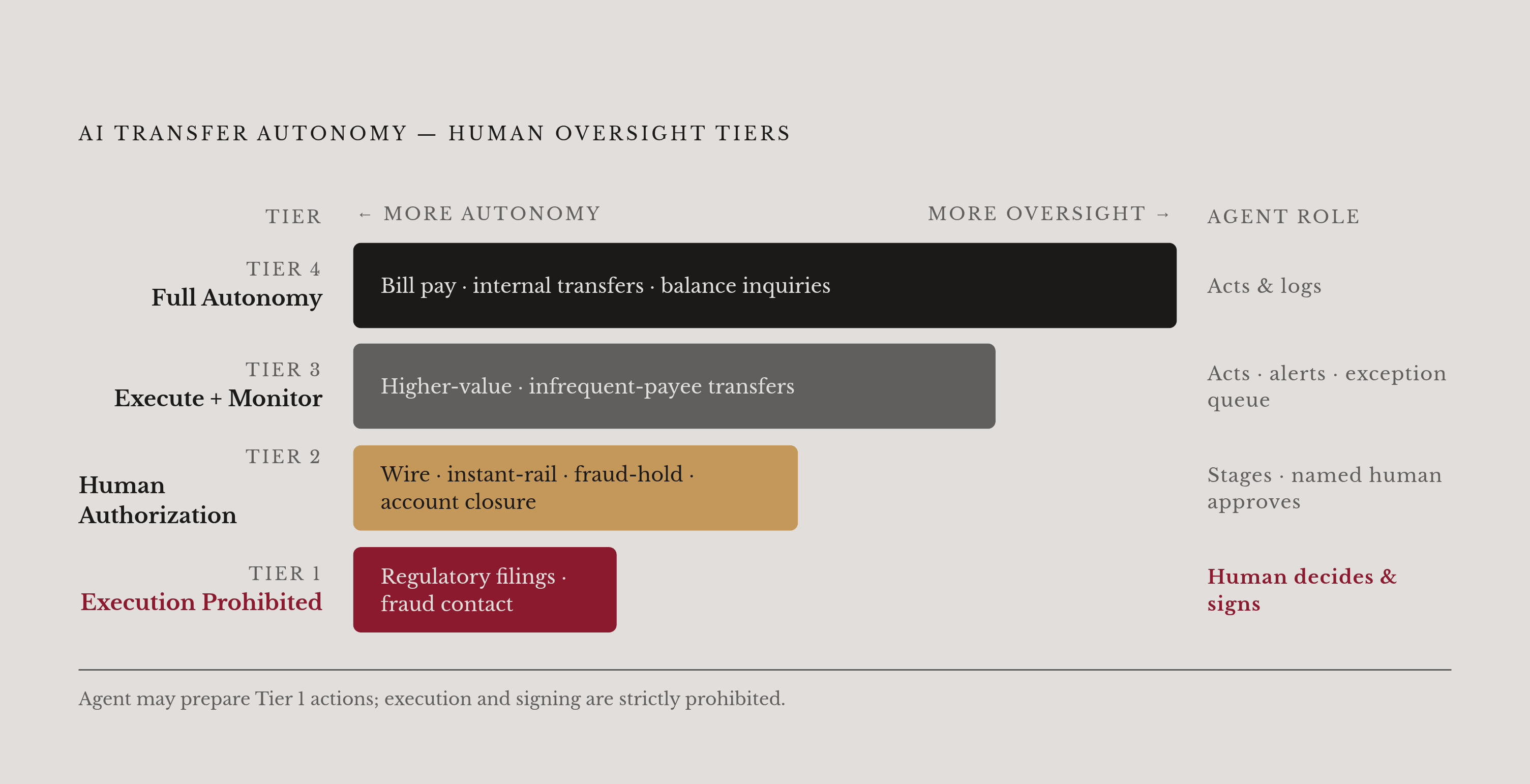
Every AI-initiated action should belong to exactly one tier before deployment, with explicit criteria for its placement and escalation. In this four-tier design, Tier 4 permits full autonomy. It covers routine actions that are low-value, can be reversed, and stay within hard dollar limits, including bill pay to a pre-authorized payee within a standing limit and internal transfers between a member’s own accounts within a defined limit. Balance inquiries made as part of a transfer also fit here. The agent acts and the action is logged, without an interrupting human approval step.
Tier 3 permits execution with real-time monitoring and exception escalation. It covers routine transfer types that involve higher values or payees that have not been used within a defined period. A transfer above the low-value limit but below a threshold set by the institution may belong here. The agent acts, but alerts fire when its behavior departs from a behavioral baseline, and staff review cases in an exception queue.
Tier 2 requires human authorization before execution. It includes releasing a payment on an instant rail, a domestic wire above a set limit, and releasing a fraud hold. Related account actions include closing or reopening an account and changing a customer’s risk rating. The agent prepares and stages the action. A named human must authorize it before funds move.
Tier 1 prohibits agent execution, while allowing preparation. Actions with a direct regulatory filing obligation belong here, as do contacting a customer about suspected fraud or an account closure. The human decides and signs, going beyond a review of work already done. OCC Bulletin 2026-54 places autonomous payment agents and fraud-hold release among the uses requiring the most stringent oversight regardless of model performance.
Where the tier thresholds sit and how to define them so they hold under examiner scrutiny
The institution needs documented rules that explain why one transfer proceeds automatically while another requires approval. No universal dollar amount follows from this framework. A defensible threshold instead connects the transaction’s value, recipient, rail, frequency, and account status to the autonomy allowed.
The dollar limit must be a hard value enforced in the action gateway. Payee novelty needs a definition just as precise, covering whether the recipient has received funds from that account before, over what period, and above what total value. Rail type adds a separate constraint because RTP and FedNow differ structurally from ACH in reversibility. An instant-rail mistake cannot be recalled the way an ACH entry can.
Velocity limits trigger escalation when transfers repeat within a rolling period, no matter how small each transaction is. Account flags add another boundary. If the account has a fraud alert, elevated risk rating, or active dispute, the action automatically moves to the next tier. Together, these inputs prevent the dollar amount from becoming the only measure of consequence.
To enforce those rules, a policy engine sits between the agent’s output and the core ledger. This orchestration layer evaluates the proposed action before passing it downstream. The CSBS framework and the OCC’s four-tier approach both connect autonomy with consequence, giving institutions a basis for documenting their choices. A record showing how thresholds map to those dimensions is stronger than limits chosen by feel or an assurance that “the agent knows not to.”
What the escalation path looks like when a transaction crosses a tier boundary
An escalation needs a person, a deadline, and a default. A queue without an owner does not establish who must act, and a notification without a response window does not establish when a decision is due. The institution should name an owner, a validator, someone able to stop the agent externally, and someone responsible for declaring an incident.
In a trading context, a kill switch can halt position-taking, providing a symmetric, low-cost default. Payment decisions are less straightforward. Auto-approval and auto-decline have asymmetric costs that cannot substitute for one another, so neither is simply a neutral absence of action. The institution must choose and document the default before deployment, typically decline and log with a customer notification path.
The workflow must also specify whether the transaction is held, staged, or reversed pending approval. That status belongs with the named recipient, response window, and default action in the escalation design. The approver then needs more than an approve-or-deny notification. Transaction details, the agent’s reasoning, the policy rule that fired, and the triggering evidence provide the basis for judgment.
HSBC’s public governance commitment is to “maintain human judgement, human decision-making and human accountability at the core”. That principle requires a meaningful decision point. If the person receives too little evidence or can only ratify an action after the fact, the presence of a human has not supplied the oversight the tier promises.
Why the policy controls must sit outside the model and what that means in practice
The agent’s output must be a request for execution. A probabilistic model connected directly to a deterministic payment rail would otherwise combine proposing an action with authorizing it. Instructions to be helpful and instructions to stay safe do not resolve that conflict on their own. An independent orchestration layer holds the policy the model cannot override.
Anbang Ruan’s March 2026 working paper on autonomous agent economies describes what goes wrong when agents plan, carry out, and judge their own actions. The paper is a pre-peer-review argument. Its proposed remedy requires separation of those functions beyond improvements in alignment alone. In payments, that separation means the agent does not become the authority deciding whether its own proposed transfer is permitted.
OWASP’s guidance on excessive agency places authorization in downstream systems. Its prompt injection guidance also states that prompt injection cannot be reliably prevented. The rules must still hold even when the model is told to ignore them.
In practice, the external layer evaluates each request against the tier rules before it reaches the core. Those rules are immutable from the model’s perspective. The layer keeps a tamper-evident audit trail of approved, escalated, and blocked decisions that does not depend on model memory or session state. It also holds the kill switch, so an authorized human can stop agent-initiated payment actions without changing the model, core, or digital banking layer.
What examiners are actually checking when they review AI-initiated payment controls
There is no separate AI exam for these controls. NCUA or OCC review reaches AI-initiated payments through existing frameworks, including BSA/AML, vendor management, third-party risk, and consumer compliance. The questions within those frameworks are now AI-specific. For an agent that moves money, governance, risk assessments, vendor management, and security all become part of the examination record.
For every AI-driven decision, examiners expect a complete audit trail that shows data inputs, model outputs, the policy rule that fired, and version control. Written rules must spell out which actions are in-bounds, approval-required, or blocked, and the system must enforce those rules. A prompt that describes those categories cannot demonstrate that a prohibited action was prevented. The distinction is between describing authority and proving its limits.
The April 2026 interagency model risk management guidance, SR 26-2, explicitly excludes generative and agentic AI from its scope. The guidance is expected to apply most to institutions above a certain asset threshold. That leaves a governance gap for community banks and credit unions, but not a reason to wait. Existing frameworks provide the basis for building a defensible payment-agent control structure before a specific AI rule arrives.
Citi’s Arc platform, launched in April 2026, and HSBC’s heightened-scrutiny inventory process illustrate institutional responses to this problem. Citi’s September 2026 public statement describes agents deployed with “the same rigor and control applied to any critical system within the firm”. The relevant standard is therefore not a special exemption for new technology, but evidence that the institution governs its consequences.
How to keep the tier structure current as models update, transaction patterns shift, and new rails are added
A sound launch decision can become stale. A vendor’s model update may change behavior at tier boundaries, particularly under adversarial input, so it should trigger reassessment. A new payment rail also needs its own tier review because reversibility may differ from the rails already approved. Adding FedNow, for example, changes what can follow from an agent’s actions as well as what the agent can do.
Transaction patterns can change without a model or rail update. A significant shift in transfer velocity or value distribution should therefore reopen the tier assessment. An action that was low-value and infrequent at launch may become high-volume and high-value.
Security incidents and supervisory signals require review as well. The Bankr incident of May 19–20, 2026, involved an attacker accessing wallets through injection via messages, after which transactions were disabled. An incident at a peer institution is a reason to retest local controls. A new supervisory bulletin or examiner letter similarly changes what the institution must be able to demonstrate.
The kill-switch owner, runbook, and test results belong in a living record. Reassessment must be institutionally owned and extend beyond a vendor’s release schedule. The institution holds the funds, the license, and the kill switch, so it remains accountable when a boundary fails. Approval tiers, external policy controls, escalation paths, and reassessment all express that same allocation of authority.