Wire Transfer Irrevocability and Its Implications for Fraud Recovery
Settled wires can't be reversed, so recovery depends on speed.
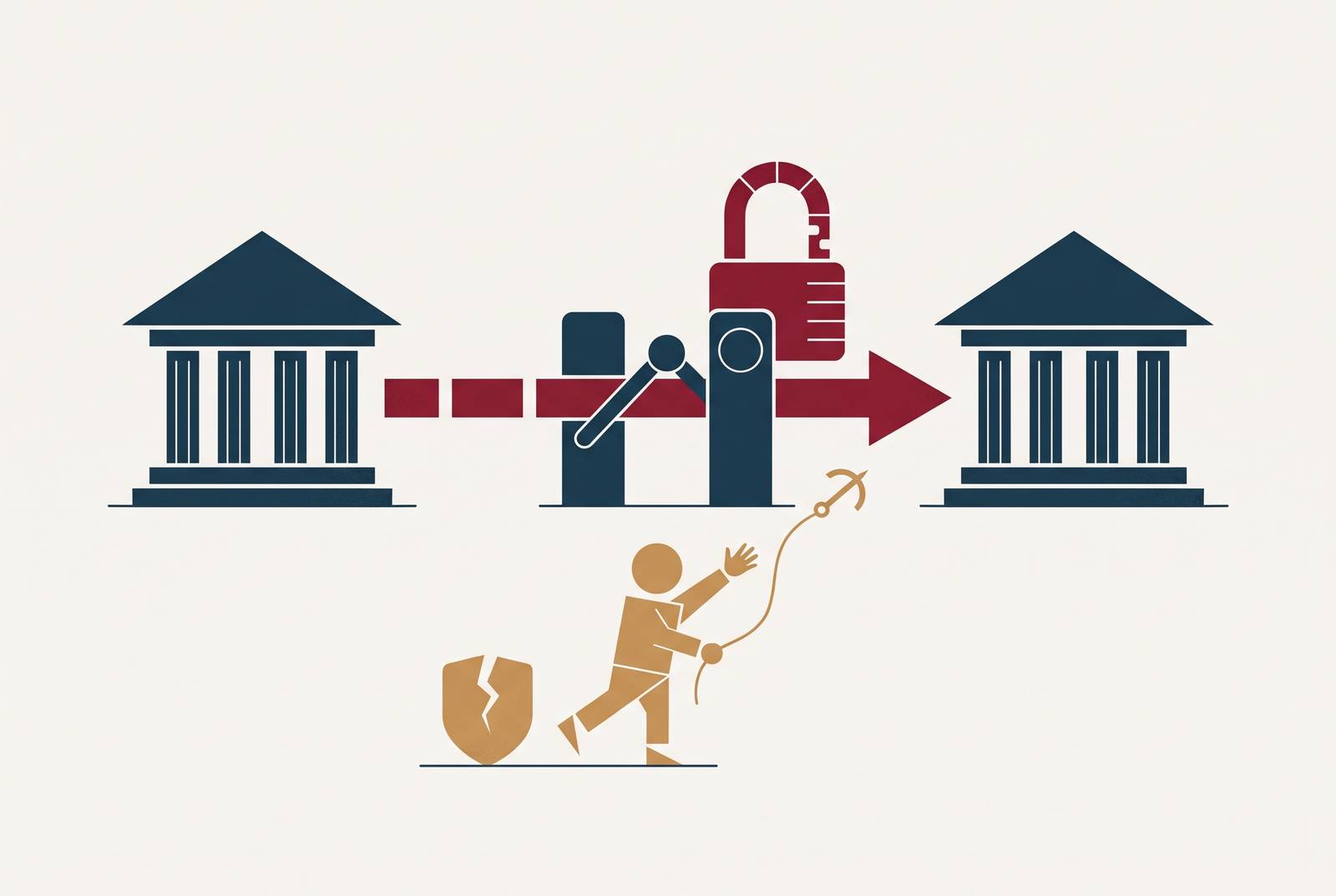
Wire transfer irrevocability determines both what fraud victims can recover and how banks process payments. Once a wire is accepted, recovery depends on cooperation, speed, and whether the money is still within reach. This makes prevention before execution the only structurally reliable defense, while recalls and law enforcement remain urgent but uncertain backstops.
Why wire transfers are structurally different from every other payment method
Wire transfers are legally final when the receiving bank accepts the funds. UCC Article 4A, adopted across all U.S. jurisdictions, establishes that finality. The distinction is built into the payment method. Unlike ACH transactions, which have return rights for several business days, Fedwire transfers have no built-in reversal mechanism. A sender cannot undo a settled wire simply by reporting that the payment was a mistake.
A wire is a push payment, with the sender directing cleared funds to a beneficiary through the banking system. Once those funds are credited to the account, they can move again. Same-day settlement, high limits, and the absence of chargebacks make wires useful for legitimate commerce, but they also make wires attractive to fraudsters. Speed and finality serve both purposes equally well. That legal and operational finality is the starting point for understanding every fraud recovery option.
The difference between a wire reversal and a wire recall, and why it matters for fraud victims
What, then, does a bank mean when it offers to recall a wire? It does not mean the bank can reverse it. A reversal applies when the bank itself made an error, such as sending the wrong amount, duplicating a transfer, or using the wrong account. The bank is obligated to correct its own error. Fraud often presents a different situation because the bank executed the instructions the sender approved.
A recall is a bank-to-bank request asking the receiving institution to return funds voluntarily. Under UCC Article 4A, that institution has no legal obligation to comply with the recall request. Two conditions must therefore align for it to work. The money must remain in the receiving account, and the receiving bank must cooperate. If that bank agrees to freeze and return the funds, it will require a Hold Harmless Letter or Letter of Indemnity from the sending bank to protect itself from liability, adding another procedural step.
Authorization creates a further distinction that can be easy to miss during a crisis. A sender deceived by business email compromise or real estate deposit fraud may still have authorized the payment. Account takeover, where the victim gave no authorization, presents a different legal situation and stronger protections. Both may involve fraud, but the legal standing and escalation path are not interchangeable.
How fast fraud operations drain receiving accounts and what that does to recovery odds
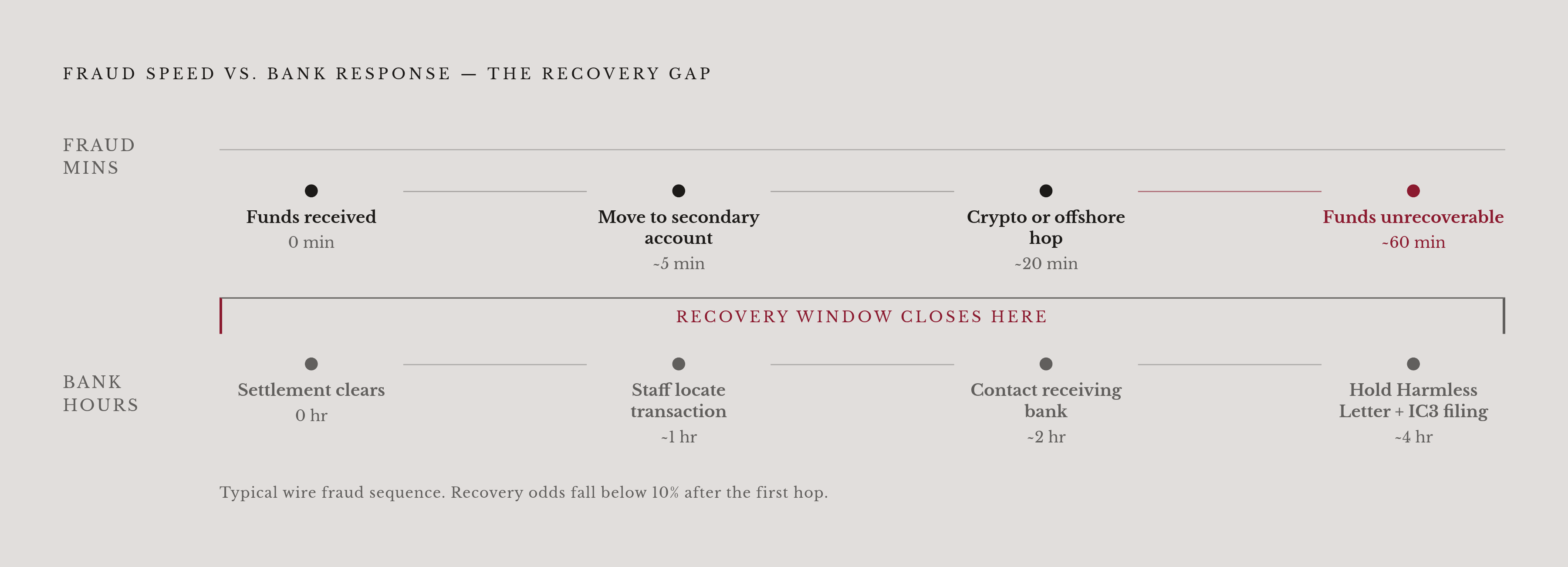
A recall depends on the money staying still, while professional fraud operations are set up to keep it moving. Fraudsters quickly move funds from the first receiving account to other accounts, often overseas. The recovery window can be measured in minutes. Each transfer makes the money harder to reach, and turning it into cryptocurrency or moving it into offshore accounts can leave banks with almost no way to recover it on their own.
Banking processes operate on a different clock. A sending bank’s recall request and the receiving bank’s response typically process within the same day, but that work starts after settlement. Fraud operations move at machine speed while bank employees find the transaction, contact the other bank, and get the required paperwork ready. The relevant window is not the bank’s response time alone, but how much of that time passes before the receiving account is drained.
Discovery delay widens the gap further. Phishing, business email compromise, account takeover, malware and remote-access software, and tech-support scams, including the “Phantom Hacker” variant, all seek to delay the victim’s recognition of the loss. The IC3 2025 Internet Crime Report summary said that reported losses from business email compromise were in the billions. The scale is substantial, but the operational problem is specific to each payment. If banking channels cannot reach the funds after they move, what can law enforcement offer?
What law enforcement programs can and cannot do once a fraudulent wire has executed
The Financial Fraud Kill Chain provides a route for banks and law enforcement to coordinate an urgent freeze. The IC3 Recovery Asset Team, established in 2018, streamlines communication between financial institutions and FBI field offices. The IC3 report states that the kill chain was initiated on thousands of incidents in 2025 and froze a majority of the dollars targeted in those cases. Those are meaningful results within the cases reached. They are not a recovery rate for everyone who loses money to wire fraud.
FinCEN’s Rapid Response Program provides another federal route to interdict and recover stolen proceeds. The program has facilitated the interdiction and recovery of billions since 2015 on behalf of thousands of U.S. victims, though that remains a small fraction of total fraud losses over the same period. Victims cannot activate it by contacting FinCEN directly. A victim or financial institution must file a complaint with IC3 or the Secret Service, after which law enforcement reviews the complaint and refers it to FinCEN. Incomplete information can delay or derail that process.
These mechanisms extend the reach of recovery, but they do not remove its dependence on timing. The kill chain can reach “second hop” transactions in domestic or international accounts, although each hop reduces the chance of a successful freeze. Authorization also remains a separate legal question. Federal intervention does not turn a deceived sender’s authorized payment into a bank error with an automatic correction right. The best chance still comes when the fraud is reported quickly, the records are complete, and the funds are still within reach.
Could investigation and prosecution eventually make up for a missed freeze? A conviction rarely produces financial restitution because the funds are typically long gone through layering by the time prosecution ends. Accountability and repayment are different outcomes. Everything described so far responds to a payment that has already executed. A proactive posture begins with preparation for that emergency, but ultimately has to reach further back, to the decision to release the wire.
The immediate steps that maximize the odds of any recovery at all
For a victim facing a suspected fraudulent wire, the immediate task is to reach the people who can request a hold. The first call should go to the bank’s fraud or wire department. State clearly that this is suspected wire fraud requiring an urgent recall and recipient-bank hold request. Before dialing, have the account number, exact amount, transfer date and time, recipient bank name, recipient account number, and routing number ready.
Preserve the evidence without altering it. That includes fraudulent emails with full headers, wire confirmation screens, the source of the payment instructions, and the internal approval chain. Prepare a timestamped, one-page incident timeline so banks and law enforcement can follow the sequence. The first two hours are especially important, and complete records help institutions act without having to reconstruct basic facts. Ask the bank representative whether the Hold Harmless Letter or Letter of Indemnity has been initiated for use if the receiving bank agrees to freeze the funds.
Classify the event immediately as authorized but induced by deception, or unauthorized through account takeover. That difference affects which legal protections apply and which escalation path to take, so the account should describe what happened without assuming that all fraud is treated alike. File a complaint with IC3 or the Secret Service so law enforcement can act. Recovery prospects drop sharply after the first day, but even a prompt, accurate, well-coordinated response cannot guarantee that money will remain available to recover.
Why the recovery odds, even under ideal conditions, make prevention the only structurally reliable defense
Freezing a majority of the dollars targeted in selected kill-chain cases does not establish that most victims will recover their funds. The denominator changes the meaning of the result. Cases that reach an interdiction program are not the same population as all fraudulent wires, including those discovered after the money has disappeared. Successful intervention shows that urgent reporting is worthwhile.
Even the Rapid Response Program depends on several conditions lining up, including prompt reporting, complete documentation, law enforcement referral, and funds that remain within reach. The victim can control only some of those conditions. Faster reporting cannot put money back into an emptied account, and better paperwork cannot create a reversal right. Meanwhile, staff hours, bank trace fees, legal consultation, and operational disruption add to the loss. Partial recovery does not remove those costs.
What if the organization has fraud insurance? Insurance may cover some losses, but it introduces delays, deductibles, and documentation requirements, and premiums rise after claims. It does not repair client relationships or reputational damage. Prevention is structurally different because it acts before the institution loses control over execution. That is why pre-execution controls deserve priority, but what do those controls look like inside a financial institution?
What pre-execution controls look like inside a financial institution, and where human review breaks down
Segregation of duties and approval workflows reduce errors by placing checks between payment instructions and execution. Dual approval, callback verification, and payment instruction change protocols work when staff follow them every time. Their value should not be dismissed. Their weakness is that they depend on human judgment under time pressure, including situations in which a fraudster is deliberately making a false request appear routine or urgent. The design of the attack creates the problem despite the commitment of operations or compliance staff.
CertifID’s 2026 State of Wire Fraud Report found that business email compromise attacks surged 1,760% since generative AI tools became widely available. Faster, more convincing impersonation makes a reviewer’s task harder at the same time that attack volume increases. Account takeover creates a different weakness. A fraudster operating inside an authenticated session can bypass approval workflows rather than persuade a legitimate sender to approve false instructions. A control built around trusted access is less useful when that access has already been compromised.
Manual review also places a throughput constraint on payment operations. As payment volume grows, more wires require scrutiny, and understaffed queues create pressure to approve without scrutiny. Instant payment rails add to that pressure because FedNow and RTP transactions are designed to settle in seconds, leaving even less time for intervention. Manual controls remain necessary, but institutions increasingly need automated validation that operates before execution at the speed of the transaction itself.
How automated pre-execution validation and agentic controls close the gap that manual review cannot
Automated account validation checks who owns a bank account in real time and can stop suspicious transactions before they execute. That places the check before irrevocability attaches. Rather than depending only on whether an instruction looks convincing to a reviewer, it tests the account ownership associated with the payment.
Agentic AI systems can be configured to flag, hold, or escalate wire instructions that match fraud patterns. These controls can run on existing banking rails, so banks can keep the infrastructure they have paid for and face fewer hurdles when putting the controls in place. Automation changes the timing and consistency of review. It can apply configured checks without human fatigue and without relying on a reviewer’s ability to resist social pressure in every interaction. That gives human judgment a different place in the process.
The governance model keeps human stakeholders in control of thresholds, with visibility and a complete audit record of each flag, hold, and release decision. Voice and text interfaces can bring alerts and hold notifications to the right decision-maker in real time. Speed and accountability need not be opposites. Automated controls can spot and hold a suspicious payment while people review the escalation before the payment is released. The decisive shift is from trying to reclaim money after finality to deciding, with better evidence, whether the wire should execute at all.