ACH vs Wire Transfer Speed in Intraday Bank Operations
Banks choose payment rails based on timing needs and error recovery, not speed alone.
ACH vs. wire transfer speed in intraday bank operations depends on how well each rail fits the payment as well as how fast it moves money. Payments land on time when routing decisions match settlement windows, cutoff times, transaction urgency and the need for error recovery. For banks and credit unions, that means using standard ACH, Same-Day ACH, wire and instant payments as different tools to make payments each day.
Why the ACH-vs.-wire framing understates what operations teams actually decide
A payment operations team has a payroll batch, a large vendor settlement and a time-sensitive funding obligation to route. All three need to reach their destinations, but they do not necessarily need the same treatment. Payroll may be scheduled ahead, while a funding obligation may need final settlement today. The vendor payment raises another question. Is same-day arrival enough, or does the transaction require irrevocable finality?
Commerce Bank’s 2026 explainer places routine, schedulable payments with ACH and urgent, high-value or international payments with wire. That is a useful starting point, but it leaves out the distinctions between standard ACH and Same-Day ACH. It also leaves receiving-bank access and error recovery unresolved. The team must therefore choose a rail that fits the obligation at execution time.
How ACH batch processing creates fixed operational windows across the business day
ACH groups payments into batches that run on set schedules, typically three per business day. Initiation and settlement are separate moments. A payment enters the available processing window rather than moving individually as soon as it is submitted. This makes the window more useful for intraday planning than general descriptions such as “fast” or “slow.
Standard ACH settles in one to three business days, with weekends and banking holidays extending elapsed time. It therefore does not serve a same-day funding obligation. Same-Day ACH addresses that timing gap by settling within hours when the payment is submitted before the relevant processing window closes, with settlement by 6 PM ET. The cutoff is the decisive constraint.
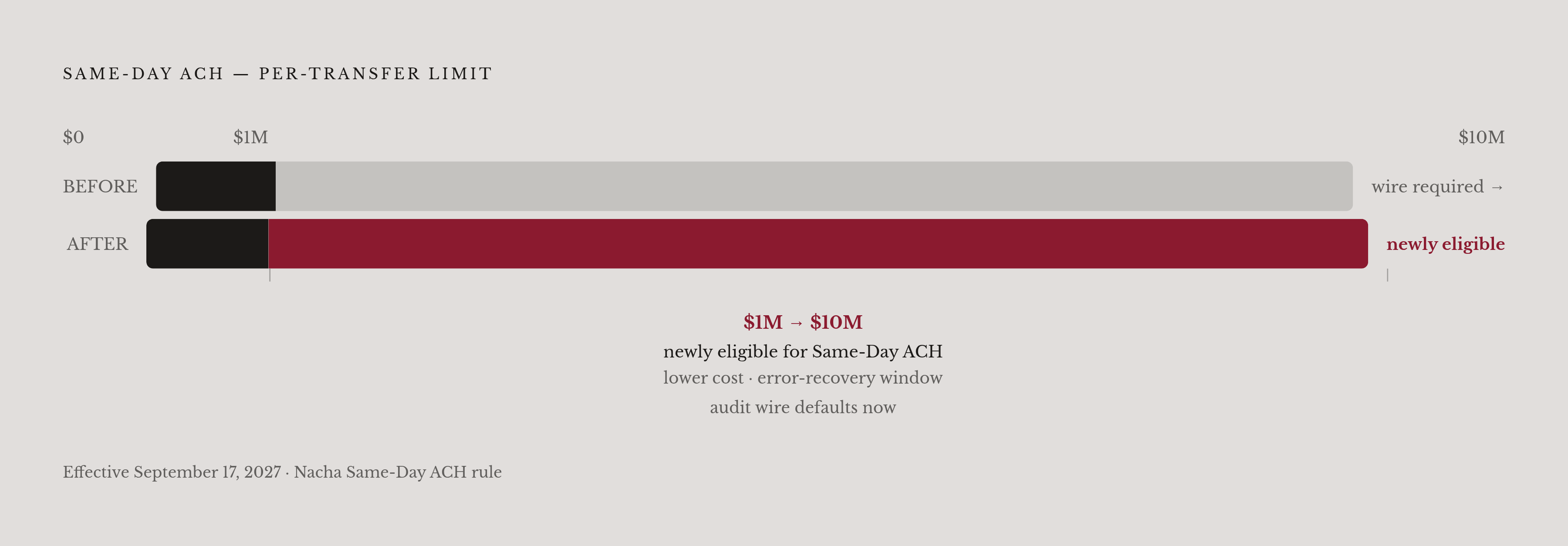
Same-Day ACH also has a per-transaction surcharge and a current network-level limit of $1 million per transfer. A payment may fit the schedule but exceed the limit, or fit the limit after its usable window has closed. Routing details create another practical constraint because ACH and wire routing numbers differ at most U.S. banks. Using the wrong identifier can cause a failed transaction, so choosing the rail and using its correct routing details belong to the same execution decision.
How wire transfers behave differently across the intraday window
Domestic wires go through the Federal Reserve’s Fedwire Funds Service or CHIPS, the Clearing House Interbank Payments System, one at a time. They settle the same day when submitted before the institution’s cutoff. That deadline remains an operational boundary. Most banks require payments to be sent before 5:00 PM ET, but each sending institution sets its own cutoff, so that time is no promise from the wire network.
Once a wire settles, it is irrevocable. There is no network-level reversal mechanism, and recovery depends on voluntary cooperation between banks. Finality is precisely the value for a payment that must settle conclusively today, but it moves the control burden before release. Banks therefore add authorization steps and manual reviews for high-value wires. Those checks must be done in the time left in the intraday window.
Wire has no network-level transaction cap, so it can handle commercial real estate closings, major equipment purchases and urgent large-dollar settlements that exceed ACH limits. International wires are a separate timing case. SWIFT is a secure messaging network, and the actual funds move through correspondent banks or systems such as CHIPS. Settlement typically takes one to two business days, with additional fee layers from intermediaries.
Reversibility as an intraday operational variable, not just a risk footnote
The ability to correct an error changes which rail fits a payment before anything goes wrong. ACH allows reversals for qualifying errors within up to five banking days, while Nacha’s rules give unauthorized transactions a much longer return window. This is a meaningful but bounded recovery option. It is particularly relevant to payroll batches where account-detail errors emerge after initiation and high-volume disbursements where exceptions are a recurring operational concern.
The corresponding question for wire is whether verification can be completed before release. Wire’s finality makes post-execution correction an unsuitable operating assumption. For a time-sensitive domestic payment below $1 million, Same-Day ACH can often settle on the same business day and still allow error recovery. That combination can be more appropriate than wire when the payment fits the cutoff and does not require irrevocable finality. Speed alone does not settle the choice.
RTP and FedNow are also final on receipt, with no reversal mechanism. A payment that could use an instant rail may still be better suited to Same-Day ACH if the receiving deadline allows it and error recovery remains important.
Where instant rails fit — and where they don't — in the intraday stack
RTP and FedNow can settle eligible domestic payments in seconds, at any time of day or night. Their speed creates a distinct execution option. Yet availability of the service does not mean every receiving bank is reachable through it. Essentially every U.S. bank accepts Same-Day ACH, while participation in RTP and FedNow is not universal. Banks must therefore check that they can reach the counterparty before choosing an instant rail.
The two services also impose different liquidity arrangements. FedNow settles directly in each bank’s Fed master account using central bank money, while RTP uses a prefunded joint account at the Fed that requires institutions to preposition funds. Reachability alone is not the whole operational test. The rail’s liquidity mechanics must fit the institution’s ability to execute the payment.
Where instant settlement is appropriate, a practical routing heuristic is to use RTP when the receiving bank participates and the amount is within its limit. FedNow is an alternative when the receiving bank is on FedNow but not RTP, subject to its applicable constraints. If neither is available, Same-Day ACH can serve domestic urgency that fits its window and does not require wire finality. Wire remains appropriate for payments exceeding ACH limits, international counterparties or obligations requiring the finality it provides.
A scenario-based framework for rail selection across the intraday execution stack
For routine payroll, recurring vendor invoices and B2B collections that do not need to settle the same day, standard ACH is a good place to start. Its cost per batch suits a predictable number of payments, and its reversal window gives banks a way to recover from qualifying errors. The key condition is adequate lead time. A routine payment that has become urgent through late submission no longer presents the same routing problem.
For a time-sensitive domestic payment below $1 million, the next question is whether error recovery remains important. If it does, and the payment can meet the processing cutoff, Same-Day ACH offers same-business-day settlement at less cost than wire. Wire suits a commercial real estate closing, major equipment purchase or urgent supplier settlement that needs guaranteed same-day finality for a large amount. Its verification requirements and the institution’s cutoff still apply. A large amount does not remove the need to finish authorization in time.
For a domestic payment requiring seconds-level speed, RTP or FedNow fits when both parties have the necessary rail access, the amount is eligible and reversal is not required. An international payment calls for wire through SWIFT and correspondent banking, which takes longer to settle and has fees from intermediaries.
These scenarios expose the weakness of treating “urgent” as an automatic instruction to send a wire. Urgency needs a deadline attached to it. A payment due today may fit Same-Day ACH, while one that needs immediate final receipt may fit an instant rail if both parties have access. Defaulting to wire without resolving those distinctions increases cost and gives up an error-recovery option that the transaction may still need.
Why automating rail selection — rather than leaving it to manual judgment — changes intraday execution
The framework becomes harder to apply manually as payment volume grows because its inputs change during the day. Cutoff windows close, counterparty participation changes and urgency varies from transaction to transaction. A rail that fits one payment may not fit the next. Manual routing therefore becomes a bottleneck when staff must repeatedly reconcile amount, destination, access, timing and finality before execution.
Agentic AI is starting to help with this problem by choosing routes as payments flow through the system. An agent can evaluate urgency, size and counterparty access to choose wire when its cost and finality are justified or Same-Day ACH or an instant rail when either fits instead. This is the same decision framework applied at execution time. Its purpose is not to introduce a different standard for choosing rails, but to apply the institution’s standard without requiring individual human review of every transaction.
Deployment goals include automating more payments, handling exceptions better, more straight-through processing and a better ability to keep working when problems arise. Their value depends on whether the system can apply the framework reliably to live transaction parameters. For banks and credit unions, the relevant model is an execution layer operating on existing banking rails without requiring replacement of core infrastructure. That makes institutional control over its decisions the next essential question.
What governance and auditability requirements look like when AI executes payment routing decisions
Revised Federal Reserve and OCC guidance dated April 17, 2026 leaves a specific governance gap. SR 26-2, which replaces SR 11-7, and OCC Bulletin 2026-13 place generative and agentic AI models outside that model-risk guidance’s scope. Exclusion does not remove the institution’s obligations. Consumer protection laws, data privacy rules and internal governance practices set the controls for how agentic AI is used in payments.
The U.S. Treasury’s Financial Services AI Risk Management Framework, released February 19, 2026, offers controls that institutions can choose to use while they wait for mandatory rules. Every routing decision needs a complete audit trail, and the institution needs configurable parameters defining which rails the agent may use and under what conditions. Human override must be available at every step as a payment is carried out. Trust rests on those controls rather than on reassurance about the system’s intelligence.
SOC 2 Type II certification is an important compliance credential, while PCI DSS is the mandatory baseline for systems handling payment card data. ISO 42001 and AIUC-1 are emerging AI-specific governance standards. None substitutes for visibility into payment execution.
What operations teams should take away when building or auditing their intraday rail strategy
For teams building or auditing this framework, the first question is where existing habits substitute for payment-specific decisions. Are wires the default for urgent payments that Same-Day ACH could settle within the required business day while preserving error recovery? The next question concerns access. Is receiving-bank participation in instant rails built into routing logic, or does it depend on individual judgment?
Is every routing decision logged, can the institution configure controls, and can a human override or halt execution? Those capabilities are part of operational readiness and must be considered before deployment. Participation coverage, payment limits and automation capabilities change, so the routing configuration needs periodic review. The aim is a decision process that can be explained and audited after the payment has moved.
Nacha’s scheduled limit change gives that review a concrete deadline. On September 17, 2027, the Same-Day ACH per-transfer limit is set to rise from $1 million to $10 million. Institutions should identify which wire-routed payments will then become eligible for a lower-cost alternative with a recovery window, while still testing their timing and finality requirements. That is a specific reason to revisit routing now, before the eligible payment set changes.