ISO 42001 AI Management System Standard in Banking Contexts
Banks gain a rigorous framework for auditing AI systems deployed in credit and fraud decisions.

ISO/IEC 42001:2023 is the first international standard built specifically to govern how organizations manage artificial intelligence. Published jointly by ISO and IEC, it covers the full lifecycle of an AI system: sourcing the data, training the model, testing it, putting it into production, watching it run, and eventually retiring it. For banks and credit unions now wiring AI agents into credit decisions, fraud checks, and anti-money-laundering work, the standard offers something the industry has been missing: a way to prove, to an outside auditor, that the AI is actually being managed rather than just deployed and hoped for.
The full title is dry, "Information technology, Artificial intelligence, Management system," but the scope is wide. The vendor training the model, the fintech wrapping someone else's model in a nicer interface, and the bank running an internal credit-scoring system all qualify, since any organization that builds, sells, or uses AI falls within it. The standard follows the same Plan-Do-Check-Act structure as ISO 27001 and ISO 9001, so institutions already certified under those won't find the clause numbering unfamiliar. Ten clauses total, with the real substance starting at Clause 4.
Clause 4 asks an organization to define its scope: who's affected by the AI, and what it's actually meant to do. Clause 5 puts accountability at the top: a bank's leadership owns the AI policy and can't hand the whole matter off to the engineering team and call it governed. Clause 6 is where risk enters the picture formally, requiring a systematic process for identifying and evaluating AI risk, plus something called an AI System Impact Assessment, arguably the most distinctive piece of the entire standard. Clause 7 covers the resourcing and documentation needed to support all this. Clause 8 is where day-to-day operation lives, Clause 9 is measurement and internal audit, and Clause 10 handles what happens when something goes wrong and needs fixing.
Annex A holds the operational teeth: 38 controls spread across nine categories, covering everything from AI policy governance to human oversight to supplier relationships. Not every control applies to every organization. A bank using only third-party models has a narrower set of obligations than a company building its own, and the standard handles that through something called a Statement of Applicability, a document where an organization picks which controls apply and justifies the ones it excludes. Annex B then walks through how to actually apply those controls to AI-specific risk.
What separates this from a policy binder gathering dust in a compliance drawer is the impact assessment requirement under Clause 6. It forces an institution to write down, in specific terms, what a given AI system can do to a specific person or process, before that system goes live. That's a very different exercise than a general risk statement about "responsible AI use." It's the difference between saying an AML agent will be monitored, and documenting exactly what happens if it misflags a customer or misses a real case.
How certification works in practice: timelines, cost, and ongoing obligations
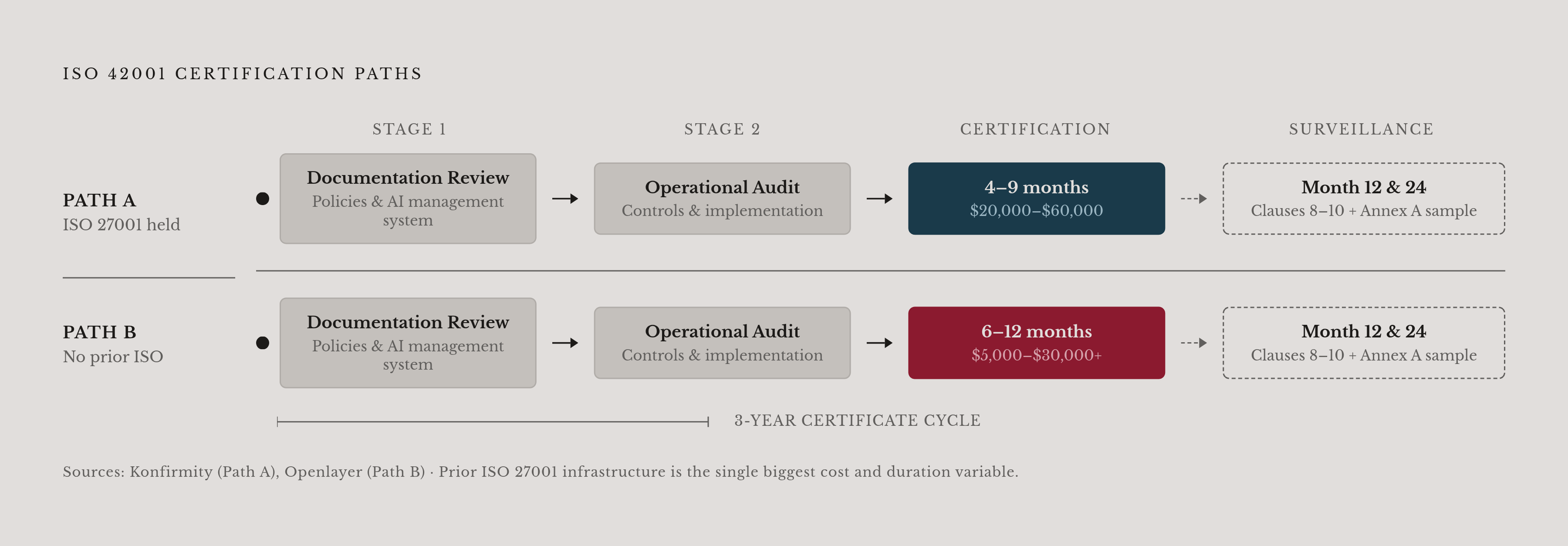
Certification runs through a two-stage audit, done by an accredited certification body rather than an internal team. Stage 1 checks the documentation and readiness. Stage 2 checks whether the system actually works the way the paperwork claims.
Cost and timeline estimates vary by source, which says something about how new and unsettled this market still is. Openlayer's June 2026 guide puts the initial audit at six to twelve months and $5,000 to $30,000 or more, with the range driven by company size and how much governance infrastructure already exists. Konfirmity's July 2026 guide is a different band: $20,000 to $60,000, over four to nine months, with the shorter end reserved for organizations that already hold ISO 27001 and can reuse much of that groundwork.
Once certified, the certificate holds for three years, following the same cycle as ISO 27001 under ISO 17021-1 and ISO 42006. That doesn't mean three years of silence, though. Surveillance audits happen every twelve months in years two and three: shorter reviews that check Clauses 8 through 10 and sample a slice of the Annex A controls. It's a middle step: less than a full re-certification but more substantial than a formality.
Openlayer identifies three real friction points in adoption: documentation grows harder to keep current as the AI systems themselves keep changing, qualified auditors remain in short supply, and organizations with no existing ISO infrastructure to build from face a significant resource drain. The auditor shortage is a scheduling risk on its own. Openlayer reports that Stage 2 wait times at some certification bodies stretched past six months in 2025, as demand for audits outpaced the supply of qualified auditors. Firms including BSI, Bureau Veritas, TÜV SÜD, and SGS, along with various nationally accredited labs, are actively hiring to work through the backlog.
A regulatory wrinkle adds to this timing pressure: ISO 42006:2025, the standard governing how certification bodies themselves get assessed, was published on July 7, 2025, and on November 20, 2025, the European co-operation for Accreditation voted to make it the mandatory Level 4 standard for accrediting bodies that certify AI management systems. ISO 42006:2025, the standard governing how certification bodies themselves get assessed, was published on July 7, 2025. On November 20, 2025, the European co-operation for Accreditation voted to make it the mandatory Level 4 standard for accrediting bodies that certify AI management systems. Practically, that means auditor quality and consistency will tighten as 2026 accreditation cycles roll forward, which is one more reason a bank starting this process now should build in extra lead time and use the gap between application and audit to run at least one internal audit cycle before the real one begins.
Where ISO 42001 fits, and where it doesn't, in banking's existing regulatory stack
ISO 42001 is not a harmonized standard under the EU AI Act. Certification doesn't hand a bank a presumption of legal conformity, a point the CEN-CENELEC JTC 21 Inclusiveness Newsletter made explicit in December 2025. The standard doesn't cover every quality management requirement the Act demands. A separate deliverable, prEN 18286, is being developed specifically to satisfy the Act's Article 17 Quality Management System requirement, which tells you something important: ISO 42001 is necessary groundwork, not the whole legal answer.
What it does give banks is the governance discipline the AI Act actually requires, expressed in operational terms: risk management, documentation, human oversight, and monitoring after the system ships. Clauses 8 through 10 map fairly directly onto the Act's lifecycle controls, its post-market monitoring rules, and its incident reporting requirements.
DORA, the EU's Digital Operational Resilience Act, adds another layer. It requires banks to manage IT risk from critical vendors, including proof that an AI management system exists and that incidents get logged. ISO 42001's supplier controls and audit trail speak to exactly that.
Germany's BaFin issued non-binding guidance in December 2025 that reframes AI as an ICT risk under DORA rather than an innovation topic or an ethics debate. The framing is blunt: anyone using AI has to understand it, manage it, and control it the way any other IT system gets controlled, while still accounting for what makes AI behave differently from ordinary software. That single reclassification raises the bar on governance, transparency, and accountability for banks operating in Germany, and it's a fair signal for where European supervision is heading more broadly.
In the US, SR 26-2, the interagency model risk guidance arriving in April 2026 to replace the long-standing SR 11-7, explicitly leaves generative and agentic AI out of scope, calling them novel and still evolving too fast to pin down. Banks are told to apply existing risk principles while the Federal Reserve gathers more input. That's a real governance gap, and it's one ISO 42001 is well positioned to fill from the inside, even without a regulator mandating it.
GDPR matters here too. Financial institutions using AI for customer-facing decisions carry data governance obligations under GDPR that ISO 42001's data management controls address directly.
For banks that already hold ISO 27001, the practical takeaway is that ISO 42001 extends what's already built rather than replacing it. It adds coverage for the things ISO 27001 was never designed to catch, like model behavior drift and automation bias, and the shared clause structure between the two standards makes the extension straightforward rather than a rebuild from scratch. None of this makes ISO 42001 a substitute for any single law. It builds the documented, auditable system that regulators are increasingly going to expect to see the moment they ask a bank how its AI is actually managed.
The banking AI deployment context ISO 42001 must govern
Banking has become the industry most reshaped by agentic AI, and also the one with the least tolerance for a bad outcome. Analysis from The CG AI Group in 2026 finds that banks are now wiring autonomous agents directly into AML investigations, credit decisions, and payments infrastructure. This isn't a pilot-stage curiosity anymore. The Financial Brand reported that as of September 2025, 70% of banking institutions were using agentic AI, split between 16% in live deployment and 52% running active pilots.
The named platforms already in the market show what "agentic banking AI" looks like in practice. Fiserv's agentOS runs on AWS Bedrock AgentCore with OpenAI as a strategic collaborator, with First Interstate Bank and Boulder Dam Credit Union piloting it, while Salem Five, City National Bank, Bank OZK, and SouthState are co-developing the next round of agents alongside Fiserv. FIS built its Financial Crimes AI Agent with Anthropic, with BMO and Amalgamated Bank first into development ahead of a general release slated for the second half of 2026. That system compresses AML evidence-gathering from a multi-day process to minutes: it pulls evidence across a bank's core systems automatically, checks it against known money-laundering patterns, drafts the SAR narrative, and surfaces the riskiest cases for a human to review, with client data kept inside FIS-controlled infrastructure by design. Backbase launched its AI-native Banking OS in April 2026, structured around three layers: Intelligence for signals, Nexus as a shared semantic record, and Sentinel, an authority layer that checks every agent's permissions against bank policy before it acts and logs the action afterward. Backbase also folded Kasisto's banking-tuned agents into the platform through acquisition.
Credit unions are moving even faster on a proportional basis. 17% have already invested in or deployed agentic AI, compared with 7% of banks. Data cited to CUNA and America's Credit Unions, alongside Cornerstone Advisors, Gartner, Upstart, and Freddie Mac, puts 66% of credit unions planning to use AI specifically for credit decisioning. Leading credit unions in that same body of reporting say they're processing loans 70% faster and approving 25% more members while still holding NCUA compliance. FORUM Credit Union's AgentFlow system integrated directly into its existing Temenos core, running straight-through without ripping out the underlying banking stack.
Automation now links trading, credit, and compliance systems across institutions through continuous data exchange, and S&P Global's 2025 analysis warns this systemic link could amplify volatility if multiple agents react to the same signal. S&P Global's 2025 analysis warns that automation now links trading, credit, and compliance systems across institutions through continuous data exchange, which could amplify volatility if multiple agents respond to the same shock in a correlated way. No single bank's governance framework fixes that on its own. But that's exactly why the internal governance still matters: a bank can't control what every other institution's agents do, but it can control whether its own agent's behavior is documented, tested, and bounded.
That control is where the gap becomes visible, in the results Deloitte and other 2026 governance analyses report. Deloitte's State of AI in the Enterprise report found only one in five companies has a mature model for governing autonomous agents. A separate 2026 governance analysis projects a 94% program failure rate for agentic AI in banking specifically, driven by governance gaps, exposure to security risk, and what practitioners call "invisible failure": systems that pass every control placed in front of them and are still, quietly, wrong. That's the environment ISO 42001 has to operate in. Not a hypothetical AI use case sitting in a slide deck, but live agents moving real money at scale, with regulators asking sharper questions than the old model-risk frameworks were ever built to answer.
How ISO 42001's 39 controls map to banking's specific AI risks
Matching Annex A's nine control categories against actual banking risk is the practical starting point for building a Statement of Applicability, done category by category.
AI system lifecycle controls make up the largest group, roughly eleven controls covering design, development, testing, and eventual retirement. For a bank, that means a credit-scoring model or an AML agent needs documented design decisions, defined test criteria, and an actual plan for what happens when it's retired, not just quietly switched off. This is exactly the terrain SR 26-2 leaves only partly covered for agentic systems, and it matters even more when the AI in question comes from a vendor. Whether it's Fiserv's agentOS or FIS's Financial Crimes Agent, the bank still owns lifecycle governance for how that system runs inside its own environment.
Human oversight controls speak directly to the problem of systems that pass every check and are still wrong. These controls require documented checkpoints where a person actually enters the decision loop. The FIS and Anthropic AML agent is a clear example: the agent drafts the SAR narrative and flags the highest-risk cases, but a human investigator still reviews and decides. Backbase's Sentinel layer, checking permissions and logging actions before execution, is the same idea built into the platform architecture rather than left to policy alone.
Data management controls, six in total, cover compute, data pipelines, and staffing. In banking, that translates into questions about where training data came from, how clean it is, and where inference data physically lives. FIS's choice to keep client data inside its own infrastructure rather than routing it through a third-party inference environment is the kind of decision these controls are built to document. GDPR and DORA both push in the same direction: banks need to show exactly what data moves where, and ISO 42001 gives that documentation a structure to live in.
The AI System Impact Assessment, required under Clause 6, is the standard's most distinctive requirement. It forces a bank to write down what a specific AI system can actually do to specific people, before it launches. Credit decisioning AI affects whether someone gets a loan. AML agents affect the people who get flagged for investigation. With two-thirds of credit unions reportedly planning to use AI for credit decisions in the near term, a large number of institutions are going to need to run these assessments soon, not eventually.
Supplier controls are only two in count, but they carry real weight in procurement. A bank running agentOS, the FIS agent, or the Backbase platform needs a documented answer to a basic question: what is the vendor responsible for, what does the bank still own, and how does an incident get reported back into the bank's own governance process? Analysis from Hicomply finds that enterprise buyers in banking and fintech are starting to treat ISO 42001 certification as a screening requirement when evaluating AI vendors, which makes a bank's own certification useful leverage on both sides of that relationship.
Internal organization controls, five in total, require named roles and clear escalation paths rather than a general ethics statement nobody can point to when something breaks. For a bank running autonomous agents across AML, credit, and payments, that means someone specific owns the outcome when an agent gets it wrong, and everyone in the chain knows who that person is before the first incident, not after.
Sources
- ISO 42001: A Complete Guide to AI Management Systems in June 2026 | Openlayer
- ISO 42001: The AI Management System Standard (2026) | Konfirmity
- ISO/IEC 42001:2023 - AI management systems
- The Risk-Adjusted Intelligence Dividend: A Quantitative Framework for Measuring AI Return on Investment Integrating ISO 42001 and Regulatory Exposure
- backbase.com
- hicomply.com
- deloitte.com
- biztechmagazine.com