ACH Transfer Posting Times Across Major U.S. Banks
Three separate clocks determine when ACH transfers actually arrive at your bank.

ACH posting times across major U.S. banks depend on more than the network’s schedule. The useful answer comes from separating three clocks, namely the sending bank’s submission time, the network’s settlement window, and the receiving bank’s release of funds. Once those clocks are distinguished, a quoted range such as “1–3 business days” becomes an understandable schedule.
Why ACH transfers don't arrive on a single predictable schedule
ACH is a batch processor by design, so banks group transactions and submit them at scheduled intervals. The sending bank first decides when to submit its file, which determines which settlement window the payment can catch. The receiving bank then applies its posting and hold policies. Those decisions happen in sequence, but a customer usually sees only the request and the eventual deposit.
That gap makes “my bank is slow” an understandable conclusion. It is not always the right one. NACHA identifies the Federal Reserve and The Clearing House as the two ACH operators, which route transactions to receiving institutions. But money can reach the receiving bank before it is available to spend.
The four settlement windows that set the outer boundary for every ACH payment
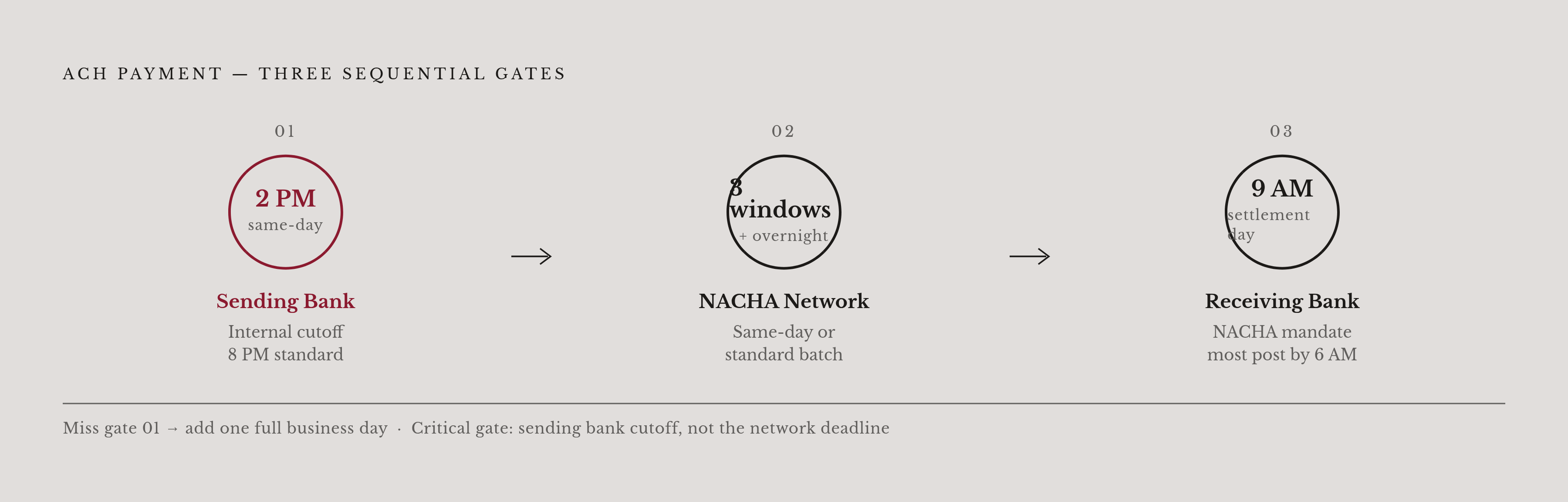
NACHA has four settlement windows each banking day, with three same-day windows and one standard overnight window. These windows give banks a common timetable. They do not mean that every customer sees a deposit at the same hour, because settlement and funds availability are separate steps. The network’s deadlines set the outer boundary for release under the applicable rules, while banks often post deposits earlier.
The first, second, and third same-day windows each give payments another chance to settle that banking day. Payments in the standard window settle overnight. Which route does a particular file take? Same Day ACH is triggered by the file’s Effective Entry Date. When that field contains the current processing date and the file reaches the operator within a same-day window, the operator settles it that day.
The operator’s deadline is not the customer’s deadline. Before transmission, the bank needs time to assemble and screen the file. Its internal cutoff for a customer’s instruction therefore typically falls earlier, sometimes by an hour or more. A request can be too late for the bank even while the operator’s window remains open.
Credits and debits also follow different clocks. NACHA mandates that non-same-day ACH credits be available by 9:00 a.m. on the settlement date, while debits must be processed by 8:30 a.m. In practice, most banks clear incoming deposits by 6:00 a.m. local time.
ACH does not run on weekends or federal holidays. A submission after a bank’s Friday cutoff waits until Monday’s early-morning window, and a holiday Monday can push that submission to Tuesday settlement.
Why the same network produces different arrival times at Chase, Bank of America, and Wells Fargo
Chase gives standard ACH transfers a range of 1–3 business days. Incoming ACH deposits are available by 9:00 a.m. local time on the settlement date, though Chase typically posts earlier, often between 3:00 a.m. and 6:00 a.m. Eastern. The distinction is useful for planning.
Chase’s same-day ACH cutoff is 2:00 p.m. ET. Payments authorized after that time arrive the next business day, while its standard ACH cutoff is 8:00 p.m. ET. Consider an instruction submitted at 4:00 p.m. ET. It is too late for Chase’s same-day option but still before its standard cutoff, so it can catch the next-day route. The same instruction time therefore produces a different answer depending on which service the customer expects.
Bank of America usually completes standard ACH within 3 business days. Its standard cutoff is also 8:00 p.m. ET. That shared cutoff does not make its overall timing identical to Chase’s, because a cutoff describes when an instruction can enter processing rather than when the recipient can spend the money. Bank of America does not publish a promise that incoming deposits will be available by 8:00 a.m. Its standard transfer range should not be converted into a bank-specific morning posting promise.
Wells Fargo gives standard ACH a range of 1–2 business days, with deposits posting by 8:30 a.m. Eastern. Wells Fargo’s published API reference gives a same-day ACH cutoff of 2:00 p.m. CT. The time zone is part of the rule. A three-window Pacific-time schedule is not documented by the bank, so that schedule should not be substituted for the published cutoff. These banks differ in when they submit files and post deposits, while the ACH network runs at the same speed for all of them.
How credit unions handle ACH timing compared to major banks
Credit unions use the same NACHA settlement schedule as banks. Their network-level windows are therefore identical, but their own cutoffs and same-day offerings can differ. Navy Federal, PenFed, and Alliant each offer outgoing ACH transfers in 1–3 business days and incoming transfers in 1–2 business days. Direction changes the expected wait. A member moving money out should not assume the incoming transfer range applies to that instruction.
Navy Federal and PenFed offer same-day ACH, while Alliant offers it for incoming transfers only. Outbound same-day ACH is not currently available at Alliant. A credit union can therefore receive a same-day payment without offering members the ability to originate one.
The three factors that add days to an otherwise clean ACH transaction
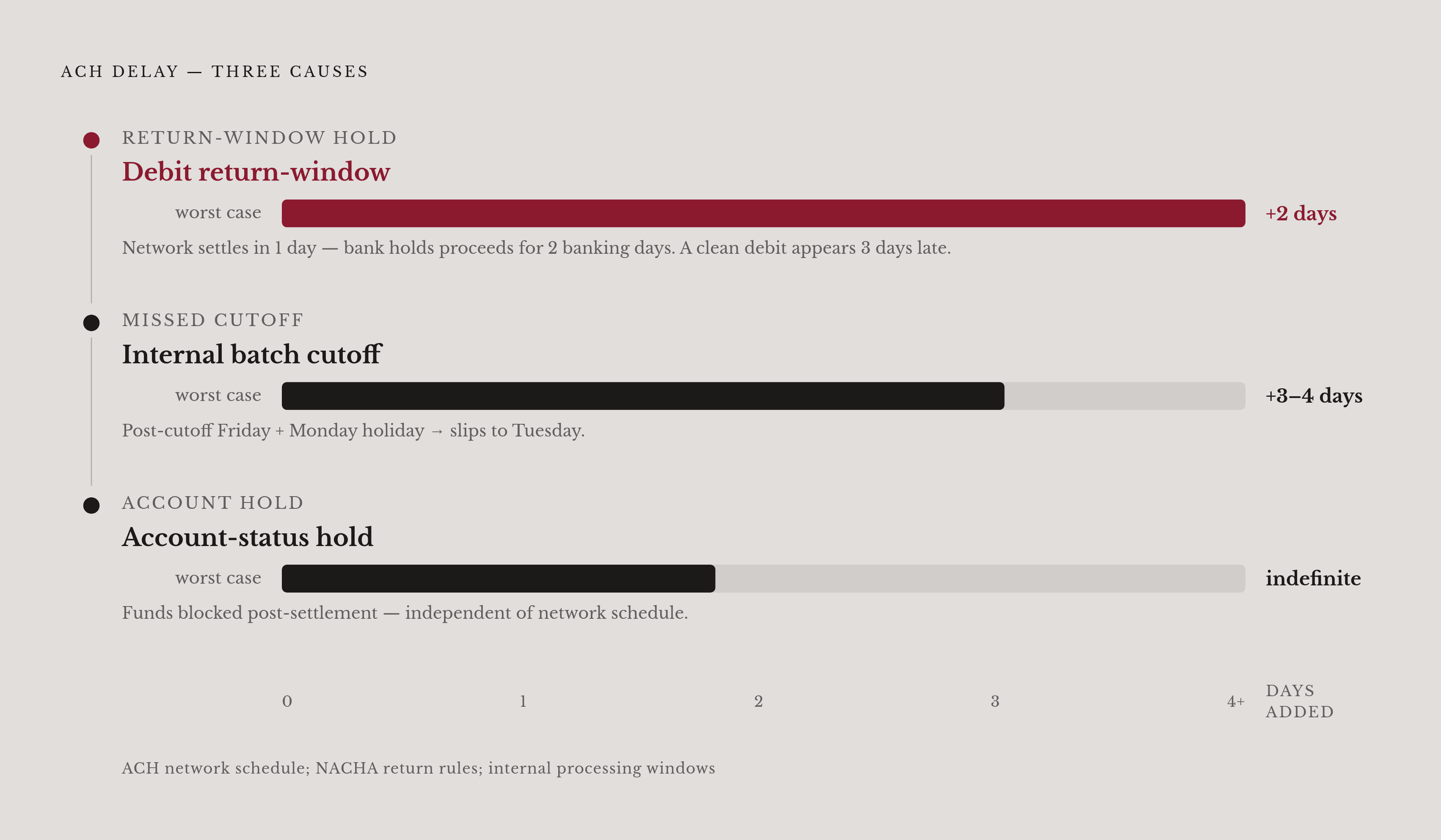
For debit transactions, the delay that is easiest to miss comes after settlement. The receiving bank has two banking days to return most debit entries, so most banks and processors hold debit proceeds through that window before releasing them. A payment may consequently appear to have “taken three days” even though the network settled it in one. The money is not necessarily stuck in transit. Someone is waiting out return exposure as a risk-management decision.
This distinction changes how an unexpectedly long wait should be understood. A debit is a pull payment, so fast settlement does not by itself establish that the proceeds will be available immediately. The return window remains a separate clock. Asking only whether the ACH file has settled can get a correct answer while leaving the customer’s real question unanswered. The missing fact is whether the bank or processor is still holding the proceeds.
A missed internal cutoff is the second common cause. Submitting after the bank’s deadline pushes the file to the next batch and can add a full business day. The operator’s later deadline does not rescue that instruction, because the bank still has to prepare and transmit it. Friday makes the difference especially visible. A request submitted after cutoff waits through the weekend, and a federal holiday can extend the calendar gap further.
An account-status hold is the third cause of delay. Even when the instruction catches the expected batch and settlement window, a hold condition can postpone access to funds. That makes the account or transaction’s hold status a separate part of the diagnosis. The schedule alone cannot resolve that question. A clean path through the network does not establish that every bank-level condition for release has been met.
How to reliably predict when funds will arrive at any given bank
First, identify the transfer type. Is it a credit, which pushes money to a recipient, or a debit, which pulls money from another account? Next, establish which same-day or next-day cutoff the submission will catch, then check for an account or transaction hold. That order prevents a common planning error. A settlement estimate should not become a promise of spendable funds before the release conditions are known.
For a credit, check the applicable same-day cutoff and allow for the bank’s file-assembly time when working back from an operator deadline. The sending bank’s customer cutoff sets whether the instruction gets submitted in time, while the receiving bank’s posting policy sets when the money is available after it arrives. Those are separate checks. If the same-day opportunity is missed but the payment catches the next-day window, the credit is available by 9:00 a.m. the following business day.
For a debit, build the two-banking-day return window into the availability estimate on top of settlement. Then count the banking days. A Friday instruction that misses cutoff does not settle until Tuesday if Monday is a federal holiday.
Same Day ACH removes much of the scheduling uncertainty by offering three opportunities within a business day. All banks must accept it, but the sender’s bank must offer origination for the relevant account type. That condition is easy to overlook. Receiving capability alone does not establish that a customer can send a same-day payment. The same timing framework applies whether a human treasurer manages these decisions or an automated system executes them on the treasurer’s behalf.
What ACH timing means when AI agents are executing payments on behalf of a bank or its customers
An AI agent that makes payments still follows the same NACHA rules. Cutoffs, settlement windows, and hold policies become configurable rules rather than constraints that disappear through automation. For example, an agent handling a pull payment can hold the funds through the two-banking-day return window so a person does not have to track each payment’s exposure one by one. The potential benefit is consistent execution at volume. Systems can route payments and track banks’ cutoffs, but they must still treat settlement and permission to release funds as separate steps.
A missed cutoff can delay payroll, a hold can create an overdraft, and an early debit release can expose funds before the return window closes. An automated system must therefore maintain a full audit trail of what it did, when, and why. Configurable rules, visibility into each action, and complete audit records allow banks to use automation on existing ACH rails without rebuilding their infrastructure.